Paul's third missionary journey: Three years in one city, a riot in the theatre, and a road that ends in chains
Read it →The third journey is the one that stops moving. Paul leaves Antioch in half a verse, walks the plateau road through Galatia and Phrygia strengthening disciples Luke does not name, comes down the inland road to Ephesus, and then stays there for the better part of three years — longer than he stayed anywhere else in his life. Three months arguing in the synagogue, two years in the lecture hall of a man called Tyrannus, and a whole province evangelised by someone who did not travel: Luke says all the residents of Asia heard the word, and Paul is in one city the entire time. The trouble, when it comes, is commercial rather than theological. Demetrius the silversmith makes shrines of Artemis, calls a meeting of the trade, and points out what the preaching is doing to the business; the city fills with confusion and rushes into the theatre; and for two hours the crowd shouts "Great is Artemis of the Ephesians" while most of them do not know why they came. A town clerk breaks it up by observing that the courts are open. Then Paul goes — Macedonia, three winter months in Greece, and a plot laid against him as he was about to sail for Syria, which turns him round and sends him back overland the way he came. Passover at Philippi, five days across to Troas, and a Sunday night that runs past midnight until a boy named Eutychus falls asleep in a third-storey window and drops into the street. From Troas the coast is named port by port: Assos, which Paul walks to alone while the ship rounds Cape Lectum; then Mitylene, Chios, Samos, Miletus, one anchorage a day. He will not put in at Ephesus, because he is racing Pentecost, so he sends thirty miles up the road for its elders instead and says goodbye to them on the beach, and they weep because he has told them they will not see his face again. Cos, Rhodes, Patara, a bigger ship for Phoenicia, Cyprus left on the port bow, and Tyre. At Tyre the disciples tell him through the Spirit not to go on; at Caesarea a prophet takes his belt and ties his own hands and feet with it. He goes up anyway. The journey closes at 21:16 with the party lodging in the house of Mnason of Cyprus, and within a week of the arrival a crowd from Asia has dragged him out of the temple and a Roman tribune has put him in two chains.
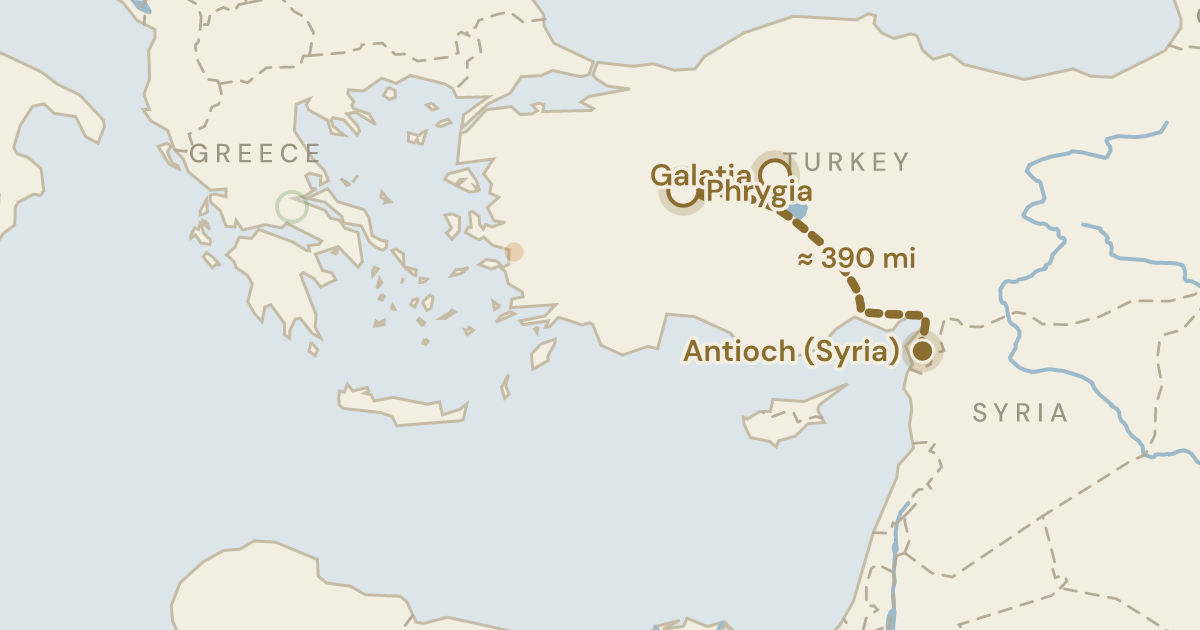
Regions on this map
Acts 18:23: the whole outward leg in one sentence. Paul leaves Antioch for the last time and goes from one place to the next across the plateau, strengthening disciples Luke does not name in towns he does not list.
The starting line, and Luke gives it half a verse: "After spending some time there, he departed." The church that had sent out the first two journeys and heard both reported back never sees him again — this one ends in custody at Jerusalem, and the next voyage is under guard. Not the Antioch of the first journey's sermon, which is four hundred miles west in Pisidia.
Today: Antakya, Turkey
Half of the phrase at 18:23, which is the same phrase Acts 16:6 used and carries the same two-century argument: the old kingdom on the northern plateau, or the Roman province's southern towns Paul had already planted. The pin is the gazetteer's, near Ankara; the road drawn here crosses the plateau without ending on it, because a line to that dot would settle a question the sentence does not.
Today: the plateau around Ankara (representative point)
The other half of the phrase, and the last named ground before the descent to the coast. The "inland country" of 19:1 is the high road on from here, down the Lycus and Maeander valleys to Ephesus.
Today: west-central Turkey (representative point)
Acts 18:24–19:41: three months in the synagogue, two years in the hall of Tyrannus, and a province that hears the word without the preacher walking it. It ends with a silversmiths' trade meeting and two hours of shouting in the theatre.
Named in nine verses of the journey, more than anywhere else on the map. He had promised at 18:21 to come back if God willed, and he came back and stayed the better part of three years — three months in the synagogue, two years in a hired lecture hall, and a farewell at 20:31 that puts the whole stay at three. He leaves after the riot and then refuses to land here on the way home.
Today: Efes, near Selçuk, Turkey
The province the Spirit had forbidden him on the second journey, and the one Luke says heard the word entire while Paul sat in a single lecture hall for two years. Its officers, the Asiarchs of 19:31, are the friends who send word telling him to stay out of the theatre. Plotted at the gazetteer's point inland, not at its capital.
Today: western Turkey (representative point)
Acts 20:1–6: out of Ephesus once the uproar has died down, north through Macedonia, three winter months in Greece, and a plot on the quayside that sends him back overland instead of straight across to Syria.
The Roman province Corinth was the seat of, and the second half of the plan Paul forms at 19:21 — pass through Macedonia and Achaia, then Jerusalem. He does exactly that. The gazetteer's point for the province falls in central Greece, well north of the city he wintered in.
Today: southern Greece (point near Lamia) (representative point)
Named at 19:1 to say where Apollos was, and named nowhere in the account of the three months — for those Luke writes "Greece". Every reading puts them here: 19:21 plans Achaia, Romans was written that winter from a Corinthian's house, and the plot of 20:3 is laid as the party is about to put to sea, which from Corinth means from Cenchreae six miles away.
Today: Archaia Korinthos, Greece
Crossed twice on this journey and named in six verses of it. Timothy and Erastus go ahead into it while Paul stays on in Asia; Paul follows once the uproar has ceased; and when the plot closes the sea route he comes back through it on foot rather than sail. Plotted at the gazetteer's representative point, north of any road the party walked.
Today: northern Greece and North Macedonia (representative point)
Luke's word for where the three winter months were spent, and the only time in Acts he uses it. The province is Achaia and the city, on every reading, is Corinth: the letter to the Romans was written in those months and sends greetings from a Corinthian host and commends a deacon of Corinth's own port.
the gazetteer offers Athens' own coordinates, and Athens is neither on this journey nor where the three months were spent. The stage's pin is Corinth.
Where the party keeps the days of Unleavened Bread before sailing, and where Luke's "we" comes back into the book after seven years of "they" — he had last written in the first person here, on the second journey, and appears to have stayed behind when Paul moved on.
Today: Philippi, near Krinides, Greece
Acts 20:6–38: the most literally drawable stretch in Acts. Five days over from Philippi, a boy who falls out of a third-storey window at Troas, Paul walking to Assos alone while the ship rounds the cape, and Mitylene, Chios, Samos and Miletus on four straight days.
Seven days, and one Sunday night that runs to daybreak. Paul talks past midnight in a crowded upstairs room full of lamps; a young man named Eutychus falls asleep in a third-storey window and drops into the street and is taken up dead; Paul goes down, bends over him, says his life is in him, goes back up and finishes what he was saying.
Today: Alexandria Troas, near Dalyan, Turkey
Paul sent the ship round without him and walked. The road across the neck of the Troad is about twenty miles and the sea route is half as far again round Cape Lectum, so the ship gained nothing and he got a morning alone — the only arrangement of the kind anybody records him making.
Today: Behramkale, Turkey
The chief city of Lesbos and the first night's anchorage after Assos. A coasting ship in these waters ran from shelter to shelter and stopped where the day ended, which is why the next verse reads like a log rather than a narrative.
Today: Mytilene, Lesbos, Greece
The following day, and Luke is careful about it: they came opposite Chios, not into it. The channel between the island and the mainland is the sheltered way south, and the ship was not stopping.
Today: Chios, Greece (representative point)
Thirty miles south of Ephesus, and chosen for that. Paul was racing Pentecost and would not risk the province, so he stopped short of it and sent up the road for the elders instead. The goodbye that follows is the only speech in Acts addressed to a Christian congregation, and it ends with the whole eldership weeping on the beach because he has told them they will not see his face again.
Today: Miletus, near Balat, Turkey
The third day's run and the last island before the mainland closes in. Touching at Samos put the ship at the mouth of the gulf Ephesus stands behind, near enough that not calling there had to be a decision rather than a course.
Today: Samos, Greece (representative point)
Cape Mycale, the mainland headland opposite Samos, lying directly on the day's run down to Miletus. It is in Acts 20:15 only in the Byzantine text, where the ship stays there for a night between the two.
the ESV does not carry the clause. This map takes its verse text from the site's own ESV, so a place that text never names gets no pin — the drawn track still rounds the cape, because the ship had to.
Acts 21:1–6: three days down the coast to Patara in a ship that hugs it, then a change to one that does not, and four hundred miles of open water to Phoenicia with Cyprus left on the port bow.
Named twice on this journey and meant two ways: the province he was about to sail for when the plot at Corinth stopped him, and the province he reached anyway two months later by the long way round through Macedonia. The gazetteer's point for it is Damascus, well inland of any coast this journey touched.
Today: the Roman province of Syria (point at Damascus) (representative point)
The first day out of Miletus on what Luke calls a straight course — running before a steady wind with no tacking. Cos, Rhodes and Patara are three days and three anchorages down a coast the ship never loses sight of.
Today: Kos, Greece (representative point)
Where the coaster stopped being useful. Patara was the Lycian port for the open run to Syria and Egypt, and here the party found a ship that would cross rather than creep — the same change of vessel, at almost the same corner of the map, that the voyage to Rome makes in reverse at Myra.
Today: Patara, near Gelemiş, Turkey
The second day's anchorage, in a harbour whose colossus had lain broken across the shore for close to three hundred years by the time this ship tied up — Pliny says people still came to look at it. The sources split between the island and the acropolis of its city, which resolve to the same point.
Today: Rhodes, Greece (representative point)
The coast the second ship was bound for, and the only part of the crossing Luke names before they are inside it. They make land at Tyre.
the gazetteer resolves it to Tyre's own coordinates, and Tyre is the landfall this map already pins
A navigational mark and not a call: they came in sight of it and left it on the left, which puts the ship on the southern passage with the island between her and the Cilician shore. Its other appearance in these chapters is a person — Mnason of Cyprus, an early disciple, who put the party up on the last night before Jerusalem.
Today: Cyprus (representative point)
Seven days ashore while the ship discharged her cargo, and the first of the two warnings: the disciples there told Paul through the Spirit not to go on to Jerusalem. When he went anyway the whole congregation, wives and children with them, walked him out through the gate and knelt down with him on the sand.
Today: Tyre (Sour), Lebanon
Acts 21:7–16: the voyage is finished at Ptolemais and the rest is a road. At Caesarea a prophet ties his own hands and feet with Paul's belt to show what waits at the end of it, and the party goes up anyway.
The destination from 19:21 onward and the end of the journey, named in eight verses of it and in four of them by somebody trying to talk him out of going. The map stops where he arrives — 21:16, the house of Mnason of Cyprus, on the last night of the road. Within a week a crowd from Asia has him out of the temple and a Roman tribune has him in two chains.
Today: Jerusalem
One day, and the end of the sea travel — Luke says the voyage from Tyre was finished here. The best natural harbour on the coast and one of the oldest continuously occupied, and the last place on this map anybody arrives at by water.
Today: Akko (Acre), Israel
Many days in the house of Philip the evangelist — the man Acts 8 sent down the Gaza road, now settled here with four unmarried daughters who prophesied — and the second warning. Agabus came down from Judea, took Paul's belt, bound his own feet and hands with it, and said the man who owned it would be bound at Jerusalem and handed to the Gentiles.
Today: Caesarea Maritima, Israel
Where Agabus came down from, which is Luke's way of saying the warning delivered at Caesarea came out of the country Paul was walking into.
no point of its own; the gazetteer offers Jerusalem, which is the last pin on this map
Places these chapters name for reasons other than travelling to them: three companions' home towns, the city a rival preacher was born in, the country the gazetteer reads behind it, and the capital Paul says at 19:21 he must also see once Jerusalem is behind him.
Apollos' home city, named at 18:24 in the paragraph that introduces him: an eloquent man, competent in the Scriptures, who knew only the baptism of John and had the way of God explained to him more accurately by a tentmaker and his wife.
seven hundred miles south of this frame
Carried by the gazetteer on the same clause as Alexandria, though the ESV names only the city. It is here because the dataset names it, and for no other reason.
the point offered is Heliopolis, one city standing in for a whole country, and it is off this frame besides
Named twice and reached in neither. At 19:21 Paul says "After I have been there, I must also see Rome", which is the first time in Acts the city is an ambition rather than a government; and at 19:40 the town clerk of Ephesus uses its law to break up the riot, warning a crowd that has no answer to give for the day. He gets there in Acts 28, under guard.
nine hundred miles west of this frame, and pinned under its own name on the map of the voyage that finally takes him there
Named once, at 20:4, for Sopater son of Pyrrhus, who joins the party there. Paul went through Macedonia twice on this journey and Luke never says he stopped in the town; it is on the second journey's map as the place he was smuggled to by night after the riot at Thessalonica.
Today: Veria, Greece
Gaius' home town, named at 20:4 in the same list of travelling companions. It is the far end of the first journey and the first stop of the second; on this one it is only where a man came from. Identified from an inscription found at Kerti Hüyük, with two other mounds nearby also proposed.
Today: Kerti Hüyük, near Karaman, Turkey
Named at 20:4 for Aristarchus and Secundus, two of the seven men who travel with Paul out of Greece. Aristarchus had already been seized and dragged into the theatre at Ephesus, and he is still aboard three years later for the shipwreck off Malta.
Today: Thessaloniki, Greece
Acts 18–21, verse by verse
Acts 18
- Acts 18:23After spending some time there, he departed and went from one place to the next through the region of and , strengthening all the disciples.
- Acts 18:24Now a Jew named Apollos, a native of , came to . He was an eloquent man, competent in the Scriptures.
- Acts 18:27And when he wished to cross to , the brothers encouraged him and wrote to the disciples to welcome him. When he arrived, he greatly helped those who through grace had believed,
Acts 19
- Acts 19:1And it happened that while Apollos was at , Paul passed through the inland country and came to . There he found some disciples.
- Acts 19:10This continued for two years, so that all the residents of heard the word of the Lord, both Jews and Greeks.
- Acts 19:17And this became known to all the residents of , both Jews and Greeks. And fear fell upon them all, and the name of the Lord Jesus was extolled.
- Acts 19:21Now after these events Paul resolved in the Spirit to pass through and and go to , saying, “After I have been there, I must also see .”
- Acts 19:22And having sent into two of his helpers, Timothy and Erastus, he himself stayed in for a while.
- Acts 19:26And you see and hear that not only in but in almost all of this Paul has persuaded and turned away a great many people, saying that gods made with hands are not gods.
- Acts 19:27And there is danger not only that this trade of ours may come into disrepute but also that the temple of the great goddess Artemis may be counted as nothing, and that she may even be deposed from her magnificence, she whom all and the world worship.”
- Acts 19:29So the city was filled with the confusion, and they rushed together into the theater, dragging with them Gaius and Aristarchus, who were Paul's companions in travel.
- Acts 19:31And even some of the , who were friends of his, sent to him and were urging him not to venture into the theater.
- Acts 19:35And when the town clerk had quieted the crowd, he said, “Men of , who is there who does not know that the city of the is temple keeper of the great Artemis, and of the sacred stone that fell from the sky?
Acts 20
- Acts 20:1After the uproar ceased, Paul sent for the disciples, and after encouraging them, he said farewell and departed for .
- Acts 20:2When he had gone through those regions and had given them much encouragement, he came to .
- Acts 20:3There he spent three months, and when a plot was made against him by the Jews as he was about to set sail for , he decided to return through .
- Acts 20:4Sopater the , son of Pyrrhus, accompanied him; and of the , Aristarchus and Secundus; and Gaius of , and Timothy; and the , Tychicus and Trophimus.
- Acts 20:5These went on ahead and were waiting for us at ,
- Acts 20:6but we sailed away from after the days of Unleavened Bread, and in five days we came to them at , where we stayed for seven days.
- Acts 20:13But going ahead to the ship, we set sail for , intending to take Paul aboard there, for so he had arranged, intending himself to go by land.
- Acts 20:14And when he met us at , we took him on board and went to .
- Acts 20:15And sailing from there we came the following day opposite ; the next day we touched at ; and the day after that we went to .
- Acts 20:16For Paul had decided to sail past , so that he might not have to spend time in , for he was hastening to be at , if possible, on the day of Pentecost.
- Acts 20:17Now from he sent to and called the elders of the church to come to him.
- Acts 20:18And when they came to him, he said to them: “You yourselves know how I lived among you the whole time from the first day that I set foot in ,
- Acts 20:22And now, behold, I am going to , constrained by the Spirit, not knowing what will happen to me there,
Acts 21
- Acts 21:1And when we had parted from them and set sail, we came by a straight course to , and the next day to , and from there to .
- Acts 21:2And having found a ship crossing to , we went aboard and set sail.
- Acts 21:3When we had come in sight of , leaving it on the left we sailed to and landed at , for there the ship was to unload its cargo.
- Acts 21:4And having sought out the disciples, we stayed there for seven days. And through the Spirit they were telling Paul not to go on to .
- Acts 21:7When we had finished the voyage from , we arrived at , and we greeted the brothers and stayed with them for one day.
- Acts 21:8On the next day we departed and came to , and we entered the house of Philip the evangelist, who was one of the seven, and stayed with him.
- Acts 21:10While we were staying for many days, a prophet named Agabus came down from .
- Acts 21:11And coming to us, he took Paul's belt and bound his own feet and hands and said, “Thus says the Holy Spirit, ‘This is how the Jews at will bind the man who owns this belt and deliver him into the hands of the Gentiles.’”
- Acts 21:12When we heard this, we and the people there urged him not to go up to .
- Acts 21:13Then Paul answered, “What are you doing, weeping and breaking my heart? For I am ready not only to be imprisoned but even to die in for the name of the Lord Jesus.”
- Acts 21:15After these days we got ready and went up to .
- Acts 21:16And some of the disciples from went with us, bringing us to the house of Mnason of , an early disciple, with whom we should lodge.