Genesis 50:13: The one field the family owns, and the last of the three couples laid in it
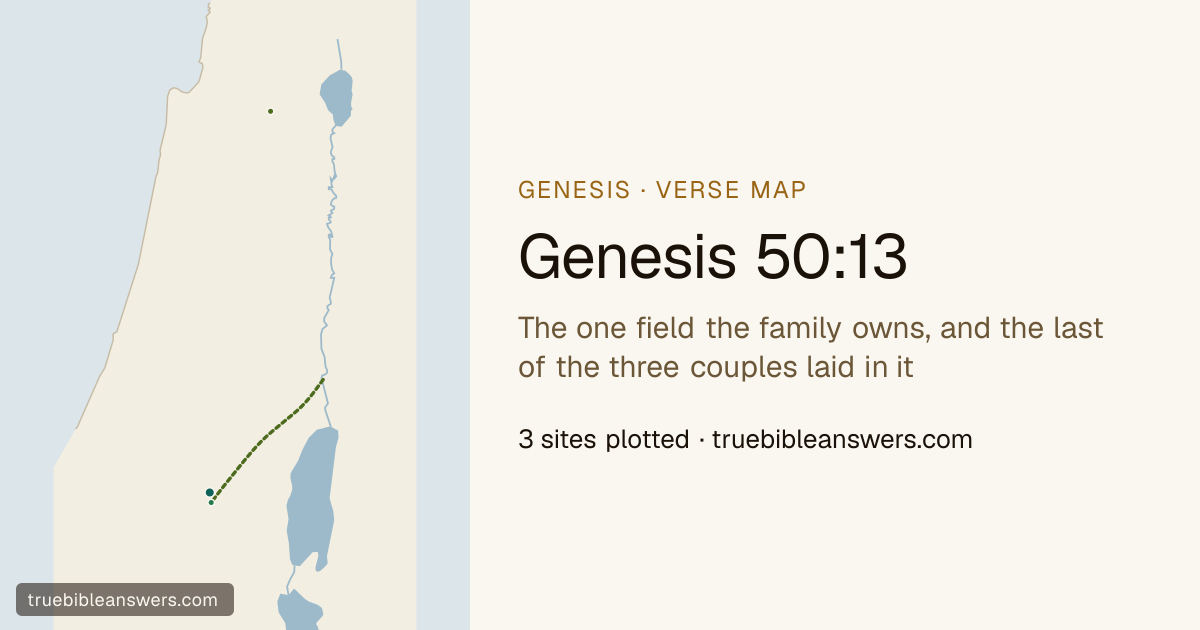
Read it →"For his sons carried him to the land of Canaan and buried him in the cave of the field at Machpelah, to the east of Mamre, which Abraham bought with the field from Ephron the Hittite to possess as a burying place." The verse spends most of itself on the paperwork. Not just the cave, but the cave of the field; not just the field, but which field, east of Mamre, and who bought it, and from whom, and what for. Genesis has told this story already, in a whole chapter of haggling at the gate of Hebron — Ephron offering it as a gift, Abraham refusing to take it as one, four hundred shekels of silver weighed out according to the weights current among the merchants. That chapter existed so that this sentence could be written. Because it is the only ground the family owns. Abraham was promised a country and died holding the title to a burial plot in it; by the end of this verse the cave holds Abraham and Sarah, Isaac and Rebekah, Leah, and now Jacob. Three generations, six people, one deed of sale, and everything else they have is in Egypt. His sons carried him. Not the servants of Pharaoh, not the chariots and horsemen — the text is careful, at the moment of burial, to put the body in the hands of the eleven who are left. The last time these brothers handled Joseph's father's grief they handed him a bloodied coat. This time they carry the man himself two hundred and fifty miles and lay him beside his first wife, in the field with the trees in it, east of Mamre. The map draws the cave, the oaks above it, and the land — Canaan pinned at the representative point the sources give the whole territory, far to the north, which is why the frame runs so tall. The line comes down from the ground at Atad, seventy miles, the last leg of the last journey in Genesis.
Regions on this map
Not the servants of Pharaoh and not the chariots — at the moment of burial the text puts the body in the hands of the eleven sons who are left.
The land, pinned at the single representative point its 500 votes resolve to, near the Jezreel valley and some eighty-five miles north of the grave — a marker for a territory, not for anywhere in this sentence. Abraham was promised the whole of it and died owning one field in it; this verse puts the third generation in the same field.
Today: the land between the Jordan and the sea (representative point)
The only ground this family owns. Four hundred shekels weighed out at the gate of Hebron, and by the end of this verse it holds Abraham and Sarah, Isaac and Rebekah, Leah, and Jacob.
The cave in the field Abraham bought from Ephron the Hittite for four hundred shekels of silver, refusing to take it as a gift so that the title could not be argued with. Its 442 votes sit under the Cave of the Patriarchs in Hebron, beneath a Herodian enclosure that has stood for two thousand years. Sarah was laid here first, then Abraham, then Isaac and Rebekah, then Leah, and now Jacob — six people and one deed of sale.
Today: the Cave of the Patriarchs, Hebron
The oaks Abraham pitched under, named in the deed because that is how the field was described when it was bought.
The oaks Abraham camped under and entertained three visitors at, with 526 votes on Ramat el-Khalil north of the town. It is in this verse as a bearing — east of Mamre — because that is the wording of the sale, and Genesis is quoting the deed.
Today: Ramat el-Khalil, north of Hebron
Genesis 50:13 in full
- Genesis 50:13for his sons carried him to the land of and buried him in the cave of the field at , to the east of , which Abraham bought with the field from Ephron the Hittite to possess as a burying place.