Genesis 25:18: The widest address in Genesis, and the only ground Ishmael is ever given
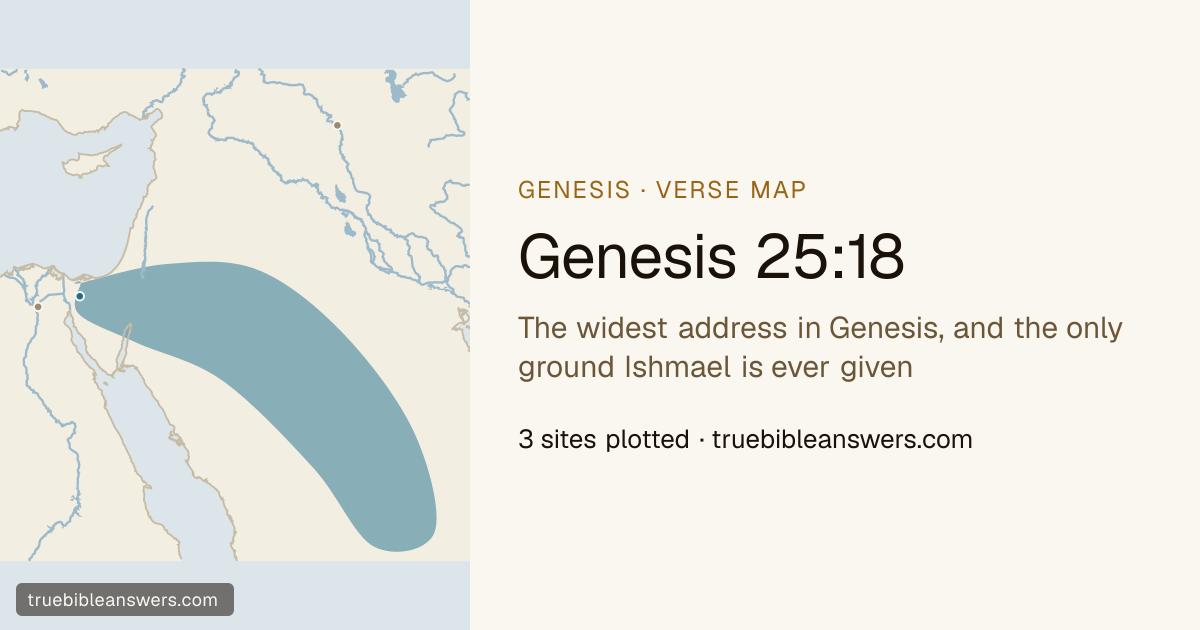
Read it →"They settled from Havilah to Shur, which is opposite Egypt in the direction of Assyria. He settled over against all his kinsmen." Abraham's walk ended two verses ago and Isaac's has not started yet. In between, Genesis stops to say where the other son's people live, and it says it the way you would describe a country to someone who has never seen it: not a town, not a camp, but a span with a place at either end and two landmarks to take a bearing off. The span is enormous. Shur is the desert at the Egyptian end of the Sinai land bridge — the road Hagar was running down when the angel found her, and the western marker Abraham's own move south was measured against. Havilah is the other end, and nobody knows where it is. Central Arabia has the largest block of votes, at a point the sources use to mean the peninsula rather than a site; the rest of the proposals run from Babylonia to Yemen. The verse is not naming two dots. It is drawing a line across the top of Arabia and saying: all of this. The two bearings are not places anyone goes. Egypt is there to say which way Shur faces, and Assyria to say which way the country runs; they are on the frame as directions and drawn in the colour this atlas keeps for a name that is not a stop. Both are countries the sources fix with a single representative point — Heliopolis for Egypt, Nineveh for Assyria — so both are open rings rather than pins. The last clause is the one that has been waiting since Genesis 16. The angel told Hagar at the spring that her son would be a wild donkey of a man, his hand against everyone and everyone's hand against him, and that he would dwell over against all his kinsmen. Here, at the end of his life, the narrator uses the same phrase as a plain geographical fact: he settled over against all his kinsmen. The promise and the map turn out to be the same sentence. Isaac has the next verse and the rest of the story. This is the last word about his brother until the two of them stand at a grave in Hebron — which has already happened, nine verses earlier, because Genesis buries Abraham before it finishes with Ishmael.
Regions on this map
Not a camp but a country, given by its two ends. Shur is the desert against Egypt and Havilah is somewhere in Arabia, and between them is the whole top of the peninsula — the only ground Genesis ever gives Ishmael, and the last thing it says about him.
The far end of Ishmael's country, and the least fixed place on this map. 230 of its votes go to a representative point for the Arabian peninsula — the sources' way of saying Arabia rather than a site — with smaller blocks for Babylonia and for a town in the Yemeni highlands. Genesis has used the name once before, of the land the Pishon runs round in Eden, and whether that is the same Havilah is its own argument.
no site identified; the leading block of votes is a representative point for the Arabian peninsula, not a place, and the rest of the field is scattered from Babylonia to Yemen
The desert between Canaan and Egypt, and the near end of the range. Hagar was running down the road to Shur when the angel of the LORD found her at the spring, and Abraham's own move south was measured between Kadesh and Shur. 298 of its 367 votes are for the dunes west of the Sinai land bridge, which is the country a caravan crosses to reach the delta.
Today: the north-west Sinai desert (representative point)
Two countries named to give a direction and nothing else. Neither is anywhere Ishmael's people go; one says which way Shur faces and the other which way the range runs, and the sources fix each of them with a single representative point.
The other bearing. "In the direction of Assyria" tells a reader which way the country runs from Shur — north-east, up the desert road toward the Tigris — a thousand years before Assyria has anything to do with Israel. All 500 votes resolve it to Nineveh, one point standing for an empire.
Today: Nineveh, on the Tigris (representative point)
Named here as a bearing, not a destination: Shur is the desert opposite Egypt, which is the narrator's way of saying how far west the range reaches. All 500 votes resolve the whole country to Heliopolis, at the head of the delta, which is a marker for a country rather than a claim about a place.
Today: Heliopolis, at the head of the Nile delta (representative point)
Genesis 25:18 in full
- Genesis 25:18They settled from to , which is opposite in the direction of . He settled over against all his kinsmen.