Genesis 50:10: Seven days of Egyptian mourning on the wrong side of the river
Read it →"When they came to the threshing floor of Atad, which is beyond the Jordan, they lamented there with a very great and grievous lamentation, and he made a mourning for his father seven days." A threshing floor is the flattest, hardest, most public ground a village owns — a bare circle of rock or beaten earth up where the wind can take the chaff. It is where Boaz sleeps, where David buys the site of the temple, where kings sit to hear prophets. It is not a cemetery. It is the one place near a settlement big enough to hold a crowd, and this crowd needs holding: the government of Egypt, stopped in open country, wailing for seven days. The locals watch and draw their own conclusion. This is a grievous mourning by the Egyptians, they say, and the name sticks — Abel-mizraim, the meadow or the mourning of Egypt. Canaanite villagers give an Egyptian name to a piece of their own ground because of a week they once watched from a distance, and Genesis records it as the reason the place is called what it is called. Beyond the Jordan is the phrase that has kept scholars busy for two thousand years, because it normally means the east bank, and a funeral travelling from Egypt to Hebron has no business on the east bank at all. Either the party swung wide around the Dead Sea, as the Exodus generation later did, or the narrator is writing from a standpoint that makes "beyond" mean the west side, or the name attached itself to two places. Nobody has settled it. So the map gives Atad a ring and not a pin. The sources are firm that Atad and Abel-mizraim are the same place — five hundred votes, no dissent — and completely unfirm about where that place is: near the mouth of the Jordan, or Deir Hajla on the west bank, or Tall al-Ajjul down by Gaza. What is agreed is the identification. What is not agreed is the ground. The ring sits on the leading reading and claims nothing else, and the Jordan is on the frame because the verse uses it as a bearing.
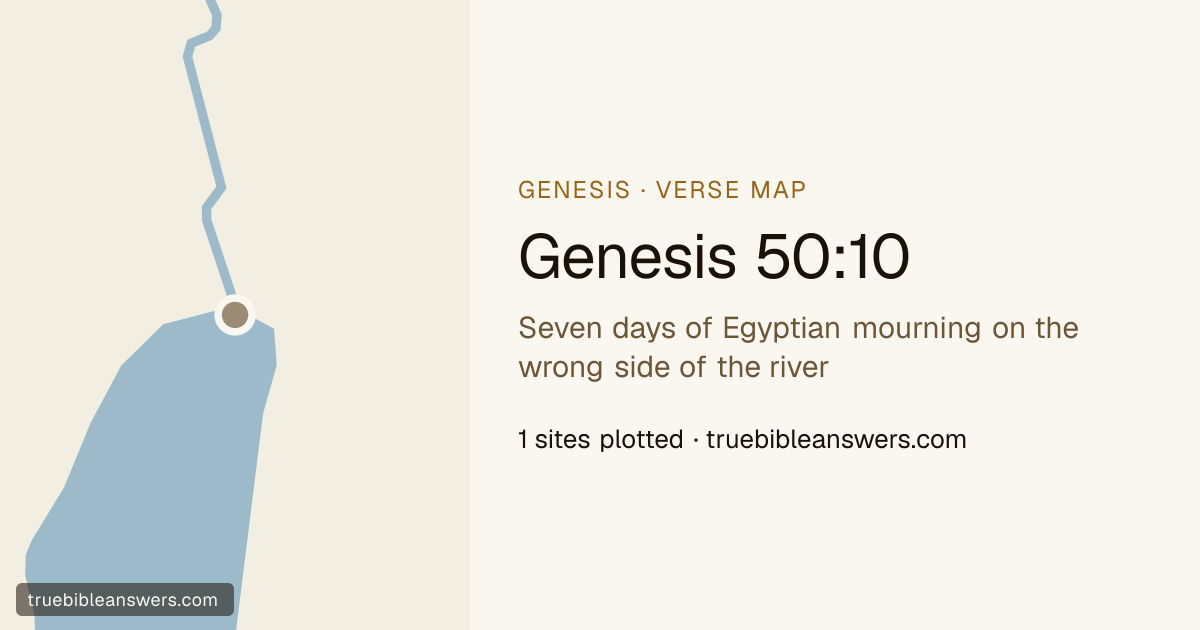
Regions on this map
A threshing floor is a village's flattest, most public ground, and the only thing near a settlement big enough to hold the government of Egypt while it wails for a week. The locals watching call the place Abel-mizraim — the mourning of Egypt — and the name stays on it.
The threshing floor where the procession halts, renamed Abel-mizraim by Canaanites who watched seven days of Egyptian mourning on it. Its one identification — that Atad and Abel-mizraim are the same place — holds all 500 votes and nothing contradicts it, but it resolves in three directions: near the mouth of the Jordan (393), Deir Hajla on the west bank (277), and Tall al-Ajjul by Gaza (255). The agreement is about the name, not the ground, so this is a ring and not a pin.
one undisputed identification resolving three ways, none of them settled; the sources agree Atad is Abel-mizraim and do not agree where Abel-mizraim is
The river is in this sentence as a bearing and nobody crosses it. It is also the problem: beyond the Jordan normally means the east bank, and a funeral going from Egypt to Hebron has no business there.
Used here as a bearing and nothing else. Beyond the Jordan is the standard phrase for the east bank, which is why this verse has been argued over for two thousand years: either the party swung wide round the Dead Sea, or the narrator is writing from a standpoint that reverses the phrase, or the name settled on two different pieces of ground. Its 500 votes give the river one representative point near the lower reach.
Today: the Jordan River (representative point)
Genesis 50:10 in full
- Genesis 50:10When they came to the threshing floor of , which is beyond the , they lamented there with a very great and grievous lamentation, and he made a mourning for his father seven days.