Genesis 37:1: Two households, two hill countries, and the one with nothing is the one with the promise
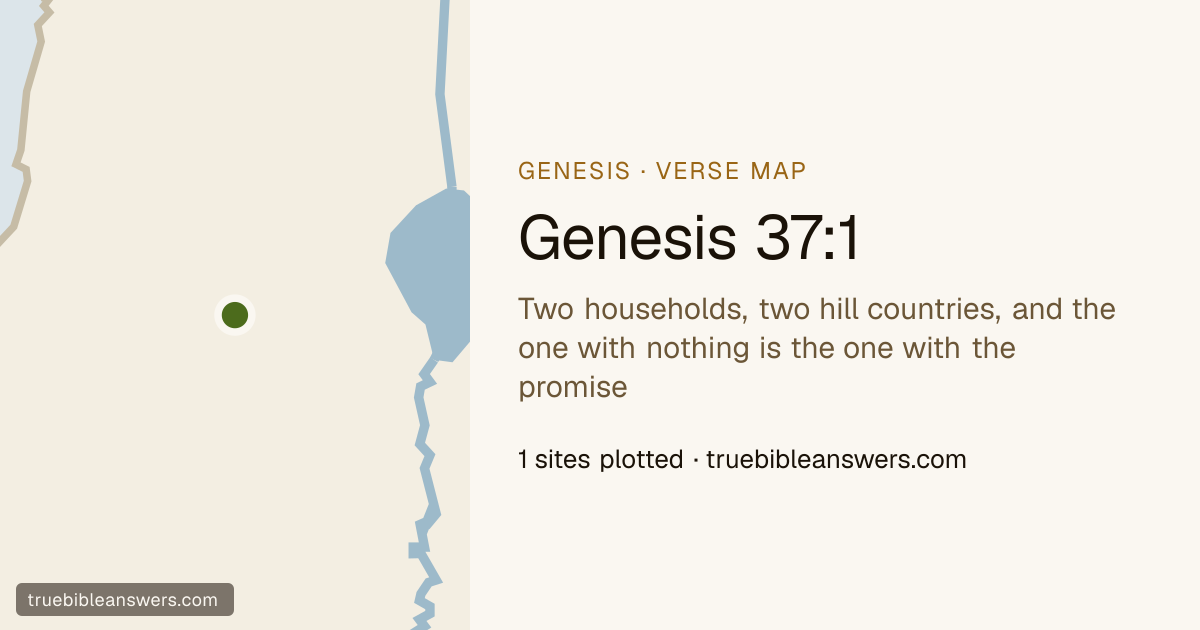
Read it →"Jacob lived in the land of his father's sojournings, in the land of Canaan." Read it beside the verse three lines above it — so Esau settled in the hill country of Seir — and the sentence is doing something careful. Esau settled. Jacob sojourned. Both words describe a man living somewhere with his family and his animals; one of them means he owns it and the other means he does not. Sojournings is the word this family has been given instead of a deed. Abraham was a sojourner and said so out loud at Hebron when he had to buy a grave: I am a sojourner and foreigner among you, give me property among you for a burying place. Isaac was told to sojourn in this land and I will be with you. Now Jacob, back from twenty years in Paddan-aram with eleven sons and everything he owns on the hoof, is described in the same term his father and grandfather were, on the same ground, and the point of saying it a third time is that nothing has changed in three generations. The land is promised. It is not held. What the family actually owns in Canaan at this moment is two fields. There is the cave of Machpelah at Hebron with the field around it, bought from Ephron for four hundred shekels, which now holds Abraham, Sarah, Isaac, Rebekah and will hold Leah; and there is the parcel outside Shechem that Jacob bought for a hundred pieces of money and where the bones of Joseph will eventually go. Two graves. That is the whole freehold. The chapter that starts with this sentence is the one that empties the house. In twenty-five verses the favourite son is out of the country, and the father is holding a bloodied robe and saying he will go down to Sheol mourning. In another nine chapters the entire household will be in Egypt, and the land of his father's sojournings will be a place they are not. So the map is a country and one man living in it, drawn deliberately without a road. It is the last still frame in Jacob's life. Everything after this verse moves.
Regions on this map
Promised to his grandfather, walked end to end by all three of them, and owned to the extent of two fields with graves in them. Esau settled; Jacob sojourned, and Genesis chooses the two words on purpose.
The land between the Jordan and the sea, and the third generation to live in it as a resident alien. Abraham called himself a sojourner at Hebron when he had to buy a grave; Isaac was told to sojourn in it; Jacob is described in the same term here. The family's freehold in the whole country is the cave at Machpelah and the field outside Shechem — two burying places. The sources give the country one representative point, which is what this map draws.
Today: the land between the Jordan and the sea (representative point)
Genesis 37:1 in full
- Genesis 37:1Jacob lived in the land of his father's sojournings, in the land of .