Genesis 36:6: The second parting in this family, and the same reason as the first
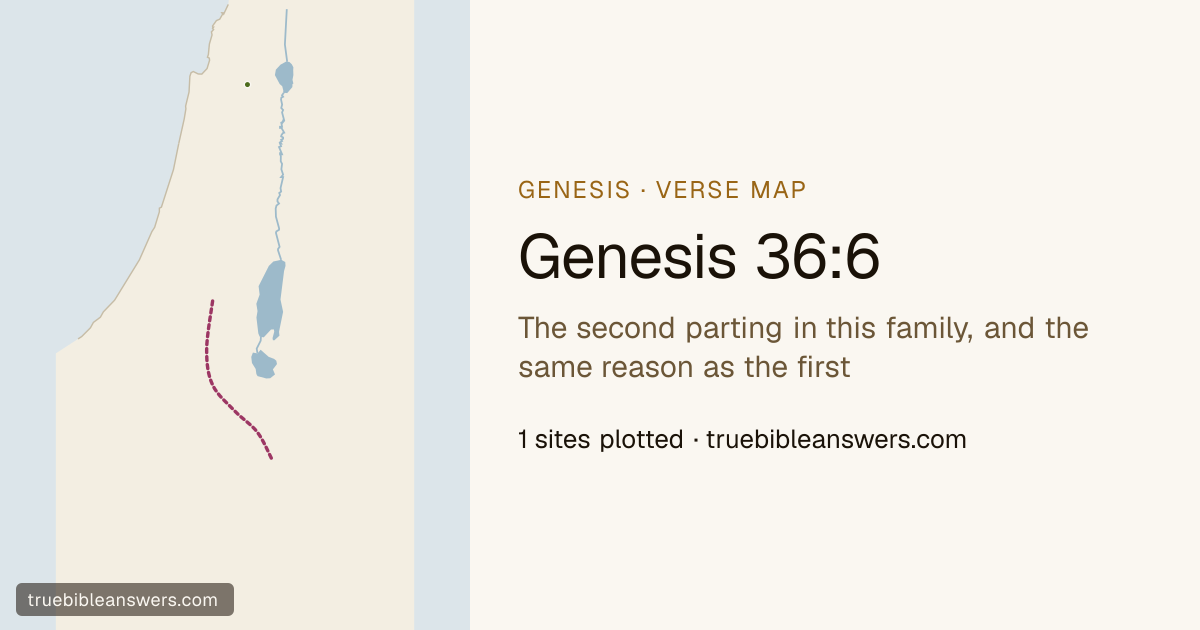
Read it →"Then Esau took his wives, his sons, his daughters, and all the members of his household, his livestock, all his beasts, and all his property that he had acquired in the land of Canaan. He went into a land away from his brother Jacob." It is the inventory that gives it away. Wives, sons, daughters, household, livestock, beasts, property — seven categories in one sentence, and the last of them acquired in the land of Canaan. Genesis writes a departure this way once before, in chapter 13, when Abram and Lot had so much between them that the land could not support them dwelling together. The wording here is almost a quotation of it: their possessions were too great for them to dwell together. So the parting is economic and not a quarrel, and that is the surprise. The last time these two brothers were in a room together, one of them was planning to kill the other as soon as their father was buried. They met again at the Jabbok and wept on each other's necks, and Esau went back to Seir the same afternoon. Their father has now died and been buried by both of them, and the murder never happens. What separates them in the end is grazing. He went into a land away from his brother Jacob. The verse will not name it. Two verses later it is the hill country of Seir and a country called Edom, but at this moment the destination is defined entirely by what it is not — not here, not where Jacob is — which is why the line on this map leaves Canaan and stops in open ground with nothing at the end of it. The difference from chapter 13 is who chooses. Lot looked at the Jordan Valley and picked it; Abram took what was left. Here nobody offers and nobody chooses: Esau simply loads up and goes, and the elder son of Isaac walks out of the land his grandfather was promised, taking everything he acquired in it with him. He is not driven out and he is not cheated this time. He leaves because there is no room, and the text has already spent a chapter establishing that he has quite enough without it. What Canaan is here is the inventory's last line — where the property came from — and the map draws it that way: a country he is subtracting himself from, with the one point the sources give it standing in for the whole.
Regions on this map
The land the inventory was gathered in, and the land it is being taken out of. Esau is the first of Abraham's descendants to leave it without being sent and without coming back.
The land Isaac never left and Esau now does. The sources give the country one representative point rather than a boundary, which is what a region gets in this dataset; it stands for the whole, from the Jordan to the sea. Everything in the verse's inventory was acquired here, and the sentence lists it in order to say that all of it is leaving.
Today: the land between the Jordan and the sea (representative point)
Too much livestock and not enough hill country — the identical arithmetic that separated Abram and Lot. The destination is named only by what it is not, so the road out of Canaan ends in open ground.
Genesis 36:6 in full
- Genesis 36:6Then Esau took his wives, his sons, his daughters, and all the members of his household, his livestock, all his beasts, and all his property that he had acquired in the land of . He went into a land away from his brother Jacob.