Genesis 33:18: The whole road home closed in one word, and a camp outside the walls
Read it →"And Jacob came safely to the city of Shechem, which is in the land of Canaan, on his way from Paddan-aram, and he camped before the city." The word is shalem, and translators have argued over it for centuries: safe, whole, at peace, in one piece — or a place name, Salem, a town near Shechem. Every reading says roughly the same thing about the map. The road that began at 28:10 with a man leaving Beersheba alone ends here with a household, a herd and a limp, and one adverb carries the twenty years. Three names in one sentence give the page its frame. Paddan-aram at the top, six hundred miles away, where he was; Canaan, which is the country he vowed at Bethel to come back to; and Shechem, which is the first town in it his grandfather stopped at. Abraham came into the land here, at the oak of Moreh, and was told this is the land I will give your offspring, and built an altar. Jacob is the second man to arrive in Canaan and the second to arrive at this spot. He camps before the city rather than in it, which is what the family always does and is not a detail: they buy ground, pitch on it and stay outside. The next verse is the purchase of the field he is camped on, and 33:20 is an altar on it with a name of its own — God, the God of Israel — the first time he uses the name he was given at the Jabbok. Shechem is a real and well-fixed place, Tell Balata below Mount Gerizim, in the pass between Ebal and Gerizim where the north–south ridge road crosses the east–west one. What happens there in the next chapter drives him out of it, and the field is the one piece of the country his family still holds at the end of the Bible: Joseph's bones are buried in it in Joshua 24.
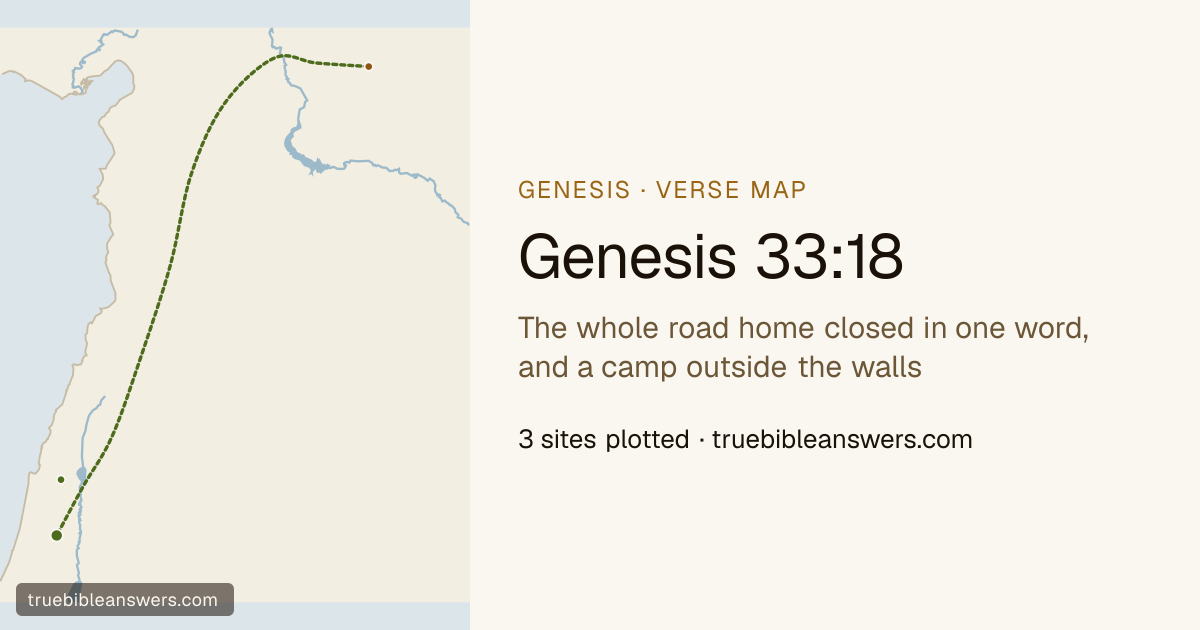
Regions on this map
Shalem — safe, whole, in one piece. One adverb for six hundred miles and twenty years, and the same town his grandfather stopped at the day he first walked into the country.
The land he vowed at Bethel to come back to, and the clause that turns an arrival into the keeping of a promise: if I come again to my father's house in peace, then the LORD shall be my God. Plotted at the land's own centre, because a country is not a place anyone stood.
Today: the land between the Jordan and the sea (representative point)
Tell Balata, in the pass between Mount Ebal and Mount Gerizim where the ridge road crosses the road down to the Jordan — which is why there has been a town here since the Bronze Age. Abraham stopped at the oak of Moreh here and built the first altar in the land; Jacob camps outside the walls, buys the field at 33:19 and builds an altar on it at 33:20. Joseph's bones are buried in that field in Joshua 24.
Today: Tell Balata, Nablus, West Bank
Named one last time, as the far end of a road now finished. He never goes north again; the rest of his travelling is southward, and at the end of it, into Egypt.
The plain of Aram round Harran, named here for the last time in Jacob's own travelling. 461 of its votes resolve it to Harran itself — a region the sources know by its town. Everything he has with him, he has from there.
Today: the plain round Harran, Turkey (representative point)
Genesis 33:18 in full
- Genesis 33:18And Jacob came safely to the city of , which is in the land of , on his way from , and he camped before the city.