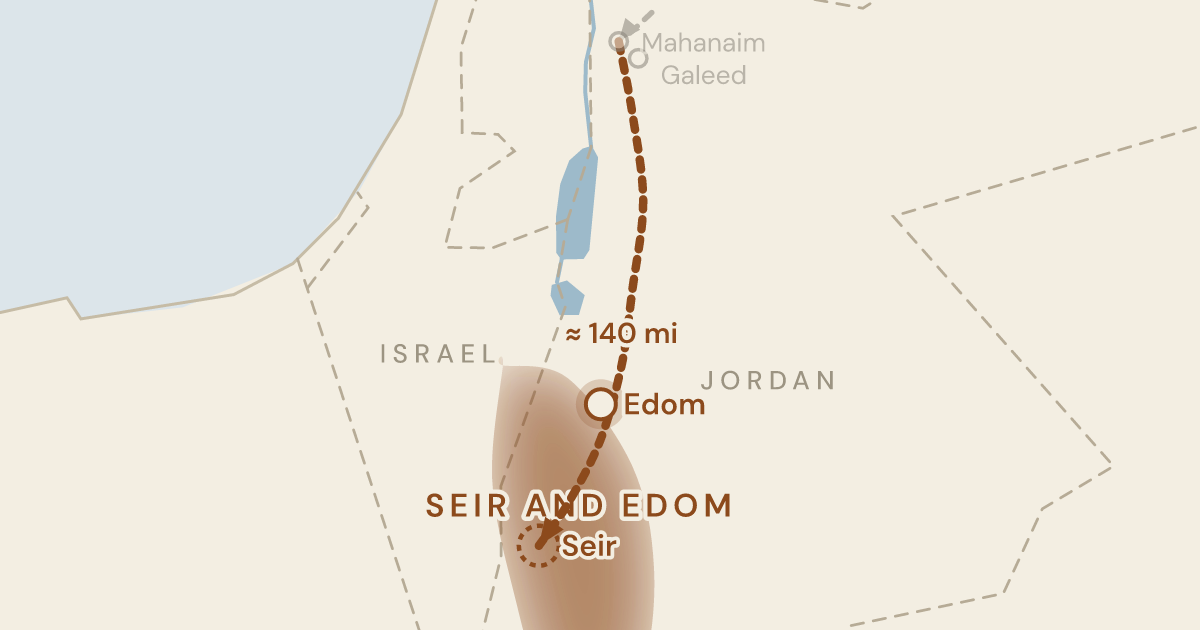
Genesis 32:3: Where his brother has got to in twenty years, and how far the message has to go
Read it →Commentary on Genesis 32:3
Jacob is on his way home, and the one obstacle he cannot avoid is the brother he wronged. God has just met him with a host of angels — and the very next thing Jacob does is send out a delegation of his own.
God's Messengers and Jacob's
The word for "messengers" here is the same word used for angels. The context decides which one is meant.
The Hebrew word usually used for angel, and the matching Greek word in the New Testament, simply mean "a messenger." Our word "angel" comes from that Greek word, angelos. Sometimes the word means an ordinary human messenger, as for example when "Jacob sent messengers before him." (Gen. 32:3).
Heaven's messengers had just met him. He answers by sending out his own.
"And Jacob went on his way, and the angels of God met him." Still God's grace follows him, despite everything. "Nothing changes God's affection." Whom He loves, and as He loves, He loves to the end… But his actions here show how little effect "God's host" had upon Jacob. "And Jacob sent messengers before him to Esau his brother in the land of Seir, the country of Edom." He feels uneasy about Esau, and he has reason to. He had treated him badly, and his conscience was not at ease. But instead of casting himself fully on God, he goes back to his usual planning to head off Esau's anger. He tries to manage Esau, instead of leaning on God.
Why Esau Surfaces Now
Watch the timing of this message.
It is remarkable too that it is just when he has met God's messengers that he sends his own to Seir to Esau. But God and Esau are evidently mixed up in his mind all through. This is not strange. It is bound to happen. Whatever brings God back to mind also brings back the person we have sinned against and never put things right with — maybe with no chance now of putting them right.
The Response Faith Would Have Given
Seir was Esau's country, and Jacob sends to it like a man expecting trouble. He had every reason to travel differently.
This was "piping" to Jacob, and Jacob ought to have "danced." He should have breathed an exulting spirit. He should have been in triumph already, before the fighting began, and even before the armies lined up… If the hosts of heaven waited on him like this, what had he to fear from the hosts of Esau? "If God is for us, who can be against us?" But this was not so with him. He laments, rather than dances, at this piping. He trembles, and prays, and calculates. He marshals his forces, as though the battle were his. This is all religious, but it is all unbelief too.
Careful Words, Uneasy Heart
The instructions he gives the messengers reveal what is really driving him.
Jacob was migrating with wives, children, servants and many animals, so he formed a large band. He now became aware that there was a second band, standing on his behalf. Even this did not free him from the fear of Esau, and his approach to him, as given in verses 3-5, though very diplomatic, bears traces of the working of a bad conscience.
The flattering titles in the message are the giveaway — and worth welcoming, since a working conscience is a mercy.
He sends messengers to Esau, who are to say, "My lord Esau; your servant Jacob says," and so on. What a message to his brother! Esau, "my lord"; and Jacob "your servant." Sin always brings its fruit, and wrong its repayment. The man is perfectly aware of the harm he has done to Esau… It is a fine thing when the conscience begins to work. Friend, has your conscience begun to work before God about the evil of your life?
God's Faithfulness, Not Jacob's
Jacob had already watched God deal with Laban.
Again he turns to his own schemes. He divides the people and the livestock into two companies, saying, If Esau comes to the one and strikes it, then the other will escape. How short and sad man's prudence is! God stopped Laban when he meant harm, and made him leave with a kiss all round. Could He not bring Esau to Jacob with an embrace, and even with tears? The Holy Spirit records Jacob's state here for our lasting profit: do not be anxious about tomorrow, but cast everything on the God of all grace, because He cares for us. Jacob had a bad conscience as yet, and had never faced it all out in God's presence. Yet God was faithful to him, not he to God.
Scripture records the failure for a reason.
God gives us the history of Jacob in such full detail in order to show how His grace could meet a man of that kind, rise above all his failures, and bless him.
Summary
- Escort. God's messengers met Jacob first. Grace arrives before the crisis does.
- Errand. Jacob answers heaven's messengers by sending his own to Seir. He manages Esau instead of leaning on God.
- Conscience. Nearness to God brings back the memory of the person we wronged. "My lord" and "your servant" expose guilt that is not yet healed.
- Unbelief. Heaven's armies surround him, yet he trembles, calculates and lines up his forces. That is religious activity, but it is still unbelief.
- Faithfulness. The God who turned Laban aside could turn Esau; Jacob was not faithful to God, but God stayed faithful to Jacob.