Genesis 32:2: Two camps: the one he is shown, and the one he makes the next morning
Read it →Commentary on Genesis 32:2
Jacob is on the last stretch of his journey home, and Esau is waiting somewhere ahead. Before he meets his brother, an escort he never asked for meets him. What he sees makes him name the ground. The name he chooses tells us as much about Jacob as about the angels.
The place and its name
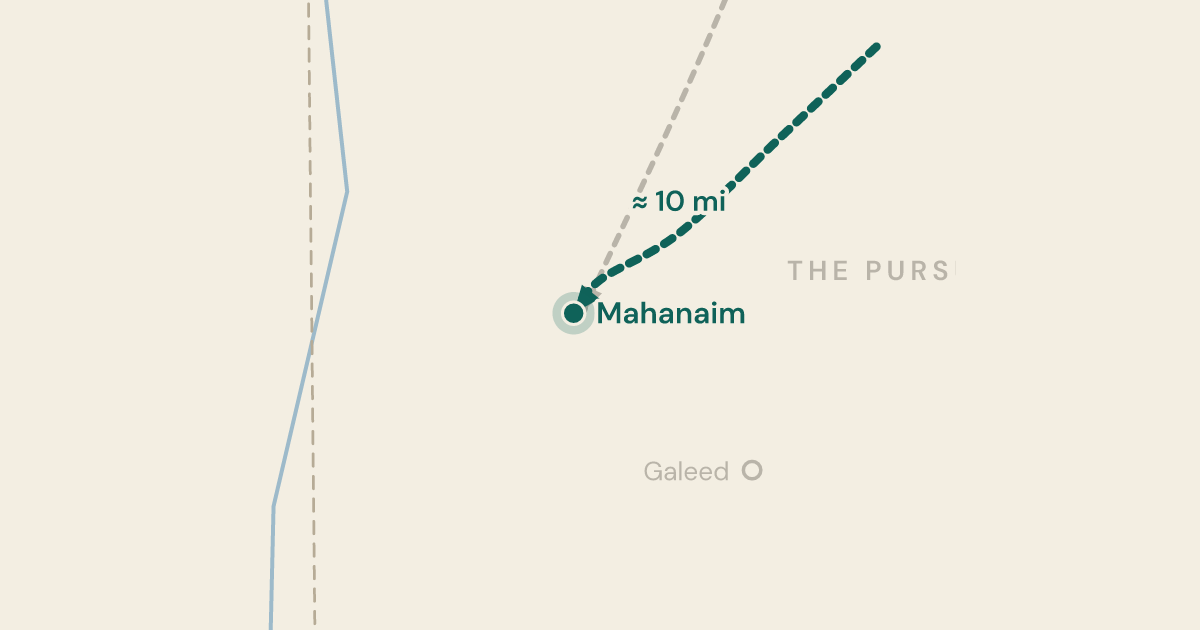
The name Jacob gave belongs to a real place on the map.
The spot east of the Jordan where Jacob met "the angels of God." He exclaimed "This is God's host," and named the place Mahanaim, "two hosts or camps." Scripture places it on the border of both Gad and Manasseh, which connects it with the brook Jabbok.
A welcome, not a ladder
Earlier, at Bethel, there was a ladder with angels going up and down it. Here the picture changes.
This was holy ground. God had fulfilled the promises of Genesis 28 and kept the pledges of Bethel. So we have no ladder here. His watchful care through angels had finished its work. He had kept Jacob in the far country and brought him home to his own land. The ladder may therefore come down. Instead of angels going up and down between heaven and Jacob, angels meet him. They stand before him, just to greet him, or to welcome him on his return.
Why "two"?
Commentators differ on what the second camp is. Some take it as the sheer size of the angelic company:
Later, the angels of God met Jacob, and he called the name of the place Mahanaim, meaning two hosts or camps. This is interesting. It shows how many angels may take part in one particular work of great size.
Another writer sees God's readiness to help, and a second camp that is Jacob's own:
How ready God is to assure us of His power, waiting only for the right moment to put it forth on our behalf!... Jacob calls the place "Mahanaim" — that is, "two hosts," or "camps." Here he must have counted in his own... How telling that in a little while we find him dividing this host of his into two camps! He says, "If Esau comes to the one camp and attacks it, then the camp that is left will escape." Such is our strength when we build on it, though perhaps we would gladly link God's power with it. In the time of need, our own — what is it? and God's — where shall we find it?
A divided heart makes divided camps
If God's camp and Jacob's camp stay separate in his mind, the split spreads.
Jacob had not yet learned to merge his interests with God's, so he treats God's "camp" as separate from his. This has its unhealthy influence on his actions soon after, when he divided his own company into "two camps" (v. 7). How much better if he had prayed the Psalmist's prayer: "Unite my heart to fear your name" (Psalm 86:11). We only resort to divisions among God's people because our hearts are not wholly devoted to Him.
Seeing angels is not the same as trusting God
The angels were a welcome. Jacob's answer was not.
This was music for Jacob, and Jacob should have danced. He should have been in triumph before the battle was even fought... If the hosts of heaven waited on him like this, what had he to fear from the hosts of Esau? "If God is for us, who can be against us?" But it was not so with him. He mourns rather than dances at this music. He trembles, and prays, and calculates.
Another writer records what came next.
Jacob learns that Esau was coming to meet him with four hundred men, and he is afraid and greatly distressed. Providences and visions do not take away terror, nor give confidence in God.
The same two hosts today
One writer sets Mahanaim beside Dothan, where a servant and a prophet faced the same danger and saw different things.
There were two hosts around Dothan that day. The servant saw the Syrians and lost heart; the prophet saw the heavenly armies and was confident. In the same way, when the angels of God met Jacob, he called the name of the place Mahanaim — "two hosts."... Danger may be very near, but God is nearer to us than all our enemies. We may well ask ourselves: which host do we see today? Is it the crowd of those who hate us, or the company of "ministering spirits sent out to serve for the sake of those who are to inherit salvation" (Hebrews 1:14)?
Summary
- Two camps named. Mahanaim means "two hosts." Jacob saw God's camp and named the ground for it, east of the Jordan near the Jabbok.
- Two camps welcomed. No ladder now. The angels stand still and greet him — God's own welcome home from the far country.
- Two camps counted separately. Jacob keeps God's camp beside his own instead of joined to it. Commentators differ: some read the "two" as the size of the angel army, others as God's host plus Jacob's.
- Two camps multiplied. A heart divided from God soon divides everything else: a few verses later Jacob splits his people into two camps, hoping one may escape.
- Two camps still. Mahanaim and Dothan set the same choice before us. Look at the crowd that threatens, or at the ministering spirits sent out to serve the heirs of salvation.