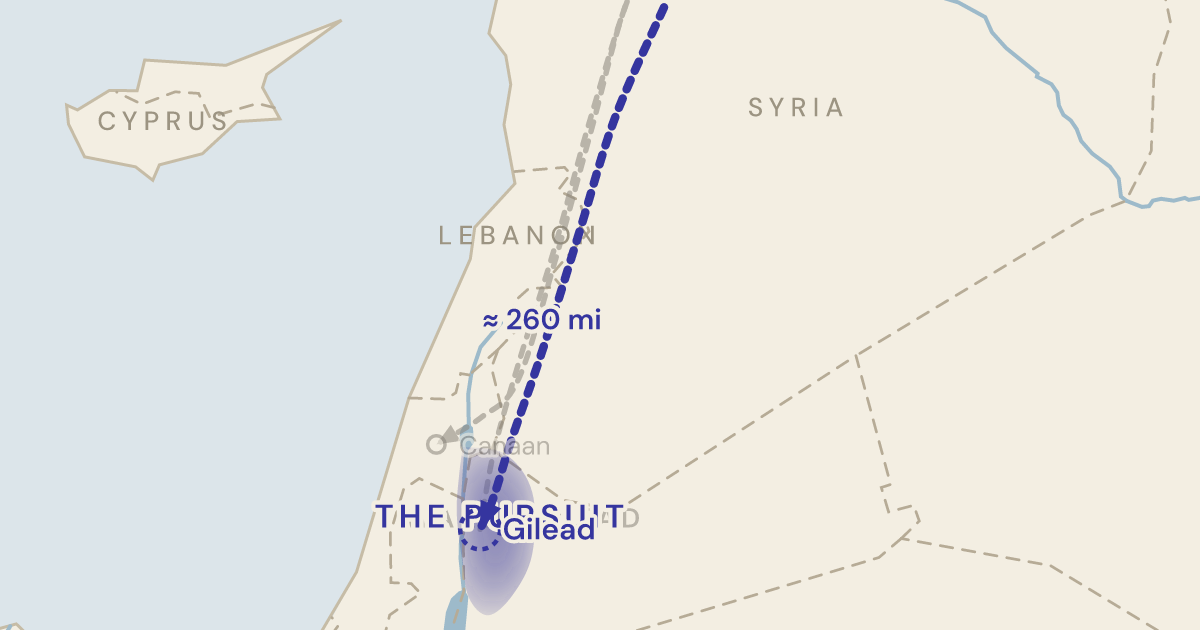
Genesis 31:23: The only chase in the book that catches up
Read it →Commentary on Genesis 31:23
Jacob has slipped away in secret, and three days later the news reaches Laban. What follows is a seven-day chase. It raises one question: who is in control — the man doing the chasing, or the God who had told Jacob to go home?
A seven-day chase
The distance covered tells its own story about Laban's determination.
The journey was long, but Jacob ought to have realized that Laban would pursue him. Jacob had a three-day start before Laban learned he had left (v.22). Even so, Laban did not delay. He took others with him and went after Jacob. After seven days he caught up with him.
Why Jacob ran in secret
God had already told Jacob to go home. So why the secrecy? One writer traces it to Jacob's conscience.
But Jacob has to flee. The time has come for him to return to his father's house, and God tells him to return. So why slip away in secret? Because he was conscious of his sins. He knew that he had wronged Laban, and so he was troubled and afraid.
The way he left shaped the way he was caught. A man who leaves like a thief gets chased like one.
He gives a touching explanation to Rachel and Leah, and leaves in secret. He did not have the confidence in God, with a clear conscience, that would have freed him from fear. The unseen hand of God was there. But the power and the honour of God could not be rightly found in such a course... So he steals away in fear, chased like a thief by his father-in-law. God, however, deals gravely with Laban, coming to him in a dream by night.
What Laban was chasing
One writer points to the household idols Rachel had taken as the main reason for the whole chase.
Soon Laban pursued and overtook Jacob. God warned the Syrian to beware how he treated Jacob. It seems the main reason for the pursuit was the teraphim (household gods). Rachel had stolen them, and Laban wanted them back. Laban's household practiced idolatry, even though he used the name of Jehovah (verse 49).
The pursuer with no case
Laban arrives at Gilead as the injured party. But he had no real claim, and his own conscience was far from clear.
Jacob was under no bond to stay. Laban and his sons gave ample signs how distasteful to them were his growth and their decay. He wanted a word from God, Who gave it to him. His wives were of one mind with his own... Now Laban and all his clan have overtaken Jacob on mount Gilead. What righteous objection could he raise? No doubt the warning God gave Laban alarmed his guilty conscience. But there was no true fear of God in him, and no sense of his own injustice — even if Jacob had been no more than a faithful servant.
Who was in charge
Laban set the pace of the chase. He did not decide how it ended.
Jehovah was faithful and gracious, Jacob a fugitive. Laban soon pursued in hot haste with no friendly intent, but in the end he had to bow to God's protection of Jacob.
How the chase ended
One writer follows the story past the moment Laban catches up.
Laban is warned to be careful what he says or does to Jacob, and he is even forced to admit it himself. While Jacob lays his complaint before him, Laban in the end cannot help seeking Jacob's help, and he enters into a special covenant with the very man he had overtaken in his flight.
Grace running alongside a poor walk
Nothing in Jacob's conduct here earns the protection he receives, and that is exactly the point the chase makes visible.
Jacob was not walking with God at this time, but God was walking in pure grace with Jacob. This is also a picture of God's preserving hand over the nation of Israel. That hand stays on them even when they have failed badly and are wandering and seeking their own way.
Summary
- Conscience — Jacob slipped away because he knew he had wronged Laban. Guilt, not faith, set the terms.
- Consequence — a man who leaves like a thief is chased like one. Laban chased him seven days and caught him at Gilead.
- Case — Laban had no righteous claim. Jacob was free to go, and it was Laban's conscience that was uneasy.
- Control — the pursuit was hot and unfriendly. In the end Laban had to bow to God's protection of Jacob, and make a covenant with the man he had chased.
- Crown — Jacob was not walking with God, but God was walking with Jacob. His preserving hand was grace, not reward.