Genesis 31:21: The river behind him, and the hills in front: the moment it cannot be undone
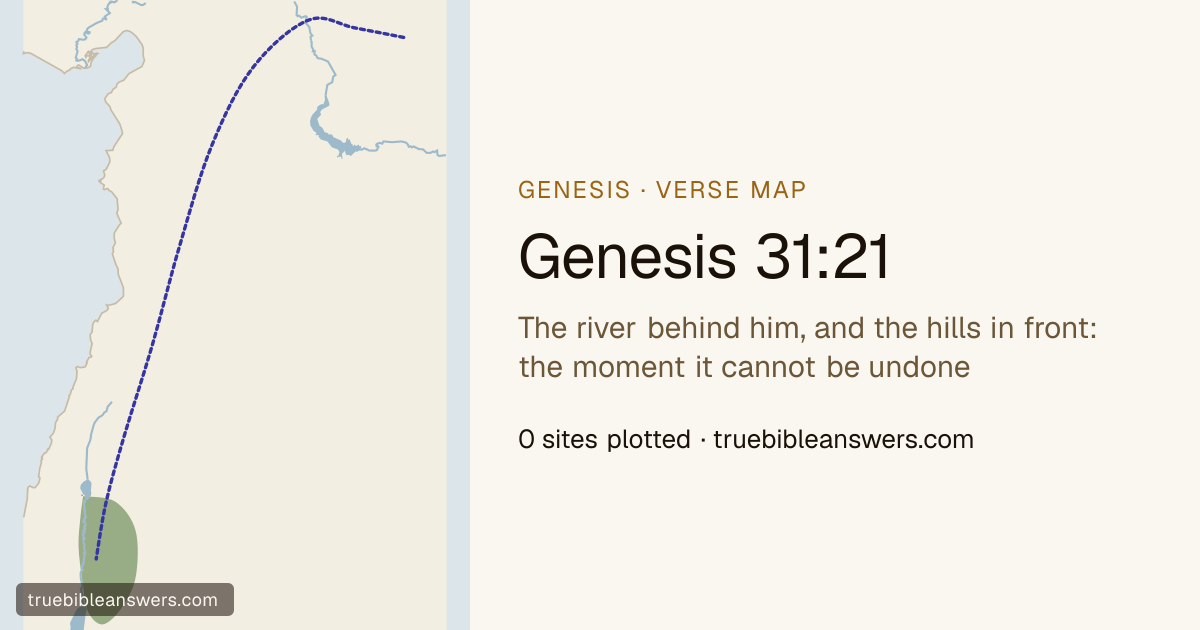
Read it →"He fled with all that he had and arose and crossed the Euphrates, and set his face toward the hill country of Gilead." This is the widest frame in the chapter and the point of no return inside it. The Euphrates is the border of the world Laban's household lives in; south and west of it the law, the language and the family connections all begin to thin out. A man who has crossed it with another man's daughters, another man's grandchildren and — though he does not know it — another man's household gods, has done something he cannot explain his way back out of. Crossing is not a small act. The river at the fords above Carchemish is two hundred yards wide and fast, and getting flocks over it takes days and rafts and men who do it for a living. The text gives it four words. What it spends its language on instead is the direction: he set his face toward the hill country of Gilead, which is a phrase about resolve rather than navigation. Gilead is still three hundred miles away. The river carries no pin here, and it is worth saying why. The sources file one point for the name Euphrates and it is the mouth, on the Persian Gulf, eight hundred miles downstream of anywhere in this story; a river is a line and this frame draws the whole reach that matters. Gilead has no pin either. It is a highland, not a town, and the one representative point on record for it sits on a mound above the Jabbok that other sources want for Mahanaim or Penuel — so the hills are drawn as hills and the point as a ring. He has a three-day start and does not know it. Laban is told on the third day; the pursuit that catches him takes seven more, and by then he is where this verse says he is going.
Regions on this map
The border of the world Laban's household lives inside. Once the flocks are over it there is no version of this journey that can be described as a visit.
The great river, and the edge of Laban's world. Everyone in this family has crossed it at least once: Terah and Abraham came down its valley out of Ur, Abraham's servant went up it for Rebekah, and Jacob walked up it twenty years ago on his own. Crossing it with flocks takes days and men who do it for a living, and the verse gives it four words.
a river is a line, and the frame draws the whole reach the verse means; the gazetteer's single point for the name is the mouth on the Persian Gulf, eight hundred miles downstream
Three hundred miles ahead of him and named as an intention. Highland east of the Jordan, wooded, well watered, and the first ground on the far side that a herdsman would call home.
The wooded highland east of the Jordan, between the Yarmuk and the Jabbok and on south — good grazing, and the first country on the far side of the river that a man driving flocks would aim at. The sources fix it only by a representative point, and that point is a mound above the Jabbok which 641 of Penuel's votes and 27 of Mahanaim's also want; the hills themselves are not in dispute, only where to put the pin for them.
a region, not a site: the one point on record is Tell edh-Dhahab esh-Sherqiyeh above the Jabbok, which is a mound other places are argued over. The outline is editorial
Genesis 31:21 in full
- Genesis 31:21He fled with all that he had and arose and crossed the , and set his face toward the hill country of .