Genesis 31:18: Twenty years of wages, on the road between two countries
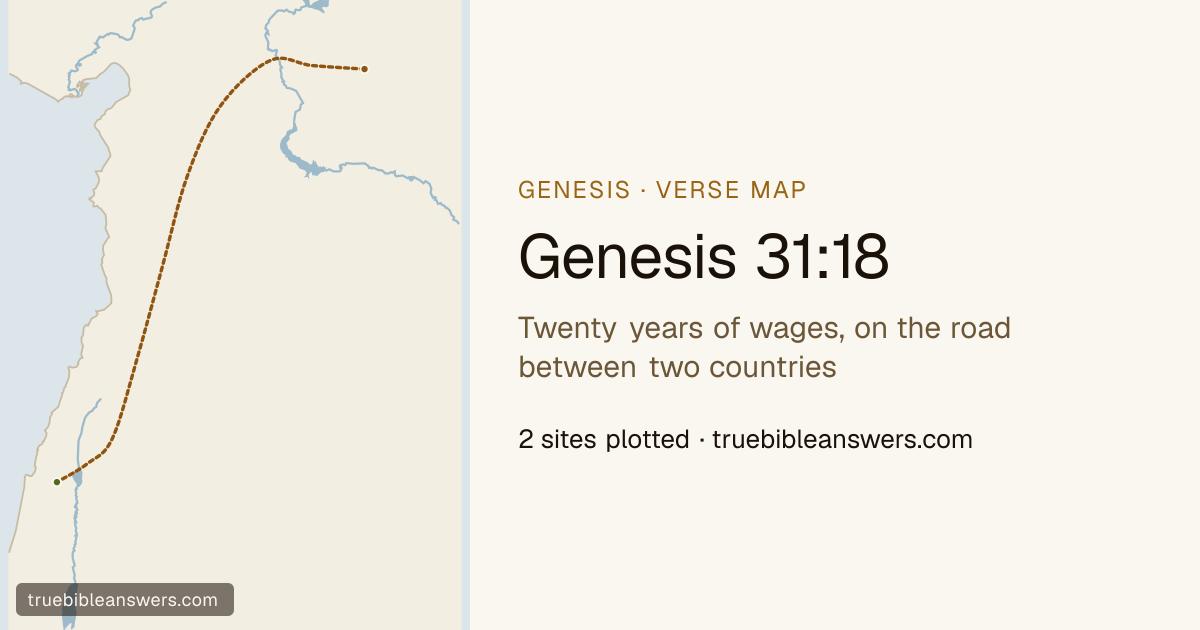
Read it →"He drove away all his livestock, all his property that he had gained, the livestock in his possession that he had acquired in Paddan-aram, to go to the land of Canaan to his father Isaac." The sentence is a list because the property is the point. He arrived in this country with a staff; he leaves it driving flocks and herds in front of him, with camels, servants, two wives, two maidservants and eleven children on the move behind. Laban has changed his wages ten times and Jacob has out-bred him anyway, and every animal in the column is an argument about who owes what to whom that the next twenty verses are going to have out loud. Both ends of the road are named in one breath, which is what makes it a map. Paddan-aram is the plain of Aram, the flat country round Harran between the Balikh and the Khabur; the sources put 461 of its votes there and file it as the region Haran stands in rather than as a town of its own. Canaan is the other end, six hundred miles by road, drawn at the land's own centre because a country is not a place anyone stood. "To his father Isaac" is the clause that turns a flight into a homecoming. Isaac is still alive — he does not die until 35:29, and Jacob does reach him at Mamre in the end — but between this verse and that one there are a pursuit, a border oath, a night at a ford, four hundred men on the road from Seir, a city put to the sword and two graves. He goes without telling Laban, and he goes the moment the flocks can travel. The column moves at the pace of the youngest animal in it, which is roughly ten miles a day, and that arithmetic is why Laban can be three days behind and still catch him.
Regions on this map
The plain of Aram, round Harran between the Balikh and the Khabur. Twenty years of it bought him two wives he did not choose in the order he wanted and a herd he did.
The plain of Aram: the flat country round Harran, between the Balikh and the Khabur, in what is now south-eastern Turkey and northern Syria. 461 of its votes resolve it to Harran itself, which is how the sources treat it — a region known by its town. Rebekah came from here, Jacob is sent here for a wife at 28:5, and he leaves it here with everything it owes him.
Today: the plain round Harran, Turkey (representative point)
Named as a destination and as a father in the same clause. He gets there — but not before a pursuit, a border, a wrestling match and two funerals.
The land between the Jordan and the sea, plotted at its own centre rather than at any stop, so the pin says a country and not a spot. Jacob has been out of it for twenty years; his father is still in it, at Mamre, and will live another long while yet.
Today: the land between the Jordan and the sea (representative point)
Genesis 31:18 in full
- Genesis 31:18He drove away all his livestock, all his property that he had gained, the livestock in his possession that he had acquired in , to go to the land of to his father Isaac.