Genesis 29:1: The only geography in three chapters, and it is deliberately vague
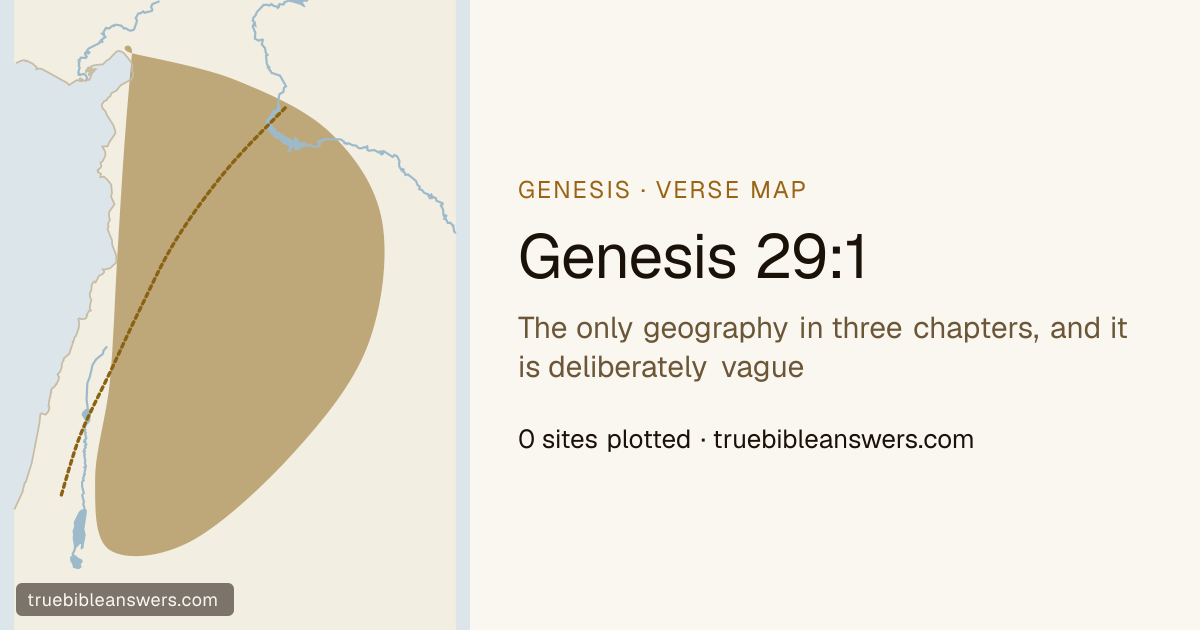
Read it →"Then Jacob went on his journey and came to the land of the people of the east." This is the arrival, and it names nowhere. Not Haran, which the last chapter said twice he was going to; not Paddan-aram, which is what his father called it; not a town, a river or a hill. The land of the bene qedem — the sons of the east — is a way of saying the country beyond the settled land, out where the herdsmen are, and the Bible uses it for Midianites and Amalekites raiding up the Jezreel valley, for Job, for the wisdom of Egypt's rivals, and here for the household Jacob's mother came from. The map has to say that rather than pretend otherwise. There is exactly one point on record for the name, and it is at Amman, because the phrase most often means the Transjordan steppe when a prophet uses it — four hundred miles from where this chapter's next four verses put Jacob, which is a well outside Haran talking to shepherds who say they are from Haran. So the point is drawn as a ring and not a pin, and the ground the phrase covers is drawn as a haze: the whole arc of steppe that runs from the edge of the Jordan rift up round the Syrian desert to the Balikh, which is the country a Canaanite means by east. What the verse does well is the thing a map cannot do at all. "Went on his journey" is two words in Hebrew — he lifted up his feet — and it is the only sentence in scripture that uses them. After the ladder and the vow he walks lighter. Between this verse and the next named place he covers five or six weeks of road, and the text spends one clause on it. Everything else in these three chapters happens indoors or in a fold: two weddings, eleven sons and a daughter, wages changed ten times, and not a mile of travel until 31:18. Twenty years pass on this page.
Regions on this map
Not a country with a border but a direction with people in it: the open grazing beyond the settled land, from the Transjordan round the Syrian desert to the Euphrates. The map draws it as a haze because the phrase is a haze.
Bene qedem, the sons of the east — the herding country beyond the settled land. Judges uses it of the Midianites and Amalekites who come up against Gideon, 1 Kings of a wisdom Solomon's is measured against, Job of the man himself. The sources give the name a single representative point, at Amman in the Transjordan, which is the sense the prophets usually carry; Genesis 29 means the far end of the same steppe, because four verses later Jacob is at a well talking to shepherds from Haran.
no site of its own. The single point on record is at Amman and belongs to the phrase's usual sense rather than to this chapter; the outline is editorial and has no edge, because the name has none
Genesis 29:1 in full
- Genesis 29:1Then Jacob went on his journey and came to the land of the .