Genesis 28:19: A certain place gets a name, and the town beside it keeps its old one
Read it →Commentary on Genesis 28:19
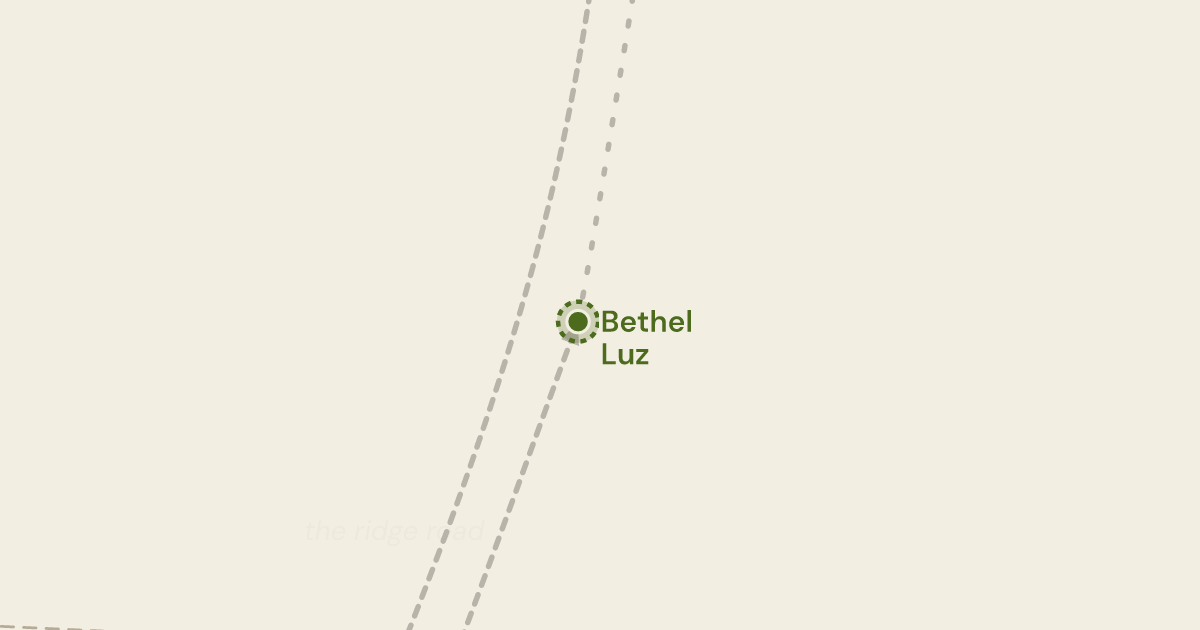
Jacob wakes from his dream and renames the ground he slept on. The old name of the town stays on record beside the new one, which raises three questions: what did "Luz" mean, why call a bare hillside "the house of God," and what became of the place later?
Luz and its meaning
Writers differ on what the older name meant. Some read it as a word for setting apart, and draw a lesson from it about God's dwelling:
He set up the stone he had used as a pillow and poured oil on it, calling the place Bethel, "the house of God." Abraham had lived earlier between Bethel and Ai (Gen. 12:8), and Jacob renames the place. "The name of the city was Luz at the first" (v. 19). This name means "separation," and it reminds us that the house of God must keep a place of holy separation from all the principles of man's civilization.
Others take the word to mean a curve or bending, and hear in the change something about the man as much as the map:
The old name of the place was Luz, meaning a curve. It pointed to what Jacob's life had been — far from straight. But now for Jacob it was Bethel, the dwelling place of God, and it had a very significant place in his later history.
The first house of God in Scripture
The first mention of God's house in the Bible comes to a man with no home of his own:
The first passage in Scripture that speaks of the House of God is Genesis 28:10-22. There Jacob, the homeless wanderer, sees a vision of the House of God. At once two things come before us: the purpose of God, and the responsibility of man towards God's House. God reveals Himself to Jacob as the One who is determined to bless man in sovereign grace... The gate stands for access to Heaven. Through it we reach Heaven with praise and prayer. And this gate is not in some far-off place: the gate of Heaven is always on earth, and while we are here we are to use it.
A name without a building
Jacob built nothing at Bethel. He set up a stone and poured oil on it. One writer draws a warning from later attempts to copy him:
Jacob set up a pillar and poured oil on the top of it (v. 18); the pillar indicated testimony or witness (Gen. 31:52). Here the witness was to the unfailing faithfulness and mercy of God... The oil was a picture of the Holy Spirit, who makes the House of God a living reality now. Jacob named the place Bethel, or House of God, although no real house stood there. Since that day many have tried to copy Jacob's example. They have put up houses and memorials of different kinds and called them God's, but without prophetic insight. As a result they have blurred the features of the real house.
What the place secured for Jacob
The name was a memorial of a promise made to a man at his lowest point:
The place where Jacob stopped would be marked by the mixed fortunes of Israel. It was no picture of the church. Jehovah made Bethel a pledge of sure mercy to Jacob when he had nothing left — whatever the king, raised up to punish the people, would later twist it into in honour of a strange and rival god.
The second naming in Genesis 35
Jacob names Bethel twice: here, and again on his return. Some have argued that the two namings come from two rival accounts. One writer answers plainly:
In the case of Bethel, God appeared to Jacob when he left the land of Canaan, and he called the name of the place "Bethel." On his return, God tells him to go up there, and already calls it Bethel. Then God appears to Jacob there a second time, and Jacob confirms the name "Bethel." He had a double reason. But the second part of the history calls it Bethel already, before he gets there. So the case is very simple and very clear.
From Bethel to Bethaven
The place Jacob named did not stay true to it. A king set up an idol there, and God spoke of the place under another name:
Bethel, meaning "House of God," was sacred as the spot where God showed Himself to Jacob, and graciously pledged Himself to His servant (Gen. 28:10-22). Now one of Jeroboam's calves stood there (1 Kings 12:28-29). So Jehovah spoke of the place with contempt as Bethaven — "house of folly" (Hosea 4:15).
Summary
- The name given. Jacob renames Luz as Bethel, "the house of God." Scripture keeps the old name on record; writers read Luz either as separation or as a crooked path now made straight.
- The name explained. The first passage in Scripture about the house of God comes to a homeless wanderer. It shows God's purpose in grace on one side, and man's responsibility on the other.
- The name witnessed. No building stood there — only a stone and oil. The pillar witnessed to God's faithfulness, and the oil pictured the Spirit, who makes God's house a living reality now.
- The name confirmed. Jacob names Bethel again on his return. That is not a rival account but a second meeting with the God who kept His pledge to him when he had nothing.
- The name lost. Where Jeroboam's calf later stood, God called Bethel "Bethaven" — the house of God turned house of folly. A people can forfeit the name grace gave them.