Genesis 11:2: the plain the migration from the east settled on
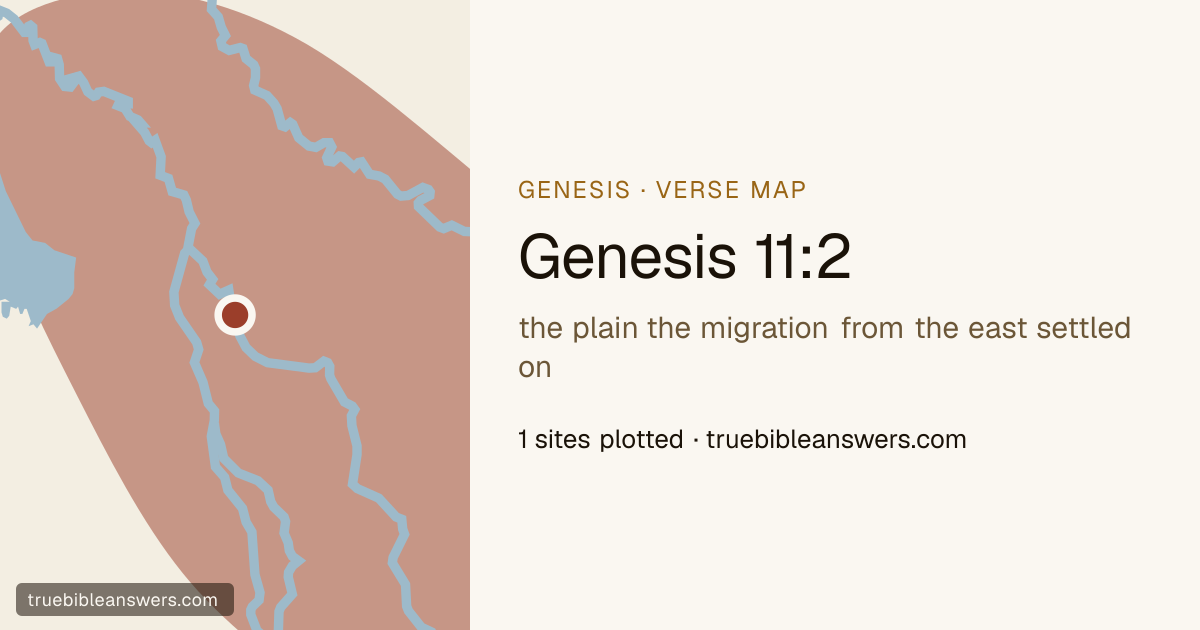
Read it →Genesis 11:2 is one sentence and one place name: “And as people migrated from the east, they found a plain in the land of Shinar and settled there.” Everything the chapter does next — the bricks, the bitumen, the tower, the scattering — happens on the ground this verse finds, and the ground is not a dot. The verse does not say they came to a city. It says they came to a plain, in a land, and stopped. So this map draws a country. Shinar is the alluvium of southern Mesopotamia: the flat, river-laid country that begins where the Tigris and the Euphrates draw within about thirty miles of each other near modern Baghdad, and runs south-east to the marshes and the head of the Gulf. It is roughly two hundred and fifty miles long and rarely a hundred wide, and it has no building stone and no timber worth the name. That absence is why the next verse is about materials. “They had brick for stone, and bitumen for mortar” is not a stylistic aside; it is what you build with when the country under you is river mud and the nearest quarry is four days away. The tower is made of the plain it stands on. The plain is Sumer and Akkad, and the cities on it are the ones the rest of the chapter and the chapter before it name: Babylon and Kish and Sippar in the north of it, Nippur in the middle, Uruk — the Erech of Genesis 10:10 — with Larsa, Lagash, Ur and Eridu in the south. Genesis 10:10 has already said so: “the beginning of his kingdom was Babel, Erech, Accad, and Calneh, in the land of Shinar.” Genesis 11:2 is the same country named a second time, before anything has been built on it. The Bible names Shinar eight times and never as a city. Amraphel is king of Shinar among the four kings of Genesis 14 who come west and carry Lot off. Achan buries “a beautiful cloak from Shinar” under his tent in Joshua 7. Isaiah 11:11 lists it among the countries the remnant is gathered from, Daniel 1:2 sends the vessels of the house of God to “the land of Shinar,” and Zechariah 5:11 sends the woman in the basket there to be given a house. It is the old and slightly archaic name for the country the exiles knew as Babylonia, which is part of why Genesis uses it: the land is being named at the beginning of things, before the empire that would take its name from one city on it. “From the east” is the verse's own difficulty, and the map does not settle it. The Hebrew can be read as “from the east,” “in the east” or “eastward,” and the plain is approached from the east if you come down off the Iranian highlands and from the north if you come down the rivers. Genesis gives a direction of travel and no starting point, so nothing is drawn for it — this map has no route on it at all. Where the sources put it is worth saying plainly. The OpenBible.info aggregate carries sixteen atlases and dictionaries for Shinar and exactly one identification, and that identification fixes the whole country with a single representative point at Babylon, near the plain's northern end. That is a reasonable answer to “which modern place stands for Shinar” and a poor one to “where is the land of Shinar,” so both are on the frame: the outlined land is the plain the verse means, and the open ring inside it is the one point the sources will actually commit to. The outline is editorial. No source fixes Shinar's borders, and it is blurred everywhere the ground itself does not decide them. The south end carries one more caution. The head of the Gulf stood a long way north of Basra when these cities were built — Ur and Eridu were near enough to the water to matter — and the land below them is silt the rivers have laid down since. So the outline stops around the ancient shoreline rather than running to the modern coast, and the country it encloses is smaller than a map of Iraq would suggest. Terah's family leaves this plain nine verses later. Genesis 11:31 takes Abram, Lot and Sarai out of Ur of the Chaldeans, which stands on the same alluvium a hundred and fifty miles downriver from Babel, and sets out for Canaan by the only road there is — up the Euphrates, the long way round. Abraham's journey is drawn on its own map, and it carries both Shinar and Babel across the fifteen chapters that follow.
Regions on this map
Verse 2: the flat, river-laid country of southern Mesopotamia — Sumer and Akkad — from the narrows near Sippar and Babylon south-east to the marshes and the old head of the Gulf. This is the plain the verse finds and the ground everything later in the chapter is built on. The outline is editorial and deliberately soft: no source fixes Shinar's borders, so it follows the alluvial plain's own edges and is blurred everywhere the ground does not decide them.
The one place Genesis 11:2 names, and the whole subject of this map: not a city but a country — the plain the migration from the east stopped on, and the ground the bricks, the bitumen and the tower all come out of. The gazetteer's sixteen sources file a single identification for it, and it fixes the entire country with one representative point at Babylon, near the plain's northern end. So the land is drawn here as a land, and the ring is where the sources will actually put their finger.
Today: the southern Iraqi plain, from Baghdad to the marshes (representative point)
Genesis 11:2 in full
- Genesis 11:2And as people migrated from the east, they found a plain in the land of and settled there.