Abraham's journey: Out of Ur by way of Haran, and buried in the only land he ever owned
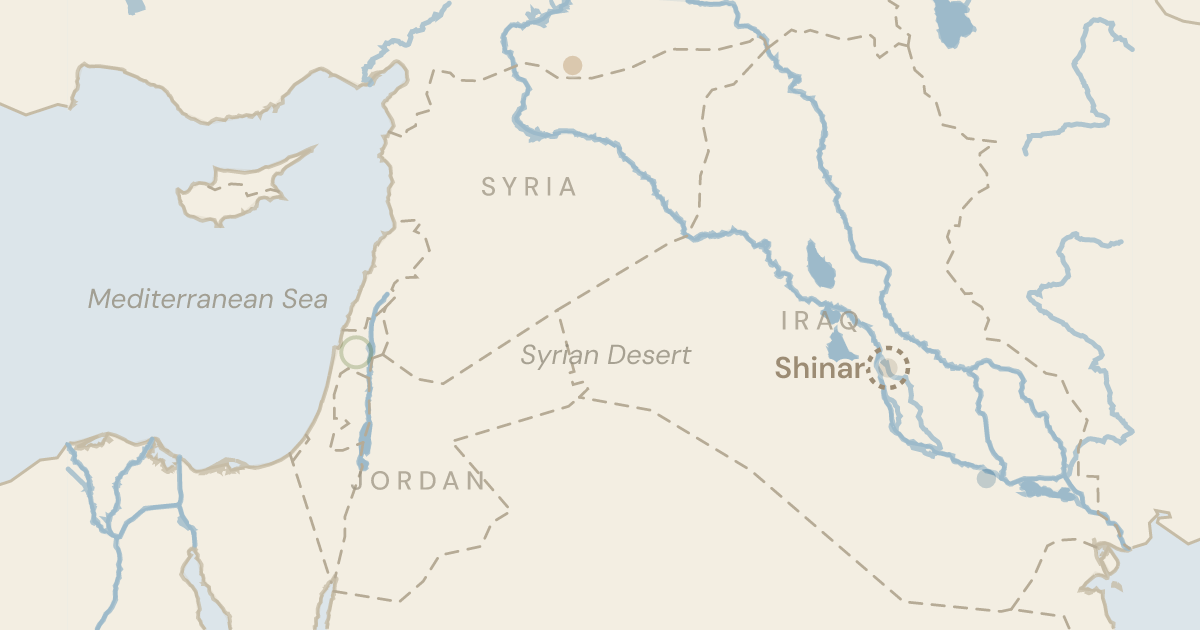
Read it →Fifteen chapters, one life, and the name changes halfway through it: he is Abram until Genesis 17:5 and Abraham after it, and this map keeps both because the text does. The journey begins as his father's. Terah takes Abram, Lot and Sarai out of Ur of the Chaldeans — a Sumerian city on the lower Euphrates, a hundred and fifty miles downriver from Babel — and sets out for the land of Canaan. Nobody crosses the Arabian desert to get there, so the road runs the long way round, up the river past Babylon and Mari to the crossing at the Balikh, and Haran is where Terah stops. He settles, and he dies there at two hundred and five. Abram is seventy-five when he goes on without him, and the road he takes is the one his father stopped on — west to Aleppo, down the Orontes past Hamath and Homs, through Damascus, into the hill country from the north. He walks the ridge and builds two altars on it, one at the oak of Moreh beside Shechem and one on the high ground with Bethel to the west of him and Ai to the east, and then keeps going south toward the Negeb. Then a famine. The hill country lives on rain and the Nile does not, so he goes down to Egypt, tells Pharaoh that his wife is his sister, and is put out of the country richer than he came. Genesis 13 walks the whole road back up in two verses. Two households have too much livestock for one hill country; Abram gives his nephew first choice, Lot looks east from the ridge, sees the Jordan Valley well watered everywhere like the garden of the LORD, and moves his tent as far as Sodom. Abram takes what is left, which turns out to be all of it, and settles by the oaks of Mamre at Hebron. Everything after that happens from Hebron, and the first thing that happens is a war. Four kings out of Shinar, Ellasar, Elam and Goiim come down the Transjordan through Ashteroth-karnaim and Ham, turn back at El-paran, beat five kings of the plain in the Valley of Siddim, and carry Lot off with the goods of Sodom. Abram arms three hundred and eighteen men born in his house and chases them a hundred and twenty miles to Dan and on past Damascus to Hobah — the furthest north he ever goes and the only fighting he ever does — and on the way home the king of Salem meets him with bread and wine while the king of Sodom offers him the plunder, and he will not take a thread or a sandal strap of it. Then the promise gets its terms: a smoking fire pot passing between the pieces in the dark, a covenant measured from the river of Egypt to the Euphrates, a new name, a son called laughter, and Hagar at a spring on the way to Shur that she names for the God who sees her. He moves south for a while — Gerar, where he tells Abimelech the same half-truth he told Pharaoh; the well at Beersheba, sworn over with seven ewe lambs and marked with a tamarisk — and from Beersheba he takes Isaac three days north to a mountain in the land of Moriah and comes back down it with a ram caught in a thicket instead of a son. Sarah dies at Kiriath-arba, which is Hebron, and the last thing on this map is a purchase. Abraham owns nothing at all in the land he has been promised, so he stands up in the gate and buys the field of Machpelah east of Mamre from Ephron the Hittite, four hundred shekels of silver weighed out in the hearing of everyone going in at the gate, because a gift can be taken back and a purchase cannot. He is buried in it himself at a hundred and seventy-five by two sons who could hardly be in the same place otherwise. Ur to Hebron is about six hundred and fifty miles in a straight line and close to twice that by the road there was, which is why this frame holds the whole Fertile Crescent and Canaan sits small inside it — and the only ground in it that was ever his is a cave and the field the cave stands in.
Regions on this map
Gen 11:27–31: Terah takes his son, his grandson and his daughter-in-law out of a Sumerian city on the lower Euphrates and sets out for a land none of them has seen. The road runs up the river, because the desert between is not a road.
Not a stop but a surname for one: the ESV says "Ur of the Chaldeans" three times — twice as Terah leaves, and once eleven chapters later when God names the place again in the covenant of Genesis 15:7 — and never names the country on its own.
no point of its own; the gazetteer resolves it to Ur, which this journey leaves under its own name
The departure, and the furthest east this map goes — a Sumerian city on the lower Euphrates, near the head of the Persian Gulf as the coast then ran, about six hundred and fifty miles from Hebron in a straight line and close to twice that by road. Where it was decides how long the road is. 846 of the 924 votes behind this dataset put it at Tell el-Muqayyar in Sumer, but 31 put it at Urfa in the north, twenty-five miles up the road from Haran, and 30 more in Urartu: on that reading Terah never crosses Mesopotamia, the journey out of Ur is two days' walk rather than a thousand miles, and the eastern half of this frame is empty.
Today: Tell el-Muqayyar, Dhi Qar, Iraq
Gen 11:31–12:5: they stop halfway and stay. Terah dies at Haran with Canaan still four hundred miles off, and Abram goes on without him at seventy-five.
Where the journey stopped for a generation: a caravan town on the Balikh, a day north of the Euphrates bend, where Terah settled and died at two hundred and five. Sixty-five years after Abram walks out of it he sends his servant back to it for a wife for Isaac, and Genesis 24 calls it Mesopotamia and the city of Nahor. Genesis 11:31 names the man Haran and the town Haran in one sentence, which is a coincidence of the ESV's spelling and not a connection.
Today: Harran, Şanlıurfa, Turkey
Gen 12:5–9: the first walk through the land, and two altars on it — one at the oak of Moreh beside Shechem, one on the high ground between Bethel and Ai — then south toward the Negeb.
Named at the outset as where Terah was going, reached only in Genesis 12, and named for the last time over Sarah's grave — "in the land of Canaan" is how Genesis 23 twice fixes the field he buys, as if the point of the purchase were which country it is in. Plotted at the land's own centre rather than at any stop, so the pin is a country and not a place anyone stood.
Today: the land between the Jordan and the sea (representative point)
The oak Abram stopped under and built his first altar beside. Genesis gives it and Shechem as one place — "to the place at Shechem, to the oak of Moreh" — and so does every identification behind this map.
no point of its own; all three identifications put it at Shechem, which is on this map
The first place named inside the land, and the first altar. It sits in the pass between Ebal and Gerizim that every north-south road has to go through, which is why the walk down the ridge starts here.
Today: Tell Balata, Nablus, West Bank
Named only to fix where the tent was — Abram pitched on the high ground with Bethel west of him and Ai east — and named again in Genesis 13:3 to say he came back to the same two miles of ridge.
Today: et-Tell, near Deir Dibwan, West Bank
The second altar, and the place the journey turns on: he comes back up out of Egypt to "the place where his tent had been at the beginning", and it is from this ridge that Lot looks east and chooses.
Today: Beitin, West Bank
The dry country south of the hills, and where Abraham spends more of his life than anywhere except Hebron. He is "still going toward" it when the famine sends him further south still; it is the first Canaanite ground he stands on coming back out of Egypt; and Genesis 20:1 sends him down into it for three chapters. Isaac is living in it when Rebekah arrives.
no point of its own; every source anchors the Negeb at Tel Be'er Sheva, which is the tell Beersheba stands on eight chapters later
Gen 12:10–20: the hill country lives on rain and the Nile does not. Abram calls Sarai his sister, Pharaoh takes her and is plagued for it, and the household is escorted out of the country richer than it came.
Where you go when the hill country fails, because the Nile does not depend on rain. Abram passes his wife off as his sister, Pharaoh takes her and is plagued for it, and the household is escorted out of the country richer than it came in — with, among other things, an Egyptian servant called Hagar. It stays on the map long after he leaves: Ishmael's wife is fetched from Egypt, and the covenant of Genesis 15 measures the land from the river of Egypt to the Euphrates.
Today: Egypt, at Heliopolis in Cairo (representative point)
Gen 13:1–4: four hundred miles walked back in two verses, and not one new place on them. Naming nothing new is what makes it a return, so this stage owns no pin and is drawn entirely in its legs.
Gen 13:5–13: two households with too much livestock for one hill country. Abram offers first choice, Lot looks east and takes the valley, and Genesis says what the men of Sodom were before anything has happened to them. Lot's two legs here are the only track on this map that is not Abraham's own feet, and they are drawn because Abram is standing on the ridge watching him go. Nobody else gets one — not the four kings of Genesis 14, not Hagar running toward Shur, not Lot again escaping to Zoar, not the servant riding back to Mesopotamia for Rebekah. They are on the map as pins.
Named beside Sodom every single time it is named: a king in the war of the four kings, a city whose outcry is great, and the second half of the sulfur and fire in Genesis 19. Its leading identification is the point Sodom already stands on, so this map gives it the argument instead of a second dot on one spot.
415 votes put it on the plain south of the Lisan, which is Sodom's point; the next candidates are north of the Dead Sea (78) and Numeira (52)
What Lot chose: the rift floor, "well watered everywhere like the garden of the LORD, like the land of Egypt" — and the same floor Genesis 19 calls simply "the valley" when the smoke of it goes up like the smoke of a furnace. The gazetteer's point is the valley's own middle, seventy-five miles north of the stretch he actually took, which is the plain around the sea's southern end.
Today: the Jordan rift, from Galilee to the Dead Sea (representative point)
The one contested site this map pins, and the pin falls on water — which is the theory rather than an error, because the leading identification puts the cities under the shallow southern basin of the Dead Sea. 477 of the atlases behind this dataset place it there, 112 north of the sea and 109 at Bab edh-Dhra; none of the candidates has a tell everyone accepts. It is named more often than anywhere else on this map: Lot moves his tent as far as it, four kings sack it, Abram refuses its king a sandal strap of the plunder, and Abraham argues God down from fifty righteous men to ten for it.
Today: disputed; most often the plain south of the Lisan, now under the Dead Sea (representative point)
The far edge of what Lot could see when he chose — he looked at the valley "in the direction of Zoar" — and six chapters later the one city small enough to be spared so that he had somewhere to run to. He was afraid of it as well, and went up out of it to live in a cave in the hills. Its one rival worth naming is Ghor es-Safi at the sea's south-east corner, where a Byzantine church was built over the site.
466 votes put it on the plain south of the Lisan, which is Sodom's point; Ghor es-Safi takes 305 and is the only rival with ground you can stand on
Gen 13:14–19:38: with Lot gone the land is promised again to the man left on the ridge, and for the rest of the book Hebron is where he lives. The third altar, the covenant cut in the dark, the new name, the three visitors under the oaks, and the morning he stood on the escarpment and watched the smoke of the valley go up like the smoke of a furnace.
Where the travelling stops and the rest of the life happens. Abram moves his tent to the oaks of Mamre, in the hills nineteen miles south of Jerusalem, and never lives north of it again. Genesis 23 calls it Kiriath-arba: it is where Sarah dies, where the field with the cave in it is bought and paid for, and where Isaac and Ishmael bury their father together.
Today: Tel Rumeida, Hebron, West Bank
The oaks Abram pitched his tent by when he came back from the parting with Lot, and his address for the rest of his life. The man the oaks are named for went to Dan with him, with his brothers Eshcol and Aner; the LORD appeared to him here in the heat of the day and was given a calf and cakes; and the field he finally buys is measured from here — "east of Mamre".
526 of 553 votes put it at Ramat el-Khalil, three and a half kilometres north of Hebron's tell and one dot with it on this frame
Gen 14:13–24: Lot is carried off with the goods of Sodom and Abram goes after him with three hundred and eighteen men born in his house — a hundred and twenty miles north to Dan, then a night attack and a chase past Damascus to Hobah. It is the furthest north he ever gets and the only fighting he ever does, and he comes back down to be met by two kings and to refuse one of them a sandal strap.
As far north as Abram ever gets, and the town is not called Dan yet: Judges 18 says it was Laish until the tribe of Dan took it centuries later, and the narrator has used the name his readers know. A hundred and twenty miles from Mamre, at the head of the Jordan, and he covered it fast enough to catch an army encumbered with plunder.
Today: Tel Dan, upper Galilee
The pursuit went past it by night, and Damascus is what Genesis 14 uses to say how far Abram got: Hobah is "north of Damascus". It comes back one chapter later in the only complaint he ever makes — that the heir of his house is Eliezer of Damascus, because he has no son.
Today: Damascus, Syria
The end of the chase, and Genesis fixes it by a city rather than by itself. Two thirds of the sources can say no more than the verse does; the one named site anybody proposes, Hoba, is seventy miles north-east of Damascus out in the desert.
148 of 218 votes locate it only in the vicinity of Damascus, which is a pin this map already carries; Hoba takes 50 and Tell el-Salihiye 20
Genesis 14:17's own gloss on the Valley of Shaveh, and the same valley Absalom later set up a pillar in for want of a son. Every identification puts it in the ravines under the eastern wall of Jerusalem — the Kidron, the Hinnom, or where the two of them meet.
195 of 418 votes put it where the Kidron meets the Hinnom and 134 in the Kidron itself, both within a kilometre and a half of Moriah's pin
Where the king of Sodom came out to meet Abram coming back with the plunder, and where Melchizedek brought out bread and wine. Genesis names it once and renames it in the same breath, and that second name is the only reason anyone has any idea where it was.
no identification places it on its own; all 500 votes reach it through the King's Valley, which stands on Moriah's pin
Melchizedek's city, and Jerusalem eight hundred years before David: Psalm 76 makes the equation and every source behind this map follows it. Abram gives him a tenth of everything and takes nothing at all from the king of Sodom, in the same hour and on the same ground.
its point is Jerusalem, a hundred and fifty metres from Moriah's pin; Genesis 14 and Genesis 22 happen on one hill and this map draws one dot for it
Gen 20:1–21:34: he leaves the hills for the dry country between Kadesh and Shur, sojourns in Gerar and tells Abimelech the same half-truth he told Pharaoh a quarter of a century earlier, then digs a well at Beersheba, swears an oath over seven ewe lambs and plants a tamarisk beside it.
The Philistine town Abraham sojourned in, where he said of Sarah "she is my sister" and heard from Abimelech the same answer Pharaoh had given him a quarter of a century earlier. The sources are all but unanimous about the tell: 628 of 641 votes for Tel Haror, on the wadi that still carries the name.
Today: Tel Haror, western Negev
The well of the oath, and the place he lives longest: Hagar and Ishmael are sent out into its wilderness, Abimelech and Phicol come out to swear a covenant over seven ewe lambs, and Abraham plants a tamarisk beside it and calls there on the name of the Everlasting God. It is where he sets out from for Moriah and where he comes back to. 382 of its 544 votes are for the tell at Tel Be'er Sheva and 162 for the wells at Bir es-Seba, three miles west, where the modern city is.
Today: Tel Be'er Sheva, Israel
Gen 22:1–19: out of Beersheba with two young men, a donkey, the split wood and his son; three days north to a mountain God would not name until they got there; and back down it with a ram caught in a thicket instead of a son. The going and the returning are one road and are drawn a few miles apart so that both can be seen.
"Go to the land of Moriah, and offer him there on one of the mountains of which I shall tell you" — the text names a country and withholds the mountain until they arrive on the third day. 2 Chronicles 3:1 builds Solomon's temple on Mount Moriah, and 260 of the 335 votes here follow it to the same rock; 23 prefer Al-Eizariya over the ridge, and 14 take the Samaritan reading, which puts it on Mount Gerizim above Shechem. Three days out of Beersheba is a fair walk to either.
Today: the Temple Mount, Jerusalem (representative point)
Not a place but a name given to one: Abraham called the mountain "The LORD will provide" after the ram in the thicket, and Genesis adds that the saying outlived him — "on the mount of the LORD it shall be provided".
151 of its 189 votes are for Mount Moriah, which is the pin it stands on; it is the same hill under the name he gave it
Gen 23:1–20 and 25:7–11: Sarah dies at Kiriath-arba and Abraham, who owns nothing whatever in the land he was promised, stands up in the gate and buys a field with a cave at the end of it for four hundred shekels of silver. It is the only ground in Canaan that is ever his, and he is buried in it.
The field with a cave at the end of it, east of Mamre, and the only ground in Canaan Abraham ever owned. He bought it standing up in the gate in front of the whole town, four hundred shekels of silver weighed out to Ephron the Hittite by the merchants' weight, refusing it as a gift, because a gift can be taken back and a purchase cannot. Sarah, Abraham, Isaac, Rebekah, Leah and Jacob are all buried in it.
all 442 of its votes are for the Cave of the Patriarchs, eight hundred metres from Hebron's tell and the same dot at any scale this frame can reach
Everywhere on this map that Abraham never stood: the plain of Shinar and the city built on it to make its builders a name, the countries the four kings came from and the whole line of their campaign down the Transjordan, the cities of the plain he refused a thread from, the bounds of the promise from the river of Egypt to the Euphrates, and the wildernesses Hagar and Ishmael were sent out into.
The plain Genesis 11 opens on, and the same southern Mesopotamian country Ur stands in under an older name — which is why the family's departure and the tower belong to one frame. It is named twice more three chapters later: Amraphel king of Shinar is the first of the four kings who come west and carry Lot off.
no point of its own; the gazetteer resolves it to Babylon, which is on this map as Babel
A city built so that its builders could make a name for themselves, and scattered for it — a hundred and fifty miles up the Euphrates from Ur, and nine verses before Terah's family leaves. Abram never goes there, and the promise to make his name great is the answer to it.
Today: Babil, near Hillah, Iraq
Chedorlaomer's country, and the reason Genesis 14 is a war rather than a raid: the king the five cities of the plain had served for twelve years ruled from beyond the Tigris, seven hundred miles east of the valley he came to punish. Susa is the furthest east anything on this map reaches, and nobody in Abram's household ever went there.
Today: Shush, Khuzestan, Iran (representative point)
Arioch's kingdom, and the one place in Genesis 14 the sources cannot even roughly agree on. The four leading identifications are Ilanzura on the upper Tigris, Assur, Larsa in Sumer and Cappadocia — six hundred miles and two civilisations apart — and the largest of them holds barely a quarter of the vote.
104 of 391 votes go to Ilanzura, 102 to Assur, 63 to Larsa and 38 to Cappadocia; no reading holds a third of the sources, and a pin would hand the argument to a winner nobody has
Tidal's kingdom, and the word is simply "nations" — the ESV leaves it untranslated because the sources cannot say which. Two fifths of them give up and point in the direction of Damascus; the rest reach for Hattusa and the Hittites.
85 of 207 votes point vaguely at Damascus, which is a pin this map already carries, and no other proposal takes more than 20
One of the five cities of the plain, on this map only as a king who went out to the Valley of Siddim and lost. Deuteronomy remembers it burning alongside Sodom; Genesis never says what became of it.
414 of 561 votes put it on the plain south of the Lisan, which is Sodom's point; the next candidates are north of the Dead Sea (54) and Tell ed-Damiyeh (37)
The fifth king of the plain, and the least said about: a name in a battle line in Genesis 14:2, the same name in the same line in 14:8, and nothing else in the book.
470 of 546 votes put it on the plain south of the Lisan, which is Sodom's point; north of the Dead Sea takes 44 and Feifa 22
The Dead Sea under its first name in scripture, and the gloss Genesis 14:3 puts on the battlefield: the four kings and the five joined forces "in the Valley of Siddim (that is, the Salt Sea)". That parenthesis is the oldest evidence anyone has that the cities of the plain are under water, and it is why Sodom's pin sits offshore.
Today: the Dead Sea (representative point)
Where the war was fought and lost — a floor full of bitumen pits that the kings of Sodom and Gomorrah fell into as they ran for the hills. Genesis says the valley is the Salt Sea, and the sources agree with it unanimously, which is why it carries no pin of its own.
every one of its 420 votes puts it on the plain south of the Lisan, which is Sodom's point: the battle was fought on the ground the cities stood on
The first town the four kings beat on their way south, in Bashan east of the Sea of Galilee, where they defeated the Rephaim. Abram is two hundred miles away under the oaks at Mamre and knows nothing about any of it until a survivor comes and tells him.
Today: Tell Ashtara, Daraa, Syria
The second town on the kings' march, where they defeated the Zuzim. It is named once in the whole Bible and nowhere else in the ancient world, and yet the sources are unanimous about which tell it is.
Today: Tell Ham, Irbid, Jordan
The third: the plain by Kiriathaim, in country that would later be Moab, where the Emim were beaten. No source places it on its own — every identification fixes Kiriathaim and lets the plain follow, which is what the name says as well.
Today: the plain by Kiriathaim, north of the Arnon (representative point)
The far end of the kings' sweep south, "on the border of the wilderness", where they stopped chasing Horites down the Seir range and turned back. Four fifths of the sources will say no more than that it is at or near the head of the Gulf of Aqaba.
Today: at the head of the Gulf of Aqaba
The red sandstone range east of the Arabah, later Edom, which the kings went down through the Horites to reach El-paran. It is the only mountain range on this map and Abram never crosses it.
Today: Jebel esh-Shera, southern Jordan (representative point)
The last place the kings hit on the way back north before the five kings came out to meet them — an Amorite town in the Arabah, which 2 Chronicles later equates with En-gedi on the Dead Sea shore. The sources split on which: 236 of 302 votes reach the oasis at En Hazeva in the Arabah, and 46 hold out for En-gedi.
Today: En Hazeva, in the Arabah
Where the kings turned back north, under its older name: "En-mishpat (that is, Kadesh)". After that it is a bearing twice and a destination never — Hagar's well lies between Kadesh and Bered, and Abraham lives between Kadesh and Shur. Three verses on this map name it and he arrives at it in none of them.
Today: Ain el-Qudeirat, northern Sinai
The far edge of the promise — "from the river of Egypt to the great river, the river Euphrates" — and also the road the family actually walked out on, since nobody crosses the Arabian desert and the way from Ur to Haran is upstream the whole distance.
a river is a line, and this map already draws the whole of it, from the delta below Ur to the bend above Haran; the gazetteer's single point for it is the mouth, which is not what Genesis 15:18 means
The wilderness on Egypt's doorstep, and always a bearing rather than a destination: Hagar is found by a spring "on the way to Shur", Abraham lives "between Kadesh and Shur", and Ishmael's sons settle "from Havilah to Shur". Nobody in Genesis arrives there. 298 of its 367 votes are for the same stretch of the north-western Sinai.
Today: the wilderness east of the Egyptian frontier (representative point)
The well Hagar named when she ran from Sarai and was found in the wilderness — "You are a God of seeing" — and the only place on this map named by a woman. Isaac is coming back from it when he first sees Rebekah, and settles at it again in the verse after his father is buried. The sources are thin: 72 of 106 votes for the spring at Ain Muweileh, and nobody is confident.
Today: Ain Muweileh, western Negev
On this map only because Genesis 16:14 uses it to fix the well: Beer-lahai-roi "lies between Kadesh and Bered". Half the sources put it at Haluza in the Negev and a quarter at a hill fifty-five miles south of that, which makes it a poor ruler to measure a well with.
Today: Haluza, western Negev
Not a place anyone on this map goes to, but a place that comes out of it: Lot's younger daughter bears Ben-ammi in the cave above Zoar, and Genesis stops the story to say that he is the father of the Ammonites. The map is at the last verse of Lot's life and the first of a nation's.
Today: Amman, Jordan (representative point)
Where Ishmael grew up after Hagar was sent away — "he became an expert with the bow" — and where his mother found him an Egyptian wife. It is the wilderness Israel will spend a generation crossing, and Abraham never goes into it.
Today: the Paran wilderness, central Negev (representative point)
Genesis 24's name for the country the servant rode back to with ten camels — "to Mesopotamia, to the city of Nahor" — which is Haran, and the family Terah left behind there sixty-five years before. Abraham will not go himself and makes the servant swear that Isaac will not go either.
all 500 votes resolve it to Harran, which is on this map under its own name
"The city of Nahor" — Abraham's brother, the one who stayed. The sources take it as Haran itself rather than a town of its own, and Rebekah is coming out to the well of it with a jar on her shoulder when the servant arrives.
377 of its 447 votes are for Harran, which this map already pins, and nothing else is proposed with a site of its own
Where the sons of the concubines were sent while Abraham was still alive, with gifts, away from Isaac — the desert beyond the Jordan, and the beginning of the Arabian genealogies. The text gives a direction rather than an address.
the gazetteer resolves "the east country" to Amman, which is the point Ammon already stands on; the text means the country beyond it and names nowhere in particular
Genesis 11–25, verse by verse
Genesis 11
- Genesis 11:2And as people migrated from the east, they found a plain in the land of and settled there.
- Genesis 11:9Therefore its name was called , because there the LORD confused the language of all the earth. And from there the LORD dispersed them over the face of all the earth.
- Genesis 11:28Haran died in the presence of his father Terah in the land of his kindred, in of the .
- Genesis 11:31Terah took Abram his son and Lot the son of Haran, his grandson, and Sarai his daughter-in-law, his son Abram's wife, and they went forth together from of the to go into the land of , but when they came to , they settled there.
- Genesis 11:32The days of Terah were 205 years, and Terah died in .
Genesis 12
- Genesis 12:4So Abram went, as the LORD had told him, and Lot went with him. Abram was seventy-five years old when he departed from .
- Genesis 12:5And Abram took Sarai his wife, and Lot his brother's son, and all their possessions that they had gathered, and the people that they had acquired in , and they set out to go to the land of . When they came to the land of ,
- Genesis 12:6Abram passed through the land to the place at , to the oak of . At that time the Canaanites were in the land.
- Genesis 12:8From there he moved to the hill country on the east of and pitched his tent, with on the west and on the east. And there he built an altar to the LORD and called upon the name of the LORD.
- Genesis 12:9And Abram journeyed on, still going toward the .
- Genesis 12:10Now there was a famine in the land. So Abram went down to to sojourn there, for the famine was severe in the land.
- Genesis 12:11When he was about to enter , he said to Sarai his wife, “I know that you are a woman beautiful in appearance,
- Genesis 12:14When Abram entered , the saw that the woman was very beautiful.
Genesis 13
- Genesis 13:1So Abram went up from , he and his wife and all that he had, and Lot with him, into the .
- Genesis 13:3And he journeyed on from the as far as to the place where his tent had been at the beginning, between and ,
- Genesis 13:10And Lot lifted up his eyes and saw that the was well watered everywhere like the garden of the LORD, like the land of , in the direction of . (This was before the LORD destroyed and .)
- Genesis 13:11So Lot chose for himself all the , and Lot journeyed east. Thus they separated from each other.
- Genesis 13:12Abram settled in the land of , while Lot settled among the cities of the and moved his tent as far as .
- Genesis 13:13Now the men of were wicked, great sinners against the LORD.
- Genesis 13:18So Abram moved his tent and came and settled by the oaks of Mamre, which are at , and there he built an altar to the LORD.
Genesis 14
- Genesis 14:1In the days of Amraphel king of , Arioch king of , Chedorlaomer king of , and Tidal king of ,
- Genesis 14:2these kings made war with Bera king of , Birsha king of , Shinab king of , Shemeber king of , and the king of Bela (that is, ).
- Genesis 14:3And all these joined forces in the (that is, the ).
- Genesis 14:5In the fourteenth year Chedorlaomer and the kings who were with him came and defeated the Rephaim in , the Zuzim in , the Emim in ,
- Genesis 14:6and the Horites in their hill country of as far as on the border of the wilderness.
- Genesis 14:7Then they turned back and came to (that is, ) and defeated all the country of the Amalekites, and also the Amorites who were dwelling in .
- Genesis 14:8Then the king of , the king of , the king of , the king of , and the king of Bela (that is, ) went out, and they joined battle in the
- Genesis 14:9with Chedorlaomer king of , Tidal king of , Amraphel king of , and Arioch king of , four kings against five.
- Genesis 14:10Now the was full of bitumen pits, and as the kings of and fled, some fell into them, and the rest fled to the hill country.
- Genesis 14:11So the enemy took all the possessions of and , and all their provisions, and went their way.
- Genesis 14:12They also took Lot, the son of Abram's brother, who was dwelling in , and his possessions, and went their way.
- Genesis 14:14When Abram heard that his kinsman had been taken captive, he led forth his trained men, born in his house, 318 of them, and went in pursuit as far as .
- Genesis 14:15And he divided his forces against them by night, he and his servants, and defeated them and pursued them to , north of .
- Genesis 14:17After his return from the defeat of Chedorlaomer and the kings who were with him, the king of went out to meet him at the (that is, the ).
- Genesis 14:18And Melchizedek king of brought out bread and wine. (He was priest of God Most High.)
- Genesis 14:21And the king of said to Abram, “Give me the persons, but take the goods for yourself.”
- Genesis 14:22But Abram said to the king of , “I have lifted my hand to the LORD, God Most High, Possessor of heaven and earth,
Genesis 15
- Genesis 15:2But Abram said, “O Lord GOD, what will you give me, for I continue childless, and the heir of my house is Eliezer of ?”
- Genesis 15:7And he said to him, “I am the LORD who brought you out from of the to give you this land to possess.”
- Genesis 15:18On that day the LORD made a covenant with Abram, saying, “To your offspring I give this land, from the river of to the great river, the river ,
Genesis 16
- Genesis 16:3So, after Abram had lived ten years in the land of , Sarai, Abram's wife, took Hagar the Egyptian, her servant, and gave her to Abram her husband as a wife.
- Genesis 16:7The angel of the LORD found her by a spring of water in the wilderness, the spring on the way to .
- Genesis 16:14Therefore the well was called ; it lies between and .
Genesis 17
- Genesis 17:8And I will give to you and to your offspring after you the land of your sojournings, all the land of , for an everlasting possession, and I will be their God.”
Genesis 18
- Genesis 18:16Then the men set out from there, and they looked down toward . And Abraham went with them to set them on their way.
- Genesis 18:20Then the LORD said, “Because the outcry against and is great and their sin is very grave,
- Genesis 18:22So the men turned from there and went toward , but Abraham still stood before the LORD.
- Genesis 18:26And the LORD said, “If I find at fifty righteous in the city, I will spare the whole place for their sake.”
Genesis 19
- Genesis 19:1The two angels came to in the evening, and Lot was sitting in the gate of . When Lot saw them, he rose to meet them and bowed himself with his face to the earth
- Genesis 19:4But before they lay down, the men of the city, the men of , both young and old, all the people to the last man, surrounded the house.
- Genesis 19:17And as they brought them out, one said, “Escape for your life. Do not look back or stop anywhere in the . Escape to the hills, lest you be swept away.”
- Genesis 19:22Escape there quickly, for I can do nothing till you arrive there.” Therefore the name of the city was called .
- Genesis 19:23The sun had risen on the earth when Lot came to .
- Genesis 19:24Then the LORD rained on and sulfur and fire from the LORD out of heaven.
- Genesis 19:25And he overthrew those cities, and all the , and all the inhabitants of the cities, and what grew on the ground.
- Genesis 19:28And he looked down toward and and toward all the land of the , and he looked and, behold, the smoke of the land went up like the smoke of a furnace.
- Genesis 19:29So it was that, when God destroyed the cities of the , God remembered Abraham and sent Lot out of the midst of the overthrow when he overthrew the cities in which Lot had lived.
- Genesis 19:30Now Lot went up out of and lived in the hills with his two daughters, for he was afraid to live in . So he lived in a cave with his two daughters.
- Genesis 19:38The younger also bore a son and called his name Ben-ammi. He is the father of the to this day.
Genesis 20
- Genesis 20:1From there Abraham journeyed toward the territory of the and lived between and ; and he sojourned in .
- Genesis 20:2And Abraham said of Sarah his wife, “She is my sister.” And Abimelech king of sent and took Sarah.
Genesis 21
- Genesis 21:14So Abraham rose early in the morning and took bread and a skin of water and gave it to Hagar, putting it on her shoulder, along with the child, and sent her away. And she departed and wandered in the wilderness of .
- Genesis 21:21He lived in the wilderness of , and his mother took a wife for him from the land of .
- Genesis 21:31Therefore that place was called , because there both of them swore an oath.
- Genesis 21:32So they made a covenant at . Then Abimelech and Phicol the commander of his army rose up and returned to the land of the Philistines.
- Genesis 21:33Abraham planted a tamarisk tree in and called there on the name of the LORD, the Everlasting God.
Genesis 22
- Genesis 22:2He said, “Take your son, your only son Isaac, whom you love, and go to the land of , and offer him there as a burnt offering on one of the mountains of which I shall tell you.”
- Genesis 22:14So Abraham called the name of that place, “The ”; as it is said to this day, “On the mount of the LORD it shall be provided.”
- Genesis 22:19So Abraham returned to his young men, and they arose and went together to . And Abraham lived at .
Genesis 23
- Genesis 23:2And Sarah died at (that is, ) in the land of , and Abraham went in to mourn for Sarah and to weep for her.
- Genesis 23:9that he may give me the cave of , which he owns; it is at the end of his field. For the full price let him give it to me in your presence as property for a burying place.”
- Genesis 23:17So the field of Ephron in , which was to the east of , the field with the cave that was in it and all the trees that were in the field, throughout its whole area, was made over
- Genesis 23:19After this, Abraham buried Sarah his wife in the cave of the field of east of (that is, ) in the land of .
Genesis 24
- Genesis 24:10Then the servant took ten of his master's camels and departed, taking all sorts of choice gifts from his master; and he arose and went to to the city of .
- Genesis 24:62Now Isaac had returned from and was dwelling in the .
Genesis 25
- Genesis 25:6But to the sons of his concubines Abraham gave gifts, and while he was still living he sent them away from his son Isaac, eastward to the .
- Genesis 25:9Isaac and Ishmael his sons buried him in the cave of , in the field of Ephron the son of Zohar the Hittite, east of ,
- Genesis 25:11After the death of Abraham, God blessed Isaac his son. And Isaac settled at .