Genesis 24:10: Four hundred miles back to the country the family left, and Abraham will not go
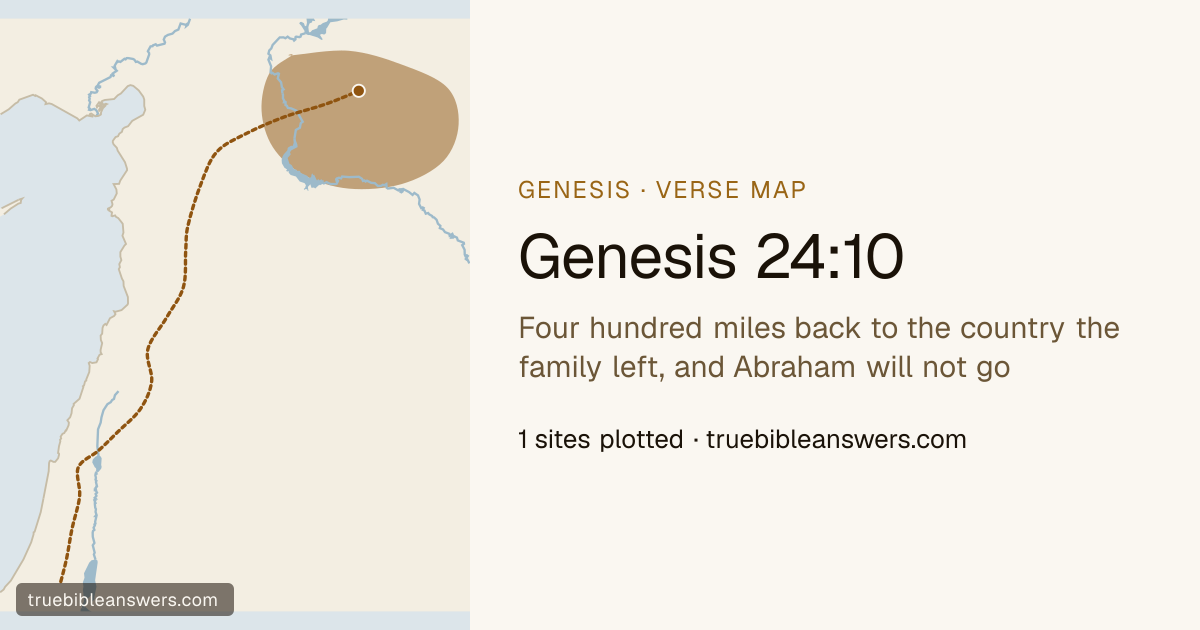
Read it →"Then the servant took ten of his master's camels and departed, taking all sorts of choice gifts from his master; and he arose and went to Mesopotamia to the city of Nahor." The longest journey in Abraham's story is one he does not make. He is a hundred and forty, Sarah is buried, and the last thing he arranges is a wife for Isaac — and the terms he sets are strict enough to need an oath sworn with a hand under his thigh: not from the Canaanites among whom I dwell, but from my country and my kindred; and on no account take my son back there. The servant asks the obvious question, what if she will not come, and is told that in that case he is released from the oath, but Isaac stays. So a household servant rides the route in reverse. Terah brought the family out of Ur to Haran and died there; Abram left Haran at seventy-five and came down the ridge into Canaan; sixty-five years later ten camels go back up it for a bride. The map draws that line, and it is the same line /maps/genesis-12-5 draws in the other direction — off the Judean ridge, north past the Sea of Galilee, through the Orontes valley and the Aleppo gap, and east along the edge of the Euphrates plain to Harran. Both names in the verse land on the same ground, which is a fact worth seeing rather than hiding. The city of Nahor is Abraham's brother's town — the brother who stayed — and 377 of its 447 votes say it simply is Haran, with nothing else proposed that has a site of its own; the remaining 70 belong to an identification that fixes nothing. Mesopotamia is the country round it, and the sources fix the whole country with one representative point, which is Harran again. So the map pins the city and rings the country at the same dot and says so on both cards; the country is also drawn as a soft outline over the Balikh and Habur plains, because a land with no fixed borders is better shown as ground than as a pin. Haran is not named in this verse and so is not a place on this page. The servant arrives at a well outside the town in the next few verses, and a girl comes out with a jar on her shoulder.
Regions on this map
The road out of Canaan run backwards by a servant with ten camels. Abraham will not go himself and will not let Isaac go, and the whole of Genesis 24 turns on that refusal.
Literally the country between the rivers, and Genesis 24's name for the family's old ground. Terah's household came out of Ur into it, stopped at Haran and buried him there; Abraham left it at seventy-five and never went back, and his last recorded instruction is that Isaac must not go back either. All 500 votes resolve it to Harran, which is the sources' way of fixing an entire country with one representative point.
no point of its own; all 500 votes resolve the whole country to Harran, which is the same dot this map pins under the name the verse gives it — the city of Nahor. The outline is editorial, and follows the Balikh and Habur plains rather than any border a source draws.
"The city of Nahor" — Abraham's brother, the one who stayed behind when Terah's household moved on. The sources take it as Haran itself rather than a town of its own: 377 of its 447 votes are for Harran, and the remaining 70 belong to an identification that fixes no site at all. Rebekah is coming out to the well of it with a jar on her shoulder when the servant arrives, and she is Nahor's granddaughter.
Today: Harran, Şanlıurfa, Turkey (representative point)
Genesis 24:10 in full
- Genesis 24:10Then the servant took ten of his master's camels and departed, taking all sorts of choice gifts from his master; and he arose and went to to the city of .