Genesis 23:19: Every name the chapter has been using, in one sentence, over a grave
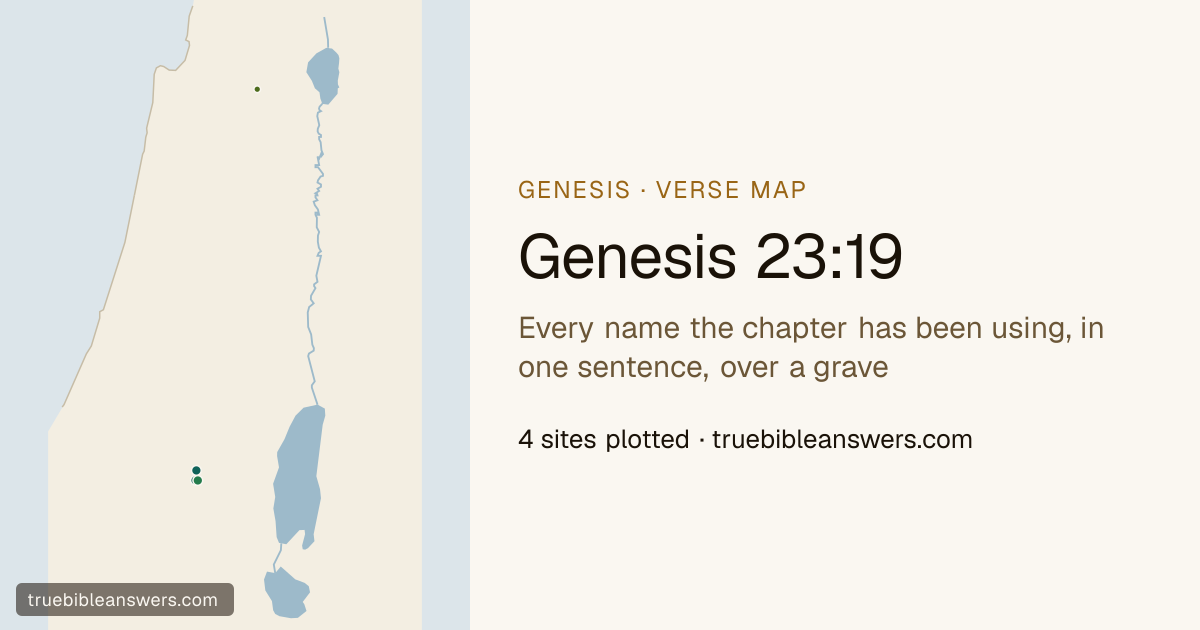
Read it →"After this, Abraham buried Sarah his wife in the cave of the field of Machpelah east of Mamre (that is, Hebron) in the land of Canaan." Four place names in a sentence about a burial, nested one inside the next like an address written by a lawyer: the cave, in the field, at Machpelah, east of Mamre, which is Hebron, which is in the land of Canaan. Nothing else in Abraham's story is located this carefully. The chapter has spent seventeen verses on a negotiation and this is the sentence where the money turns into a fact on the ground, so it is written the way you write a thing you intend to be able to prove. That is the whole force of it. He is a sojourner and a stranger, he says so himself in verse 4, and the promise he has been living on is that his descendants will have this country. What he has, at a hundred and thirty-seven, is a field with a cave at the end of it and a wife in the cave. Every later burial in Genesis comes back to this spot — Abraham himself two chapters on, then Isaac and Rebekah, then Leah, then Jacob carried up out of Egypt to be laid in it. The map is wider than the one on the page before, because this verse is not about the bearing but about the nesting. Machpelah and Mamre are the two dots that were the whole of Genesis 23:17; Hebron is the town they sit on either side of; and Canaan is a ring at the land's own centre, sixty miles north near the Jezreel, which is where the sources put a country when you ask them to put it somewhere. Seeing all four on one frame is seeing what the sentence is doing: it starts at a hole in the rock and ends at a nation.
Regions on this map
The purchase completed and used. Everyone in the family from here to Jacob is buried in this cave, and it is the only ground in Canaan any of them owns.
The purchase of the previous verses, now in use. All 442 votes go to the Cave of the Patriarchs, eight hundred metres east of Hebron's tell, under the Herodian enclosure that still stands over it. Sarah is the first of six: Abraham follows her two chapters later, then Isaac and Rebekah, then Leah, and finally Jacob, carried up out of Egypt with a procession because he made his sons swear he would not be buried there.
Today: the Cave of the Patriarchs, Hebron
The oaks and the town, given together because the narrator is fixing the spot for a reader who may know only one of the two names.
Given as a gloss — "east of Mamre (that is, Hebron)" — because the narrator is fixing the spot for someone who might know the town and not the oaks. Every vote goes to Tel Rumeida, on the western shoulder of the modern city, three thousand feet up on the Judean ridge. Abraham has lived on this ground since Genesis 13:18 and dies on it.
Today: Tel Rumeida, Hebron, West Bank
Used here as the landmark the grave is measured from, as it was two verses earlier, and with the same difficulty: 526 of its 553 votes put it at Ramat el-Khalil, three and a half kilometres north of the field rather than west of it. /maps/genesis-23-17 draws that gap at the scale it happens on. At this scale Mamre and the field are what the verse treats them as, two names for one hillside.
Today: Ramat el-Khalil, north of Hebron
The outermost of the four names, and the reason the other three are given so exactly. He has been promised this country and this cave is all of it he holds.
The last of the four names and the widest. Genesis 23 fixes the field in the land of Canaan twice, at the death and at the burial, which is not how it locates anything else in Abraham's life — the country is named because the promise was about the country. The sources plot the whole land at its own centre near the Jezreel, sixty miles north of the grave, so the ring here is a nation rather than a place.
Today: the land between the Jordan and the sea (representative point)
Genesis 23:19 in full
- Genesis 23:19After this, Abraham buried Sarah his wife in the cave of the field of east of (that is, ) in the land of .