Genesis 22:2: A country named, a mountain withheld, and the sources forty-seven kilometres apart
Read it →"He said, 'Take your son, your only son Isaac, whom you love, and go to the land of Moriah, and offer him there as a burnt offering on one of the mountains of which I shall tell you.'" The hardest sentence in Genesis is also, unusually, a set of directions — and the directions are deliberately incomplete. A country is given: the land of Moriah. The mountain is not. "One of the mountains of which I shall tell you" means he is to set out for a region and be told the rest on the way, and he does: he walks for three days before he lifts his eyes and sees the place. This is the only time in the Bible that the land of Moriah is named, and it is the reason this verse has a map at all. Everything else in the chapter happens at a place with no name until the fourteenth verse, when Abraham gives it one. Where it is, the sources will not settle, and the difference is not a rounding error. Two readings hold the field. On the first, Moriah is the Jerusalem ridge: 2 Chronicles 3:1 says Solomon built the temple on Mount Moriah, and 260 of the votes here follow it to the Temple Mount, with another 23 a mile and a half east at Al-Eizariya on the far slope of the Mount of Olives. On the second — the Samaritan reading, and an old one — Moriah is Mount Gerizim, above Shechem, which is where the Samaritan Pentateuch puts the whole story and where its temple stood. That is forty-seven kilometres north of the Temple Mount, and it makes the three days' walk half as long again. So the map does not pin Moriah. It rings both readings and draws the walk twice, as a pair of ghosts out of Beersheba, because the distance is what the sentence spends its next two verses on. Two further blocks of votes are named in Moriah's card and drawn nowhere: twenty-eight read it as Shechem itself, and ten as Mamre — Abraham's own doorstep — and each of those identifications resolves several ways at once, so it says which unfixed place Moriah stands beside rather than where either of them is. A vote like that is counted at no site here, because handing it to whichever candidate happens to score highest is how a mountain nobody proposed ends up with a pin on it. Beersheba is not named in this verse, so it is not a location on this page. Its point is where the two lines start, and the label says so.
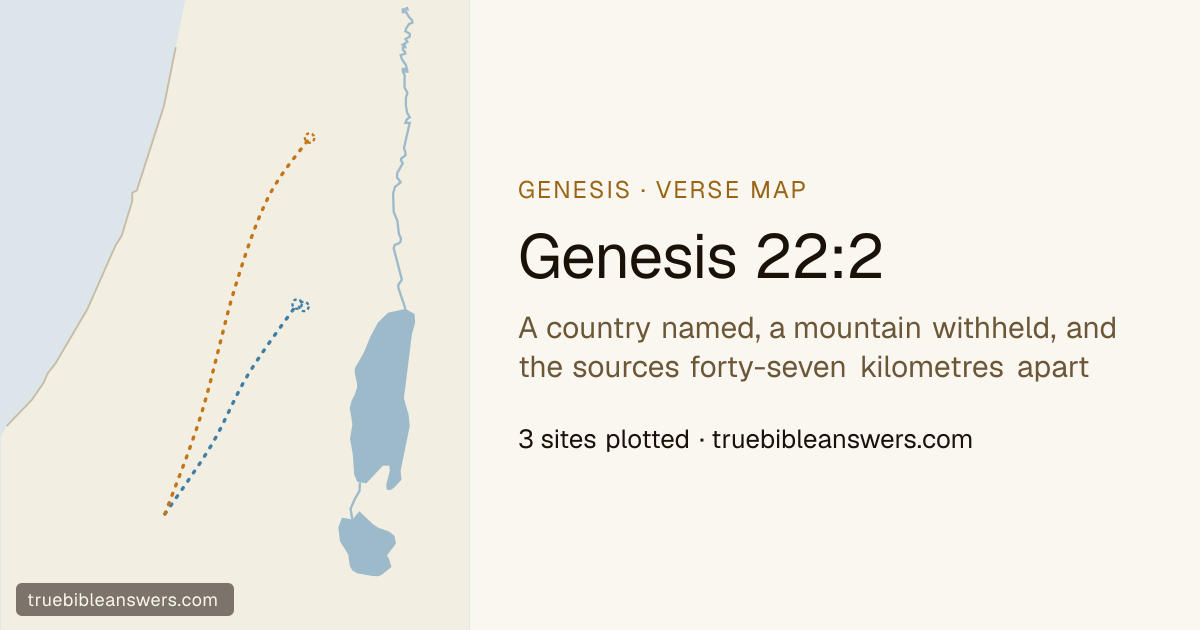
Regions on this map
A country given and a mountain withheld — the one journey in Genesis whose destination is issued in two instalments, the second of them on the road.
Named once in the Bible and nowhere else, and the whole chapter hangs off it. 2 Chronicles 3:1 puts Solomon's temple on Mount Moriah, and 260 votes follow it to the Temple Mount, with 23 more at Al-Eizariya on the far side of the Kidron. The Samaritan reading, with 14, puts it on Mount Gerizim above Shechem, forty-seven kilometres north. A further 28 votes read Moriah as Shechem itself and 10 as Mamre, but each of those identifications resolves several ways at once — it says which other unfixed place Moriah stands beside, not where either of them is — so those 38 are counted at no site on this map and are recorded here instead.
Not pinned: 283 of its 335 votes put it on the Jerusalem ridge and 14 on Mount Gerizim, forty-seven kilometres apart, and a further 38 name no single site at all. The distance between the readings is the length of the walk this verse is sending him on.
Genesis 22:2 in full
- Genesis 22:2He said, “Take your son, your only son Isaac, whom you love, and go to the land of , and offer him there as a burnt offering on one of the mountains of which I shall tell you.”
Where the sources put the contested places
One name on this map carries no pin, because the sources have not settled where it is. Every site proposed is drawn instead, in the colour of the reconstruction it belongs to.
- The Jerusalem ridge
- The majority reading, and the one 2 Chronicles 3:1 hands to it: the mountain is the ridge Jerusalem stands on, and the rock Solomon built the temple over is the rock of this chapter. Two sites carry it — the Temple Mount, and Al-Eizariya a mile and a half east across the Kidron — and between them they hold 283 of the 335 votes.
- Mount Gerizim
- The Samaritan reading, preserved in the Samaritan Pentateuch and in the temple that stood on Gerizim above Shechem. It puts the mountain forty-seven kilometres north of Jerusalem and makes the three days' walk out of Beersheba a genuinely three-day one.
Moriah
Named once in the Bible and nowhere else, and the whole chapter hangs off it. 2 Chronicles 3:1 puts Solomon's temple on Mount Moriah, and 260 votes follow it to the Temple Mount, with 23 more at Al-Eizariya on the far side of the Kidron. The Samaritan reading, with 14, puts it on Mount Gerizim above Shechem, forty-seven kilometres north. A further 28 votes read Moriah as Shechem itself and 10 as Mamre, but each of those identifications resolves several ways at once — it says which other unfixed place Moriah stands beside, not where either of them is — so those 38 are counted at no site on this map and are recorded here instead.
Not pinned: 283 of its 335 votes put it on the Jerusalem ridge and 14 on Mount Gerizim, forty-seven kilometres apart, and a further 38 name no single site at all. The distance between the readings is the length of the walk this verse is sending him on.
The Jerusalem ridge283 of 297 votes
- the Temple Mount, Jerusalem · 260 votes — The largest block by far, and the one with a verse behind it: 2 Chronicles 3:1 builds the temple "on Mount Moriah, where the LORD had appeared to David his father". Jewish, Christian and Muslim tradition have all read this chapter on that rock.
- Al-Eizariya, east of the Mount of Olives · 23 votes — A minority variant of the same reading, a mile and a half east across the Kidron valley. It keeps the mountain on the Jerusalem ridge and moves it off the temple platform, which matters to the argument about whether the site was chosen to justify the temple or the other way round.
Mount Gerizim14 of 297 votes
- Mount Gerizim, above Shechem · 14 votes — The Samaritan reading, held by the Samaritan Pentateuch and by the temple that stood on Gerizim until the second century BC. It has the oldest continuous claim of any rival and it is the only one that makes three days' walk out of Beersheba a natural three days.