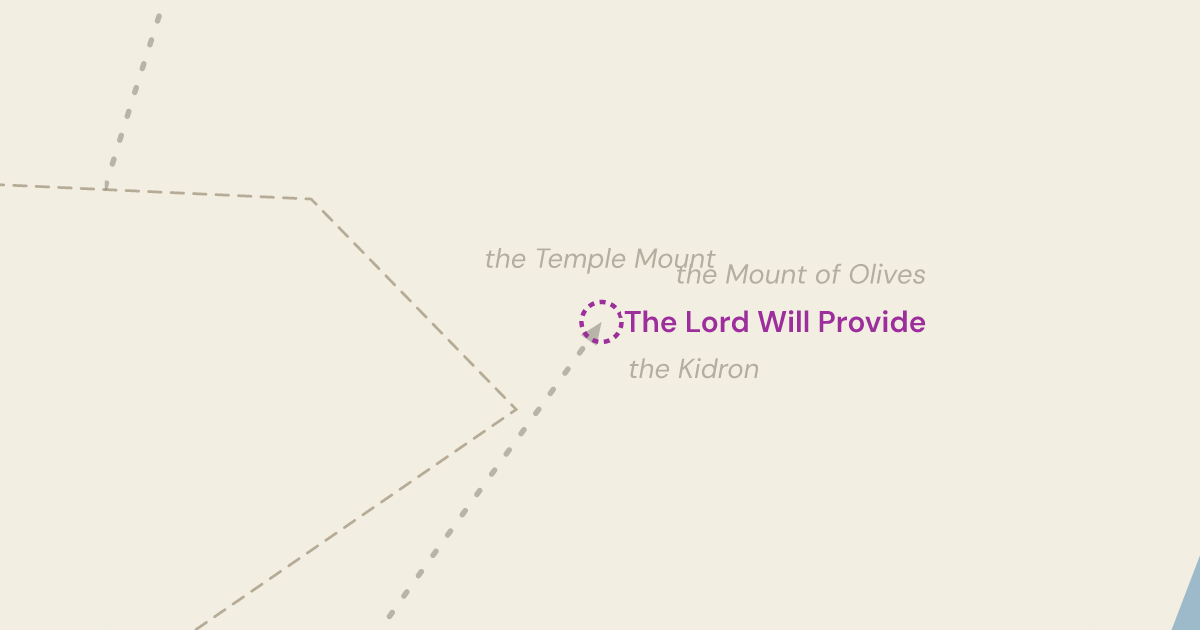
Genesis 22:14: A name given to a place, and the map is not allowed to say which place
Read it →Commentary on Genesis 22:14
God had just stopped Abraham's hand and supplied a ram in Isaac's place. Abraham names the spot for what he was given there, and the name looks ahead as well as back.
The name Abraham gave
The name is one word in Hebrew, and it holds on to what Abraham had just been given.
The Lord provided for Abraham's needs and turned his eyes to a substitute for his son (Gen. 22:13). To keep the memory of it, he called that place "The LORD will provide" (v. 14a), which is just one word in Hebrew, "Jehovah-jireh". Abraham used a compound name of the Lord, and it shows that acting this way is one of His glorious attributes: He provides the lamb for a burnt offering Himself. This wonderful name of God is the first of a series of compound names that God reveals in the Old Testament.
Why the name is joined to "Jehovah"
Jehovah is the name translated "the LORD" here. One writer explains why it keeps taking a second half, and why this one fits this moment.
God took the name Jehovah to show the relationship He would keep up by faith. It means I AM, and faith can add to that "I am — " whatever is needed. It is like a signed cheque left for the holder to fill in the amount he needs… Here the position is one of extreme need — Where is…? — and so we find JEHOVAH-JIREH, I am your provider.
The mount of the LORD
The verse also names a place. Other mountains later carry the same description, and one writer shows where this one stands among them.
We are also told that it is "the mount of the LORD." Later, Mount Sinai and Mount Horeb are called "the mount of God" and "the mount of the LORD," because the phrase speaks of the height from which God deals with mankind. But this mountain speaks of the grace of God in the gift of His Son, and it is named first, because it is nearest to God's heart. The law must take a lower place.
One writer traces this place forward through Israel's later history:
Out of that came a saying that people still used when Moses wrote these things about four centuries later: "On the mount of the LORD it shall be seen," or "shall be provided." That was the language of faith. About four centuries after Moses, the threshing floor of Ornan the Jebusite stood on Moriah. Years later Solomon built his temple there, and so it became the place for Jewish sacrifices. What all those sacrifices pointed to happened "outside the gate," for people rejected the Lord Jesus.
The answer to the name
The name is a promise: it shall be provided. One writer finds the answer in the Son God gave, and marks the one difference between Isaac and Christ.
Isaac was Abraham's "only son"; "God so loved the world that He gave His only Son." There was the answer to JEHOVAH-JIREH. But the picture could not show everything. We have One who was the eternal Son, God shown in the flesh, the eternal Word who "became flesh" — God and Man, one blessed Person, bearing all the wrath of God against sin. Nothing like the ram caught in the thicket by its horns was there to save Him from the judgment of death. So God's righteousness was upheld, and His love could flow out to guilty people.
What the place made possible
The provision here is bigger than the rescue of Isaac. One writer ties this mountain to the whole purpose of God.
God's purposes could be carried out only at Moriah (2 Chron. 3:1). Without the Father's beloved Son (Mark 12:6), there could be no sacrifice for sin. So this place is named: "On the mount of the LORD it shall be provided" (Gen. 22:14)… At Moriah grace met righteousness, and there God found the way (He alone could do it) to make these two attributes of His Being, which seem impossible to reconcile, kiss each other. So triumphant grace reigns through righteousness; so God's purposes are fulfilled!
Where the name was learned
Abraham learned this name at the altar he had built for his own son.
The victim lay bound on the altar. Nearby was the substitute, the ram caught in the thicket, given to take the place of the human life… In God's sight Abraham had completed the act of worship in the presence of His name. There at the altar he learned the name of Jehovah — on the mount of the LORD it was seen. Jehovah was the great Provider, the One Who was everything to Abraham, and Abraham showed this in his act of surrender, his act of worship.
Summary
- Need names Him. "Jehovah" is the "I AM" that faith completes; extreme need drew out the answer, I am your provider.
- Provision means substitute. The name marks a ram given in place of a son — the first of the compound names of God in the Old Testament.
- The mount ranks first. Called "the mount of the LORD" before Sinai ever was, because grace in the gift of the Son stands nearer God's heart than law.
- The promise reaches to the Son. Isaac had a ram; Christ had none — no escape from judgment, so that righteousness was upheld and love could reach guilty people.
- Surrender is where you learn it. Abraham learned this name at an altar, in the act of giving up what he loved most.