Genesis 21:21: Two countries, a marriage, and no road between them the text will name
Read it →"He lived in the wilderness of Paran, and his mother took a wife for him from the land of Egypt." This is where Abraham's story stops being the only one on the page. Ishmael is grown, living in the desert and good with a bow, and his mother goes and finds him a wife — the only marriage in Genesis arranged by a woman, and she arranges it out of her own country. Hagar is an Egyptian; the household brought her back from Egypt in Genesis 12 as part of the payment for a lie. Three chapters after being put out with a skin of water, she is fetching her son a wife from home. The two names on this map are both countries rather than towns, so both are drawn as rings at the point the sources use to stand for a whole region, and the two rings are two hundred and fifty miles apart. Paran is the wilderness of the central Negev and the eastern Sinai — the same country Israel will spend a generation crossing, and Abraham never sets foot in it. Egypt is anchored where every source anchors it, at Heliopolis, under what is now Cairo. The journey between them is the point of the sentence and is given no road at all. Genesis will spend a whole chapter on the servant's ride to Mesopotamia to fetch Rebekah — the camels, the gifts, the well, the conversation with the family — and it gives Ishmael's marriage eleven words and no itinerary. So the line here is a ghost: it says that somebody went, and it does not claim to know how. What comes of it is a nation. Genesis 25 lists twelve princes descended from Ishmael, settled from Havilah to Shur, and the last thing it says of him is that he lived over against all his kinsmen. His father's map and his do not overlap again until the two of them stand at the same grave.
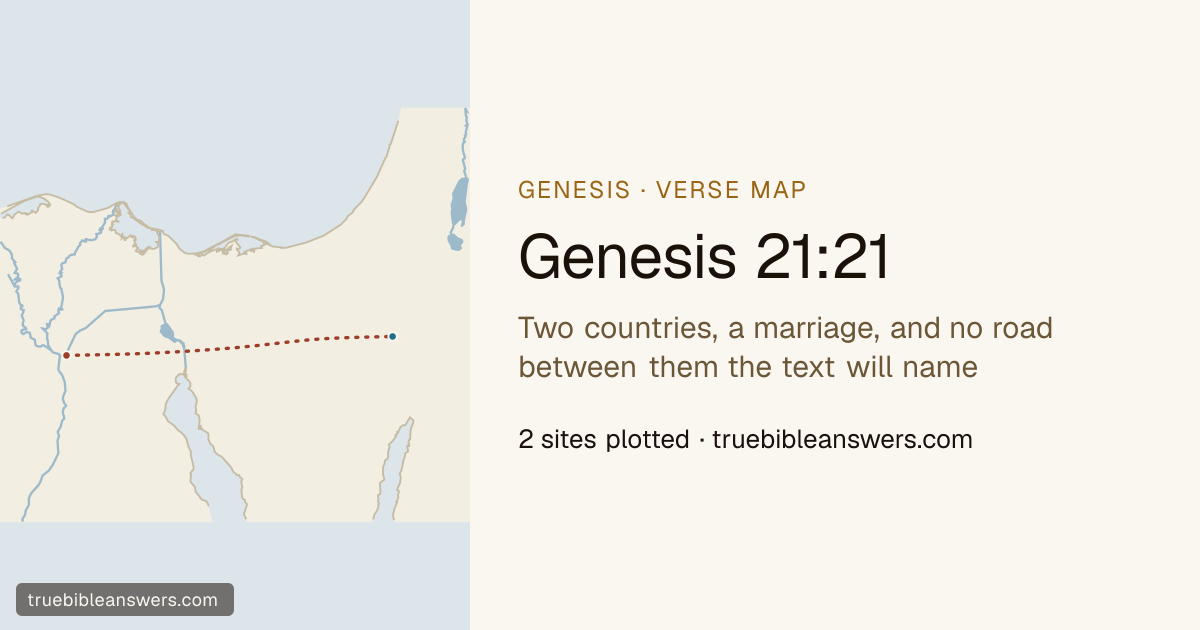
Regions on this map
The wilderness Ishmael grows up in and becomes an expert with the bow in. It is the country Israel will later spend forty years crossing, and Abraham never goes into it.
Where Ishmael settles and grows up. It is a wilderness rather than a place — the sources file one identification for it and fix the whole country with a single representative point in the central Negev, which is why it is a ring here and not a pin. Abraham is named nowhere in this verse and goes nowhere near it in the book.
Today: the Paran wilderness, central Negev (representative point)
Hagar's own country, which the household had passed through a lifetime earlier and brought her out of. She goes back to it for a daughter-in-law, and the text gives the journey no road.
The country Hagar came out of, and the one she goes back to for her son's wife. Genesis 12 brought her north as part of the settlement Pharaoh made when he sent Abram away; nine chapters later she is the one doing the fetching. The sources anchor the whole country at Heliopolis, under modern Cairo.
Today: Egypt, at Heliopolis in Cairo (representative point)
Genesis 21:21 in full
- Genesis 21:21He lived in the wilderness of , and his mother took a wife for him from the land of .