Genesis 21:14: Bread, a skin of water, and a country given instead of a destination
Read it →Commentary on Genesis 21:14
At dawn Abraham obeys a hard command: send Hagar and Ishmael away with bread and a skin of water. Two questions follow — why did the slave's son have to go, and what became of the two Abraham sent out?
Obedience without delay
The command cut against Abraham's heart, yet he did not argue or delay. One writer reads the early start as the measure of his faith.
Here was a severe test for Abraham. The thing was very painful to him because of his son. Yet he responded to it. The renunciation was made. "So Abraham rose early in the morning" — here we see the energy of his faith (Genesis 21:11, 14).
Why the son of the slave had to go
Scripture itself reads this household scene as a picture. The two mothers stand for two covenants, and the two sons cannot share one house.
Abraham's two sons should speak to every believer. One was by a slave, the other by a free woman. One was born after the flesh, the other by promise. The mothers answered to the two covenants: Jerusalem that was in bondage with her children, and Jerusalem above, the free mother of the free... the sentence of Scripture is: Cast out the slave woman and her son, for the son of the slave woman shall not be heir with the son of the free woman. Grace refuses partnership with law or flesh. The child of promise alone inherits.
The same grief in us
One writer turns Abraham's grief on the reader. Giving up the works of our own hands feels like a loss, and he says peace waits on the far side of that loss.
It was 'grievous' indeed for Abraham to cast them out; it went against his feelings and affections to do so. But it was no more grievous for Abraham to do this than it is for us to turn the law out of doors. It clings to us so tightly. It seems so hard for us to give up the works of our own hands, and to renounce what we have prided ourselves on most. But until Hagar is gone, there is and can be no peace in Abraham's house. Until we fully renounce the law, and every expectation from it, there is no peace in the soul. "Being justified by faith, we have peace."
Supplies that run out
Abraham sent them out with real supplies, but not many. One writer reads the emptied water skin as a picture of what life under law could give.
The water in the skin was soon used up. This pictures life under law. There was some ministry of the word of God, but a very limited measure, so that in the end the law itself would lead to death (compare Romans 7:10).
Wandering at the well of the oath
Hagar left with no directions, and the name of the desert she wandered into carries weight.
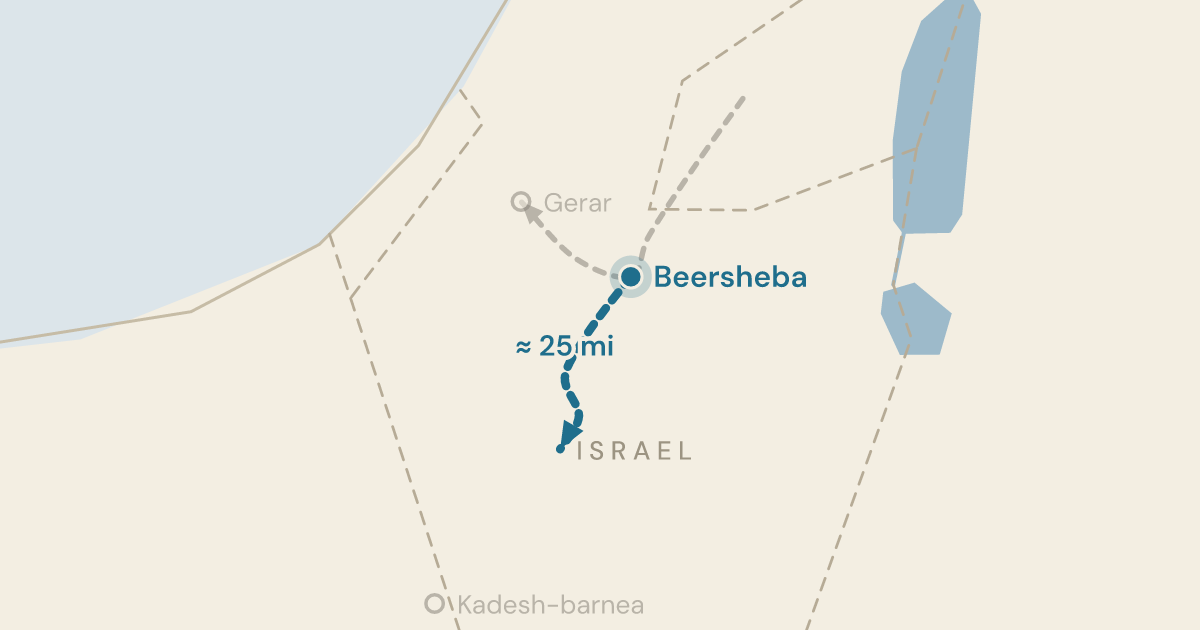
He gave her food and a skin of water, but no direction as to where to go. She wandered in the wilderness of Beer-sheba, which means "well of the oath." It is like Israel, wandering in their present state of independence from God. Yet they wander in the very place that should remind them of God's oath: He will bless them yet, without fail.
Another writer reads the same wandering as Israel's condition today, and says it does not end there.
Cast out, they wander in the wilderness of Beer-sheba, and are nearly perishing of thirst. This I take to be the present condition of Israel. The water, the word of life, is spent for them, and they do not see the well. Yet the oath of God, the covenant with their fathers, secures it for their final possession. Their eyes shall yet be opened to it.
Sent out, but not abandoned
Hagar's name suited her: she became a wanderer. But being outside the house of faith did not put her and her son outside mercy.
True to her name the poor woman became a wanderer in the wilderness. Soon all their slender supplies were gone, and the boy came almost to the point of death... Hagar and Ishmael carried this unhappy meaning in the picture, and in themselves they belonged to the world, not to the house of faith. Yet they were needy creatures, and as such objects of mercy.
Summary
- Sent early — Abraham rose at dawn, though the command went against his affections. That early start is the energy of his faith.
- Cast out — the slave's son could not share the inheritance. Grace and law cannot run one household, and the child of promise alone inherits.
- Spent — one day's bread and one skin of water show how little the law supplies, and where it leaves those who lean on it.
- Wandering — she is lost in Beersheba, "well of the oath": the very ground named after the promise she cannot yet see.
- Seen — outside the house of faith, they were still objects of mercy. The well was there all along, and one day they will see it.