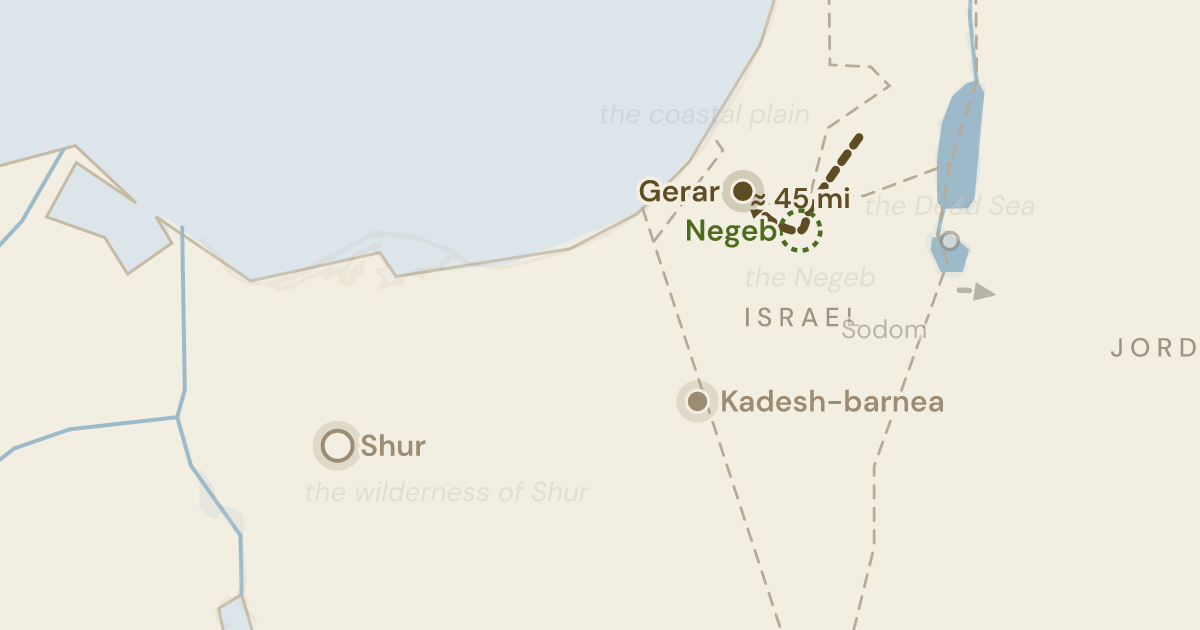
Genesis 20:1: Four place names in one sentence, and the whole of a move in it
Read it →Commentary on Genesis 20:1
Abraham leaves the place where he had prayed for Sodom and settles as a stranger in Gerar, a Philistine town. The verse reads like a travel note, but commentators see in it the first step of the fall that follows.
A move away from the place of intercession
Just before this, Abraham had prayed before the Lord for Sodom. One writer links what follows to the ground he left behind.
Yet a marked season of favour and blessing may come just before a great humiliation through carelessness and sin. So it was now with Abraham, as he lived as a stranger in the land of the Philistines. Was it that he too, like Lot, was afraid to stay under the shield of the Almighty after seeing the recent judgments? What is certain is that he travelled away from the place where he once stood before the Lord in intercession. From that same place, a little later, he had looked with awe at the ruined plain, where the smoke of the country went up like the smoke of a furnace.
The word "sojourned"
The verse says Abraham "sojourned" in Gerar. One writer shows why that word is not the same as settling down.
Following all this comes the very important and characteristic word "sojourn" (Genesis 20:1). It means day-staying, in contrast to "dwelling," which is permanent. Both words occur often throughout the Old and New Testaments, carrying important principles. So Peter urges believers, as sojourners and pilgrims, to abstain from the passions of the flesh, and to spend the time of their sojourning here in fear. They are to be only travellers in this world. They must not make it their home or dwelling place. On the other hand, these pilgrims dwell in God, and His word dwells in them, and His Spirit dwells in them.
Between Kadesh and Shur
One writer reads the verse by what each place name means.
He journeyed toward the south, which is typical of pleasant circumstances, but nearly always having danger in it. He dwelt between Kadesh and Shur. Kadesh means "set apart for a purpose," which beautifully describes God's work with Abraham, and is true of all Christians too. But Shur means "point of observation." Does this not tell us something? We know we are set apart for God, yet we sometimes look the other way to see what others may be doing.
The name of the town he moved into carries a warning too.
Is it surprising that after this he lived as a stranger in Gerar? Gerar, a Philistine city, means "dragging away." If our own observation leads us, we are always likely to be dragged away from the place of devoted separation to God.
Gerar and Egypt
Years earlier Abraham had gone down to Egypt. One writer compares the two places while commenting on Isaac's later visit to Gerar.
There is an obvious difference between Egypt and Gerar. Egypt expresses the world in its natural resources and its independence of God... Egypt lay further from Canaan than Gerar, and in moral terms it pictures a soul further from God... So Gerar was a step forward from Egypt. But it still lay within reach of very dangerous influences. Abraham got into trouble there, and so does Isaac in this chapter, and in exactly the same way.
An old weakness, untouched for years
One writer explains how a fault can stay out of sight for years.
It is remarkable to watch Abraham coming up out of Egypt — building an altar and pitching a tent... entertaining the heavenly visitors and interceding for his brother Lot. He passed through such brilliant scenes over a series of years. All that time this moral point, in which he had erred at the very start of his course, remained unsettled in his heart. True, it did not show itself during that period, but why not? Because Abraham was not in circumstances that called it out — yet it was there all the same.
Another writer looks past the personal failure to what the enemy was aiming at.
Then, under the stress of famine, he had turned aside from the land and slipped into Egypt. Here, without any such trying circumstances, but simply from fear of man, he denies the one through whom God had definitely assured him the promised heir would come. In one case he gives up the testimony of the inheritance; in the other he clouds the testimony to the heir. Then, as now, behind every failure of the people of God the enemy is attacking some great truth connected with their calling.
Summary
- Step — Abraham leaves the place where he had stood before the Lord in prayer. A high season of favour can come just before a deep fall.
- Stranger — "Sojourn" means day-staying, not dwelling. Believers travel through this world; God, His word and His Spirit dwell in them.
- Drift — He camps between Kadesh ("set apart") and Shur ("point of observation"), then ends up in Gerar ("dragging away"). Watching others drags you out of separation to God.
- Border — Gerar stands nearer to God than Egypt, yet still within reach of dangerous influences. Abraham and Isaac both fell there in the same way.
- Root — A weak point can lie unsettled through years of brilliant service until circumstances touch it. Through it the enemy attacks a great truth of our calling.