Genesis 19:30: The last movement in the story of the plain, and it is uphill
Read it →"Now Lot went up out of Zoar and lived in the hills with his two daughters, for he was afraid to live in Zoar. So he lived in a cave with his two daughters." This is where Lot's journey ends, and the whole shape of it is in the verb. He came down. He looked east from the ridge above Bethel at a valley that was well watered everywhere, went down into it, pitched his tent as far as Sodom, ended up sitting in its gate, and was pulled out of it by the hand at dawn. He begged for the little city because he could not face the hills, was given it, and inside a few verses he is afraid of that too, and goes up into the hills after all — the exact hills the angel told him to run to in the first place, arriving there without a town, without a wife, and living in a cave. The map is the only one in this series where the two readings of Zoar are not an academic matter. On the majority identification Zoar stood on the drowned plain south of the Lisan, and there is nothing behind it to go up into — the ground is under the sea and the escarpment is miles away. On the other, Zoar is Ghor es-Safi at the south-east corner of the sea, and the Moabite wall rises two and a half thousand feet directly behind the oasis within three miles of it. Only one of the two readings has a hill in walking distance, so only one of them has a line on this map. The cave is not named and cannot be placed. The leg runs out into the escarpment and stops, which is as much as the verse says.
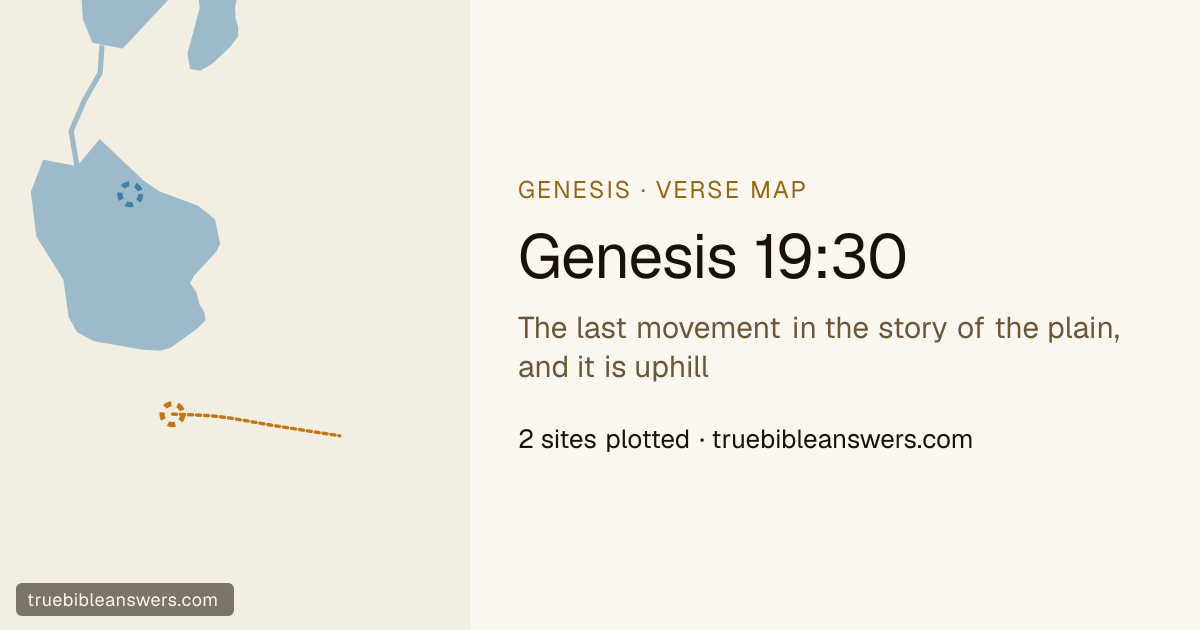
Regions on this map
The last of Lot's movements, and the first one in his story that goes uphill. He asked for a town rather than the hills, was given it, and left it within days for the hills anyway.
Named twice in one sentence, both times as somewhere he could not stay. It had been granted to him the previous morning because he was afraid of the hills; now he is more afraid of it than of them. Where it stood decides whether this verse is even walkable: 466 votes put it on the drowned plain with the other cities, and 305 at Ghor es-Safi, where the Moabite escarpment stands three miles behind the town.
Not pinned: 466 of its votes put it on the plain south of the Lisan, now under the water, and 305 at Ghor es-Safi twelve miles further south — and only the second of those has hills a frightened man could reach on foot.
Genesis 19:30 in full
- Genesis 19:30Now Lot went up out of and lived in the hills with his two daughters, for he was afraid to live in . So he lived in a cave with his two daughters.
Where the sources put the contested places
One name on this map carries no pin, because the sources have not settled where it is. Every site proposed is drawn instead, in the colour of the reconstruction it belongs to.
- Under the southern basin
- The majority reading, on which Zoar stood with the other cities of the plain on the flat ground south of the Lisan and the Dead Sea has since risen over it. It explains why no tell has ever been agreed for any of the five, and it leaves this verse with nowhere to walk up out of.
- Ghor es-Safi
- The oasis at the sea's south-east corner, where the Wadi Hasa comes down off the plateau. Byzantine pilgrims knew it as Zoar and built a church on it, and the Moabite escarpment stands directly behind it — which is the only place on this frame that the hills of this verse can be.
Zoar
Named twice in one sentence, both times as somewhere he could not stay. It had been granted to him the previous morning because he was afraid of the hills; now he is more afraid of it than of them. Where it stood decides whether this verse is even walkable: 466 votes put it on the drowned plain with the other cities, and 305 at Ghor es-Safi, where the Moabite escarpment stands three miles behind the town.
Not pinned: 466 of its votes put it on the plain south of the Lisan, now under the water, and 305 at Ghor es-Safi twelve miles further south — and only the second of those has hills a frightened man could reach on foot.
Under the southern basin466 of 771 votes
- the plain south of the Lisan · 466 votes — The largest block of votes, and the same point the sources give Sodom and Gomorrah. It puts Zoar out on the flat, with the nearest high ground a long way off in any direction, which is hard to square with a man walking up into the hills the same week.
Ghor es-Safi305 of 771 votes
- Ghor es-Safi · 305 votes — The oasis at the mouth of the Wadi Hasa, with the Moabite escarpment rising two and a half thousand feet within three miles of it. Byzantine tradition knew this as Zoar, and it is the only candidate with caves above it.