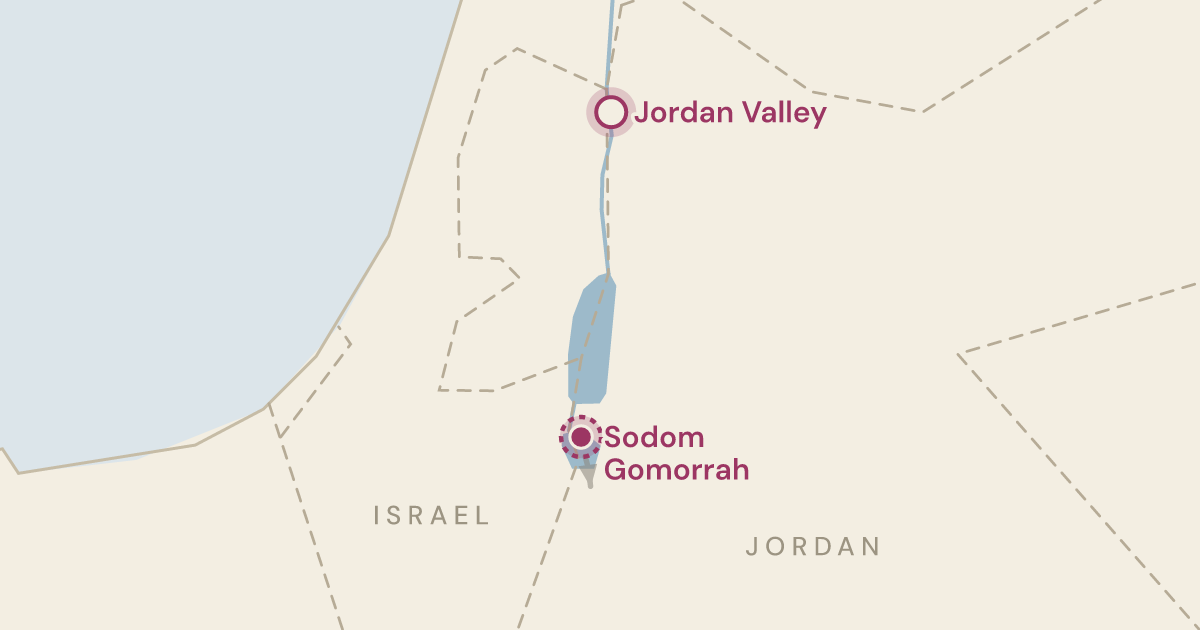
Genesis 19:28: Abraham's own verse in the chapter, and he is thirty miles away in it
Read it →Commentary on Genesis 19:28
The morning after fire fell, Abraham walks back to the spot where he had pleaded with God the day before. From that height he looks down on the burning plain — and where he stands matters as much as what he sees.
The Place He Went Back To
Abraham does not return to a random lookout. He goes back to the place of his prayer. Commentators read what he sees as the fruit of that pleading.
Abraham kept on pleading, though he stopped short of the fullness of God's mercy. We do not know all that He is going to do, as God does. Still, we may intercede with faith. Abraham grows bold as he goes on; his confidence increases. As a result he knows God much better than before. The peace of God kept his heart. The fruit of it all appears in Genesis 19:27-28. Abraham gets up early in the morning and goes to the place where he stood before the Lord. He looks down on the plain, now smoking like a furnace. From far above he sees the effects of the utter destruction. Such is our position if we are heavenly. That is how we see the judgment of the wicked.
What Met His Eyes
The plain below had once been the most attractive land in sight.
Where were those well-watered green pastures that looked like the garden of the Lord, and had attracted the worldly eyes of Lot? An immense black, desolate, charred plain was all that met Abraham's eyes. Rising from it was the smoke of Sodom and Gomorrah, like the smoke of Babylon the great that will rise at a future and not very distant time. The proud cities were now ashes. The alluring green shoots, blossoms and fruits of those treacherous pastures and gardens had become smoke.
A furnace was a familiar sight in daily work, and the word carries more weight elsewhere in Scripture:
People used furnaces for many purposes: smelting raw metal, refining metal in crucibles, making lime and bricks, and baking as an oven. Genesis 19:28; Exodus 9:8, 10; Proverbs 17:3. … In the New Testament the furnace of fire refers to the place of eternal punishment. Matthew 13:42, 50.
Watching From Above, Not From Within
Abraham's safety here was of a higher order than a rescue.
This is still elevation of the highest order. This is heaven's relationship to judgment, God's own relationship to it. Abraham was not rescued out of it like Lot. He was not taken calmly through it like Noah. He was not carried away before it came like Enoch. Beyond them all, he is given heaven's own place in relation to it. He looks down on it carried out on others, having nothing whatever to do with it.
That place also shaped how Abraham felt on the morning after.
As regards his own position, he is looking down on the place of judgment. In the morning, when the cities are in flames, he finds himself in quietness and peace on the spot where he "stood before the Lord" (v. 27). He is not at all in the place where the judgment had come. The scene before him sobers him, yet he is calm and happy with the Lord.
Why He Had Nothing to Lose
Earlier, Abraham had refused any share in Sodom's wealth. That old refusal is what leaves him with nothing burning in the plain below.
He had always lived as a stranger in the land. In the days of Chedorlaomer that had let him live outside Sodom and all its circumstances. It still kept him free, and it was the means of his escape from Sodom's unspeakable misery. The king of Sodom once asked Abraham to take a share in the things of Sodom. Had he agreed, he would have shared to some degree in its overthrow, as his brother Lot did. He himself would have been saved, but his work would have been burnt up.
A Smoke That Still Speaks
The smoke Abraham saw pointed past the four cities that made it.
The miracle was fire from the Lord out of heaven. It started the mighty blaze and eruptions that blasted these four cities out of existence. Their sites remain to this day as "an example of what is going to happen to the ungodly" (2 Peter 2:6). … This judgment was also a sample of what is yet to come on a much greater scale, in "the day of judgment and destruction of the ungodly" (2 Peter 3:7).
Summary
- The place. Abraham goes back to the exact spot where he had prayed. The place of his praying becomes the place of his seeing.
- The peace. Standing there he is calm and happy with the Lord, sobered by the scene but untouched by it.
- The position. He is not pulled out of the judgment like Lot. He is not carried through it like Noah. He is given heaven's own place above it.
- The price of choosing. Lot's green plain is now a charred waste. Abraham had refused Sodom's goods, so he has nothing burning below.
- The preview. The smoke going up like a furnace stands on record as an example — a small sample of the day of judgment still to come.