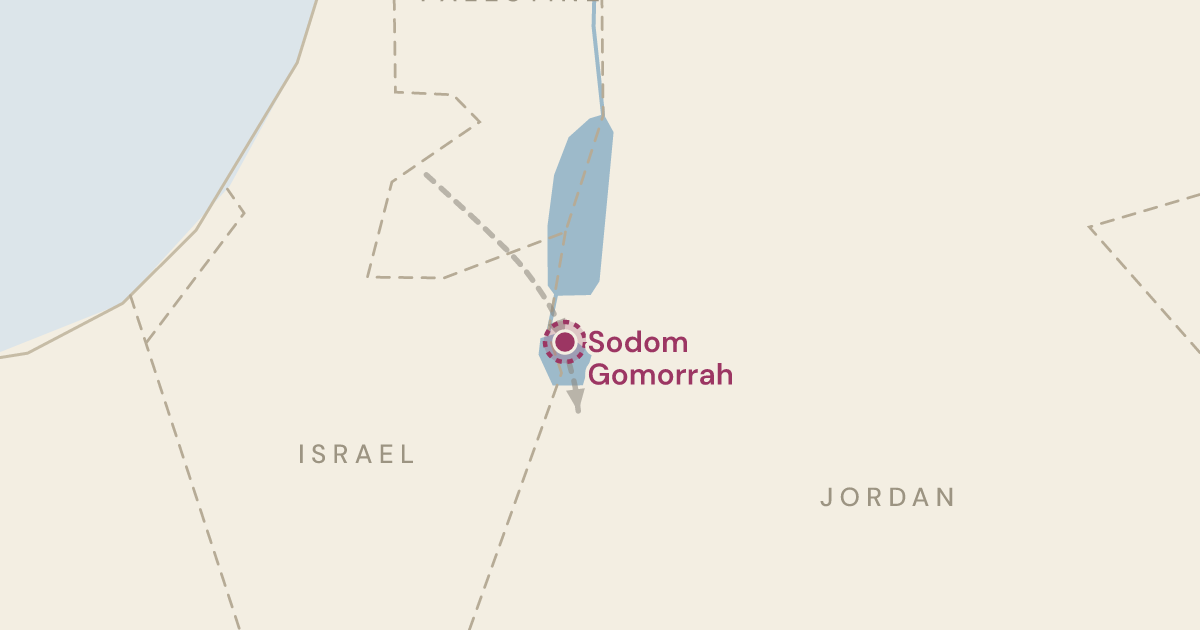
Genesis 19:24: The single event the whole southern Dead Sea frame exists for
Read it →Commentary on Genesis 19:24
Fire falls on Sodom the morning after the angels pull Lot out. The wording is strange — the LORD rains it from the LORD — and commentators ask two things: what that doubled name shows about God, and what this ruined plain still warns us about.
The LORD from the LORD
The verse names the LORD twice — once acting on earth, once sending from heaven. Where the ESV prints "the LORD," older translations use the name "Jehovah":
Notice verse 24. "Then the LORD rained on Sodom and Gomorrah sulfur and fire from the LORD out of heaven." Here was a Jehovah on earth and He called to Jehovah in heaven.
This is not two Gods. Scripture holds to one God only, yet with distinct Persons in the Godhead — and this verse hints at what the New Testament later states openly:
Though there is but one God (Deuteronomy 6:4), and no other (Isaiah 43:10), there are distinct Persons in the Godhead. The Old Testament already knew this truth. There we read (Genesis 19:24), "Then the LORD [that is, Jehovah] rained on Sodom and Gomorrah sulfur and fire from the LORD [that is, Jehovah] out of heaven." Yet only the New Testament taught it as doctrine, after Christ came in flesh. Other scriptures pointed to it as well, as New Testament teaching makes plain — Psalm 45, 102 and 110, and Daniel 7:13, which the Lord quoted, and which His hearers took to refer to a Divine Person.
after-reason: n/a
Brimstone and fire
The ESV calls it sulfur; older translations say brimstone. Scripture keeps coming back to it:
Bitumen, pitch, or sulphur, which is still found in its raw state in Palestine. God rained it down from heaven in judgment. Genesis 19:24; Psalm 11:6; Ezekiel 38:22; Luke 17:29. It is a symbol of what will add to the torment and anguish of the wicked.
How it fell
The text says what fell and who sent it. It never says how:
Judgment from God falls suddenly, as brimstone and fire, like what a volcanic eruption might produce. But we are not told how this terrible disaster came. Some would die at once. No doubt others had time to realise that God was punishing them for their gross wickedness. But it was too late to escape. The judgment and desolation was total.
The timing of the fire
The angel had said he could do nothing until Lot reached Zoar. The delay shows a principle, not a limit on God's power:
The word of the angel in verse 22 is worth noting: "I can do nothing till you arrive there." Why "cannot"? Not because power was lacking to act in judgment, but because it is a fixed principle of God's ways that eternal, punishing wrath must never touch His people. The judgment on these cities was not only God acting as ruler of the world; real punishment was involved, as Jude 7 shows. That vengeance of eternal fire could not possibly touch Lot, since he was a righteous man, though a misguided one.
The timing runs both ways: the fire waits for Lot, then waits no longer:
The sun had risen on the earth as, after this, Lot entered Zoar. And yet that sunny hour was the very time for the rain of brimstone and fire to fall. Nothing could happen till Lot entered the city, but once he was inside, nothing held the fire back.
What was left
One writer measures the destruction by what is missing today:
Almost in a moment, God's judgment wiped several once prosperous cities out of existence. The ruin was so complete that today we cannot be sure where they stood. Well may the apostle exclaim, "It is a fearful thing to fall into the hands of the living God" (Hebrews 10:31).
A small-scale preview
Why does this story stand so early in the Bible? One writer answers:
God has not left Himself without witness, on a small scale, of what He plans as punishment for the ungodly who choose to ignore His warning... The book of Genesis itself records how God destroyed the cities of the plain, not long after the flood. Their impurity was so great that it went against fallen nature itself.
Two men, two positions
Both men come through the fire, but not in the same place. One writer draws the contrast:
Abraham is again in that high place, watching the desolation from far off. He was, in the spirit of the place where he stood, in the company of the One who was carrying out the judgment. But Lot is only rescued. Lot is a delivered man; Abraham is a separated one.
Summary
- Source — The LORD rains it from the LORD. One God, yet distinct Persons — hinted here, taught openly only in the New Testament.
- Substance — Brimstone is sulphur. Scripture keeps it as the symbol of the torment of the wicked.
- Sequence — The fire could not fall until Lot was clear. Eternal wrath never touches God's people.
- Scale — God erased the cities so completely that no one is sure today where they stood.
- Sample — Sodom is a small-scale witness of the judgment God plans for the ungodly. Abraham watched it from the height; Lot escaped it just in time.