Genesis 16:7: A pregnant slave running for Egypt, and how far she got
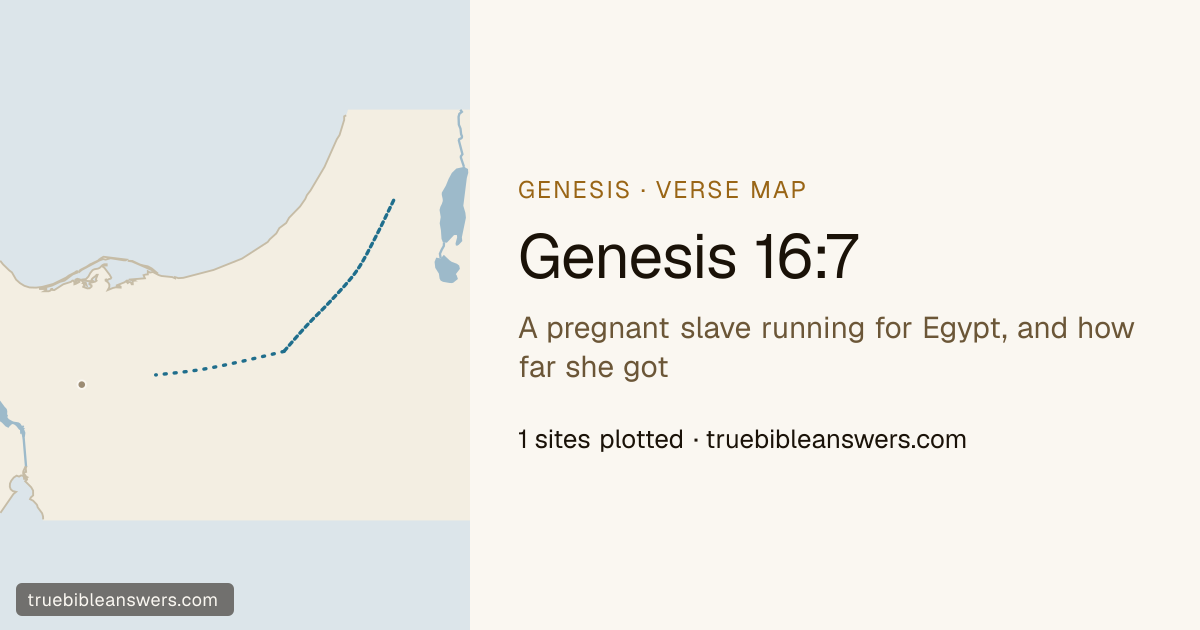
Read it →"The angel of the LORD found her by a spring of water in the wilderness, the spring on the way to Shur." Sarai has dealt harshly with her and she has run, and the verse fixes where she was caught by naming the road she was on. Shur is the wilderness on the Egyptian frontier, and nobody in Genesis ever arrives there — it is a bearing three times over and a destination none of them. Hagar is Egyptian. She is walking home. The distance is the point of the map. From the oaks of Mamre, where Abram's tent is, to the spring is about fifty miles of falling country: out of the Hebron hills at three thousand feet, down through the Negev, and into the open desert south-west of Beersheba. On foot and pregnant that is four or five days. From the spring on to the Egyptian frontier is another eighty miles of nothing, and beyond that the Nile — so she has come far enough to be out of reach and nowhere near far enough to be safe. A woman alone on that road in the second millennium BC had a poor set of odds either way. The spring is not named in this verse. It is named seven verses later, when she gives it a name herself — Beer-lahai-roi, the well of the Living One who sees me — and the map of that sentence is next in this walk. Here it is just water in a wilderness, at the one point on a long empty road where you would stop, which is presumably why the road goes past it and why the angel found her there rather than anywhere else. The unbroken line is the fifty miles she walked. The faded one is the rest of the road to Shur — a course she was on and never finished, drawn the way this series draws every intended journey nobody completes. She is sent back in the next verse, and the son she is carrying is born in Abram's household.
Regions on this map
Fifty miles from the tent at Mamre to a spring in the open desert, and eighty more to the frontier she was making for. The solid line is what she walked; the faded one is the road she was still on when the angel found her.
The wilderness on Egypt's doorstep. Genesis names it three times as a bearing — the way to Shur, between Kadesh and Shur, from Havilah to Shur — and nobody in the book ever gets there.
The wilderness between the Negev and the Egyptian border, and the road across it is the one Hagar is on. It is always a bearing in Genesis and never an arrival: the spring where she is found is "on the way to Shur", Abraham later lives "between Kadesh and Shur", and Ishmael's sons settle "from Havilah to Shur". 298 of its 367 votes are for the same stretch of north-western Sinai.
Today: the wilderness east of the Egyptian frontier (representative point)
Genesis 16:7 in full
- Genesis 16:7The angel of the LORD found her by a spring of water in the wilderness, the spring on the way to .