Genesis 15:18: A grant with two rivers on it, and nothing said about the edges in between
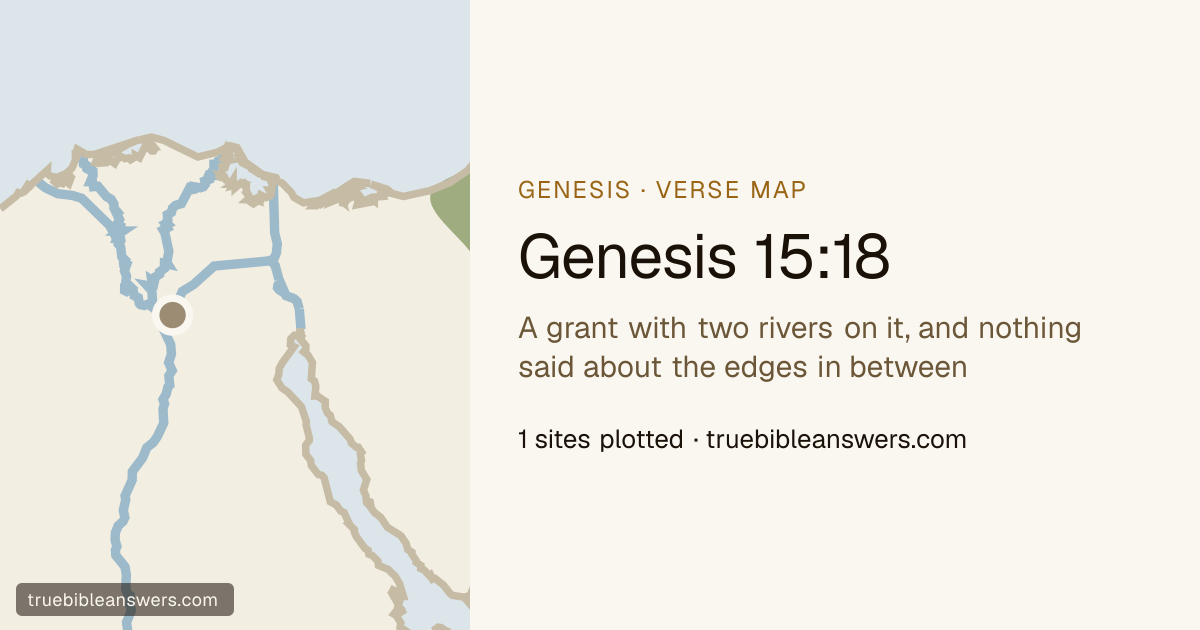
Read it →"On that day the LORD made a covenant with Abram, saying, 'To your offspring I give this land, from the river of Egypt to the great river, the river Euphrates,'" This is the most map-shaped sentence Abraham is ever given. Everything else he is promised is measured in people — offspring like the dust, like the stars, too many to count — but here the promise is measured in ground, and the ground is fixed by naming the two rivers at either end of it. Nothing in the verse moves. Abram has spent the chapter cutting animals in half and laying the pieces opposite each other, and has fallen into a deep sleep; a smoking fire pot and a flaming torch pass between the pieces, and the covenant is cut. Then the boundaries. The distance is the thing a map can say and a paragraph cannot. From the Egyptian frontier to the Euphrates is roughly seven hundred miles as the road runs, and Abram at this point owns none of it: he is a resident alien living in a tent under some oaks near Hebron, with one nephew, no children, and a household slave from Damascus down as his heir. He will die owning a field with a cave in it, bought for four hundred shekels, and nothing else. The gap between the frame of this map and the plot of ground in Genesis 23 is the whole of what the covenant is asking to be believed. Which river of Egypt is a real question and an old one. Everywhere else the frontier is the *brook* of Egypt — the Wadi el-Arish, a dry riverbed fifty miles south-west of Gaza that runs only after rain, and the border between Canaan and Sinai in Numbers, Joshua and Kings alike. Genesis 15:18 uses the other word, the one for a great river, and pairs it with the Euphrates in the same breath; some readers take it for the Nile itself. Both lines are on this map — the Nile with its delta, and the wadi as a thin line running north-west out of the Negev to the sea. The land between them is drawn as a haze with no edge anywhere, because the verse gives two limits and no border. Where the northern edge runs, where the eastern one falls short of the Euphrates, whether the desert in the middle is included at all — none of that is in the sentence, and a firm line would be an invention. Only the rivers are drawn hard, because only the rivers were said.
Regions on this map
Seven hundred miles of it, end to end, promised to a man with no children who owns nothing in it. Every edge here is soft: the verse fixes two rivers and says nothing whatever about what happens between them, so the map fills the middle with a haze rather than a frontier.
Named as limits and nothing else. Abram does not go to either of them in this verse, and the only one of the two he has ever seen is the one he was escorted out of a chapter and a half ago.
Named here for its river rather than for itself. Abram had gone down into it in the famine and come out richer than he went in, and it is the one landscape in his experience that is green without rain; now it marks the far end of the promise in the other direction from the Euphrates. Whether the river meant is the Nile drawn here or the Wadi el-Arish fifty miles south-west of Gaza has been argued since antiquity, and the map draws both.
Today: Egypt, at Heliopolis in Cairo (representative point)
"The great river", which is how the verse distinguishes it from the other one it has just named. It is also the road the family actually walked out on — nobody crosses the Arabian desert, so the way from Ur to Haran runs upstream the whole distance — and Abram has therefore already seen nine hundred miles of the boundary he is being promised, from the wrong side of it.
a river is a line, and this frame draws the whole of it; the gazetteer's single point for the name is the mouth on the Persian Gulf, which is not the reach Genesis 15:18 means
Genesis 15:18 in full
- Genesis 15:18On that day the LORD made a covenant with Abram, saying, “To your offspring I give this land, from the river of to the great river, the river ,