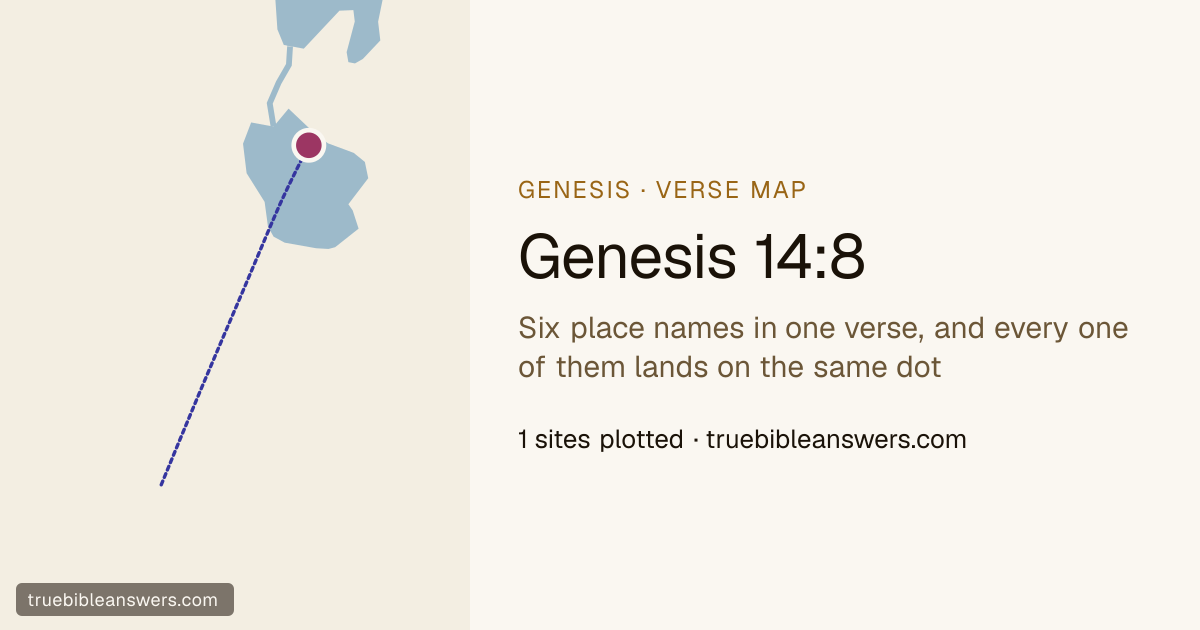
Genesis 14:8: Six place names in one verse, and every one of them lands on the same dot
Read it →"Then the king of Sodom, the king of Gomorrah, the king of Admah, the king of Zeboiim, and the king of Bela (that is, Zoar) went out, and they joined battle in the Valley of Siddim." Five cities and a battlefield are named in a single sentence, and this map is honest about the result: they all resolve to one point. That is not a shortcut. The cities of the plain are among the most argued-over places in the Bible — nobody has found them, the candidate sites run from the north end of the Dead Sea to the south, and one long-standing reading puts the whole plain under the shallow water at the sea's southern end, which would explain why there is nothing to find. The sources behind this map put them together at the southern end and decline to separate them, so Sodom carries the pin and the other four stand on it as open rings. What the map can show is the shape of the moment. The five kings do not wait to be besieged; they go out. The valley they go out into is the flat ground at the foot of the rift, and the next verses say what is in it — bitumen pits, so many that the fleeing kings fall into them. Asphalt still surfaces in the Dead Sea; the Greeks called it Lake Asphaltites for that reason. An army that knows the ground has chosen where to fight, and it does them no good. Bela is given its other name in passing — "that is, Zoar" — and Zoar is the one city of the five that survives Genesis 19, because Lot begs for it as somewhere small enough to be spared. Four verses later the winners take the plunder, and the people, and one of the people is Lot.
Regions on this map
The last leg of a campaign that has gone the whole way round its target: down from the spring at Hazazon-tamar to the flat ground at the foot of the rift.
Sodom, Gomorrah, Admah, Zeboiim and Bela — the plain Lot chose one chapter ago, on the strength of a view from the ridge above Bethel. They do not wait to be besieged.
One of the two cities of the plain that are usually forgotten. Hosea remembers them: "How can I make you like Admah? How can I treat you like Zeboiim?" — proof that the destruction of all four was a fixed memory, not just Sodom's.
no point of its own; the sources resolve it to the same site as Sodom
Sodom's twin, named with it almost every time either is named, and destroyed with it in Genesis 19.
no point of its own; the sources resolve it to the same site as Sodom
The first king named and the leading city of the five. Where it stood is genuinely unknown: candidates run the length of the Dead Sea, and one long-held reading puts the plain beneath the shallow water at the southern end. It carries the pin here because the sources give the whole group one point and it is the name the group is known by.
Today: unidentified; sited at the south end of the Dead Sea (representative point)
The fourth city, named in Genesis only in this chapter and in the table of Canaanite borders, and remembered afterwards only alongside Admah.
no point of its own; the sources resolve it to the same site as Sodom
Bela, and the verse stops to give its other name. It is the one city of the five with a future: in Genesis 19 Lot begs to be allowed to run to it rather than the hills — "Behold, this city is near enough to flee to, and it is a little one" — and it is spared.
no point of its own; the sources resolve it to the same site as Sodom
The ground they chose to fight on, and it is full of bitumen pits — the next verses have the fleeing kings falling into them. Asphalt still rises out of the Dead Sea, which is why the Greeks called it Lake Asphaltites.
The battlefield, and the only place in the Bible with this name. Verse 10 describes it: "Now the Valley of Siddim was full of bitumen pits, and as the kings of Sodom and Gomorrah fled, some fell into them." Verse 3 has already said what became of it — "that is, the Salt Sea".
no point of its own; the sources resolve it to the same site as the cities that fought in it
Genesis 14:8 in full
- Genesis 14:8Then the king of , the king of , the king of , the king of , and the king of Bela (that is, ) went out, and they joined battle in the