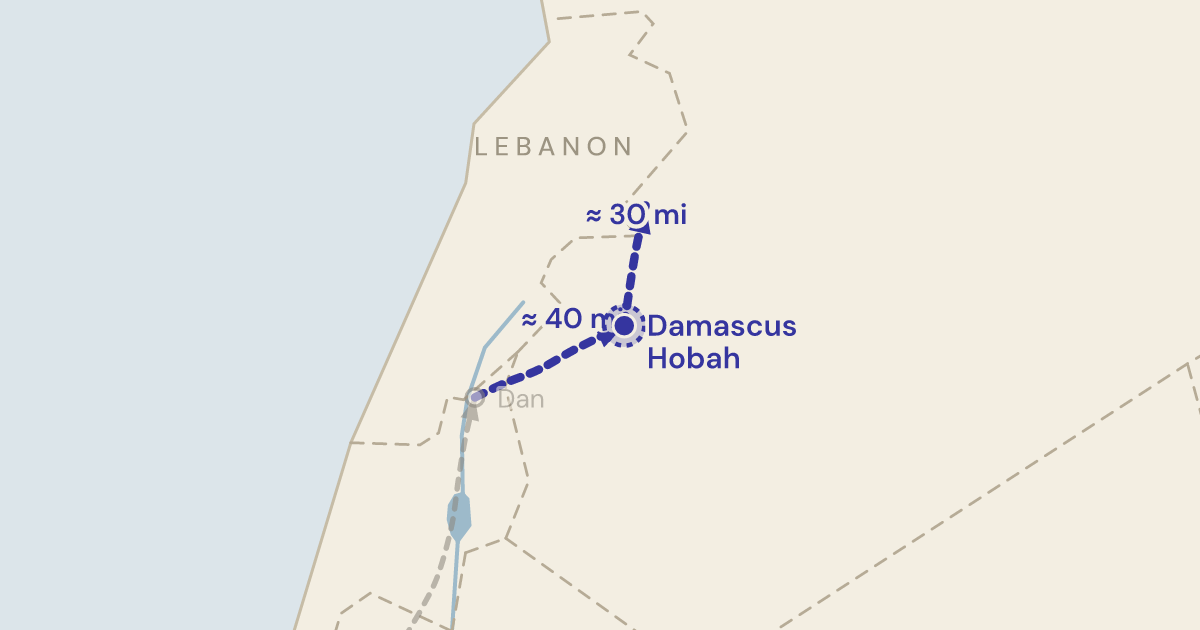
Genesis 14:15: He divided his forces by night, and did not stop at the border
Read it →Commentary on Genesis 14:15
Four conquering kings are heading home with plunder and captives. One of the captives is Abram's nephew Lot, and Abram has chased the kings the length of the land. This verse is the whole battle in one line. How does a man with 318 servants overturn an army fresh from crushing five kings?
A victory that does not depend on numbers
Abram's force was tiny beside the armies he attacked.
One verse (v. 15) is enough to describe the battle of Abram with the four kings, and his decisive victory. No doubt his adversaries far outnumbered his force of 318 men, but the Lord does not depend on numbers. God rewarded Abram's faith by making his enemies flee as he pursued them for a long distance, to north of Damascus.
Another writer looks at how quickly Abram moved, and at what the small number proves.
Abram acted with great decision as soon as the news of this disaster reached him. He armed his servants, went after the victorious kings, caught up with them by night, and utterly defeated them. We are told nothing about the number of the enemy, but we are told the small number of Abram's forces — 318 besides himself. We are told this, we believe, to show that very extraordinary faith prompted Abram's action. The army he attacked must have been far stronger than his. It was also flushed with victory all along the line up to that point. Yet he did not hesitate, and God was with him.
The stranger and the conquerors
Abram was a private man with a household, not a king with an army.
Here were victorious kings marching home with their armies. And here was a private individual, a pilgrim and a stranger. God so led and strengthened him that the victors are defeated in their turn, and the failing believer rescued.
The chapter sets the two men against each other.
But renouncing the world is the path to victory over it; the choosing of it is captive subjection to its power. Lot is carried away captive by the powerful ones of the earth, along with those among whom his worldly leanings had led him. Abram is free and walks in the faith of God. He has more force from Him than all the kings, conquerors or conquered. He delivers Lot, and he delivers the kings who could not help themselves.
What set him marching
Abram had every reason to leave Lot to the results of his own choice, and did not.
What was no small rebuke to Lot became the occasion for Abram to come out as one who walked with God and trusted Him. He also shows us that power of grace which rises above whatever had been wrong in a person. There was no doubt about Lot's failure in testimony. But Abram thought nothing about his faults now.
The same writer turns that motive into a question for the reader.
Do we have such energy of faith to seek to recover saints of God who have been ensnared by falsehood? It was not anger against the enemy that moved Abram, but love for his brother.
Why the household was ready
Abram could strike that night because he had prepared his house long before the news came. Lot's had not.
Suppose Abram had gone into conflict with the enemy without ready servants trained to bear arms. He and they too would probably have been overcome. But they were both trained and armed. Training means a long and varied discipline in the house. Arming means the right weapons of attack and defence for the occasion. All of these Lot lacked. At ease and settled here, he dreamed of no enemy, and so was taken unawares, and found defenceless.
How far the pursuit reached
The pursuit ran a long way north, past Damascus. Then Melchizedek came out to meet Abram. Commentators read the scene as a picture of Christ's final triumph.
Here we get Melchizedek, and a millennial picture. You have the heir of faith beating his enemies entirely, and then, looking at it as the accomplishment of victory, Melchizedek comes out to meet him... Seen as a picture, it is the final triumph. Christ is the Melchizedek who comes out to bless upward and bless downward. That is just what Christ will be in that day.
Kelly adds a caution about copying Abram directly: things "right enough morally" for him may still be unsuitable for a Christian, because the measure now is Christ Himself, and "God had not yet brought in any such unfolding of His mind as we have."
Summary
- Pursued by love. Abram moves because his brother is captive, not because he is angry at the invaders. He does not weigh Lot's failure.
- Pursued in weakness. 318 men went against an army fresh from victory. The small number shows extraordinary faith, and shows that the Lord does not depend on numbers.
- Pursued by a stranger. The private man defeats the kings. Whoever renounces the world gains power over it. Whoever chooses it is carried off by it.
- Pursued by the prepared. Abram's household was trained and armed long before the crisis, so the night attack succeeded. Lot, at ease, had neither, and the enemy caught him defenceless.
- Pursued to the end. The chase does not stop until Hobah, north of Damascus. The rout is total, and it opens straight into Melchizedek's blessing — a picture of Christ's final triumph.