Genesis 14:12: The verse where a war becomes Abraham's business
Read it →Commentary on Genesis 14:12
Genesis 14 tells of a war between kings. In the middle of the battle report, the verse stops to say where Lot was living — and that one clause explains why he is now a prisoner.
The Third Step Down
Lot did not arrive in Sodom in one move. Writers trace the change of wording from one chapter to the next.
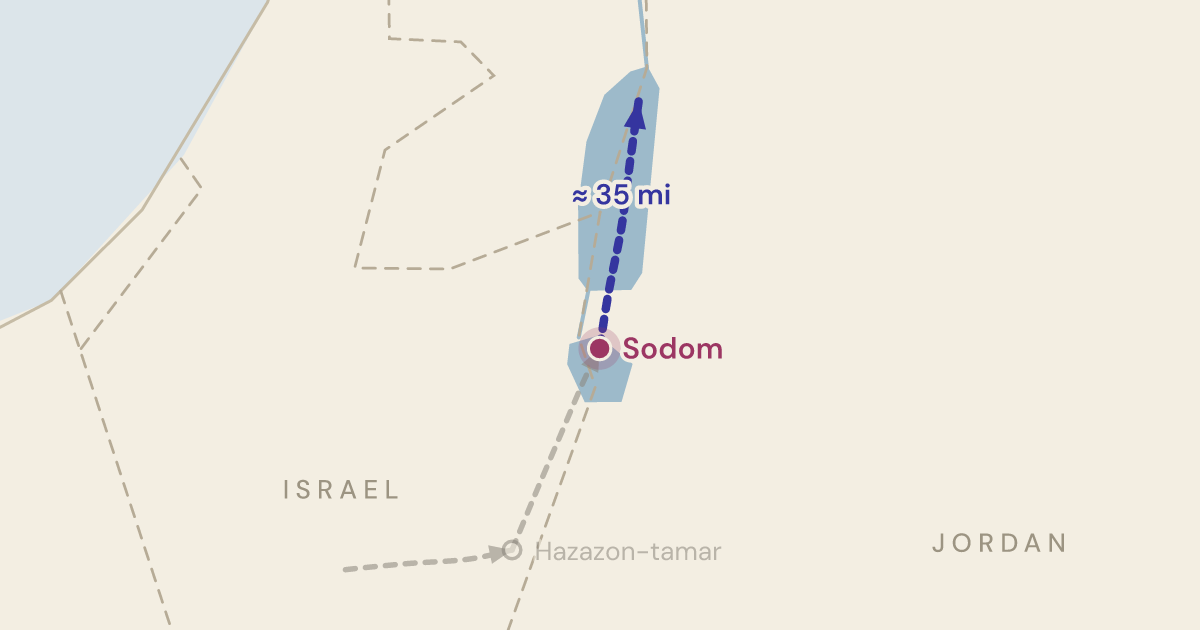
It is worth noticing what happened to Lot. In an earlier chapter he chose all the plain of Jordan and "pitched his tent toward Sodom" (Gen. 13:12). He has now taken a further step on his downward course, for here we read that he "dwells in Sodom." We may be sure that it was never Lot's intention to dwell in Sodom when he pitched his tent toward it. But one false step leads to another. Drawing near to the world, he is soon in the world. And living in the world, he gets caught up in its conflicts and falls captive to its power.
Writers also note what he gave up to get there — the tent he had lived in.
Verse 12 lets us see another step in the downward course of Lot. He was not content with pitching his tent toward Sodom. He had now given up tent life altogether and taken a permanent home in the wicked city. That spot was worse than Ur, the place he first left under Abram's guidance. He now shared the fate of the people of Sodom, and the enemy carried him away captive with all his house.
Why the Reason Is Recorded
The Bible records where Abraham lived and where Lot lived. Writers see purpose in that.
Is it not striking that the Spirit of God mentions in Genesis 13:12 that Abraham dwelt in the land of Canaan, and that Lot dwelt in the cities of the plain? Then in Genesis 14:12 He adds, "For he dwelt in Sodom." He says it as though to give point to what He had just recorded about Lot being carried away into captivity. No one can dwell in Sodom without breathing its poisoned air and feeling its polluting influences. Its people were wicked and great sinners before God. Poor Lot, by his associations, was helpless in the presence of the world.
Powerless on the Day of Battle
When war came, Lot had nothing to fall back on where he stood.
At last, dwelling in Sodom, the day of conflict comes. He finds he is a lonely man, without strength and without friends to help. He cannot count on the support of God. Powerless in the day of battle, he falls a captive to his enemies.
What He Lost
The raiders took his possessions along with the man.
What then were the results of this contest to Lot? Ruin to him and his family. The enemy made him a prisoner and took all his goods (v. 12). He had laid up treasure for himself on earth, and the thieves had broken through. Abram was above it all, in the power — the separating power — of communion with God. Lot found himself a prisoner and a beggar.
Abram's Response
Lot's capture became Abram's opportunity. Abram had every reason to blame him, and said nothing of the kind.
What was no small rebuke to Lot became the occasion for Abram. He came out as one who walked with God and trusted Him. He shows us, too, that power of grace which rises above whatever has personally been wrong. There was no doubt about Lot's failure in testimony. But Abram thought nothing about his faults now. What he saw was a righteous man swept away while the powers of the earth crashed together like clay pots. For no doubt Lot, despite everything, was righteous. This drew out his loving desire for Lot's rescue.
Rescue Is Not Repentance
The rescue that follows changed Lot's situation, not Lot.
In Lot's case it is made clear once more that circumstances have not made him what he is. A change of circumstances does not change him. God's hand freed him by using another man, yet he is not really free. Soon we shall find him needing rescue again — this time from a place that escaped man's judgment but falls under God's.
Summary
- Drift. Lot pitched his tent toward Sodom, and then he lived in Sodom. No single step looked final, but "one false step leads to another."
- Dwelling. The verse gives the reason for the captivity: Lot was living in Sodom. Where a believer settles decides which conflicts he is caught up in.
- Powerlessness. Settled in the world, Lot had no strength against the world — alone, unsupported, and unable to count on God's help in the place he had chosen.
- Loss. He went to Sodom for gain and came out a prisoner and a beggar. The treasure he laid up on earth went to the raiders.
- Rescue. Abram, still in his tent, was free to go after him. But rescue from outside did not change Lot's heart.