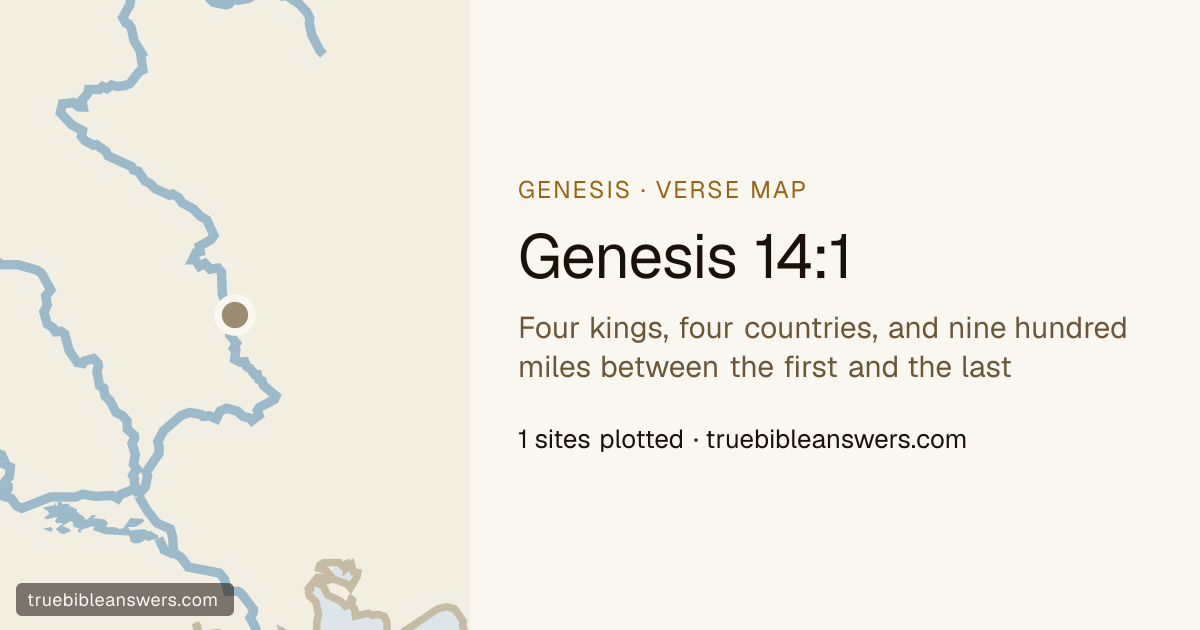
Genesis 14:1: Four kings, four countries, and nine hundred miles between the first and the last
Read it →"In the days of Amraphel king of Shinar, Arioch king of Ellasar, Chedorlaomer king of Elam, and Tidal king of Goiim." It is a list of names and it reads like the opening of a different book — and that is the point of putting it on a map. Genesis has spent three chapters on one household moving between camps, and now, without warning, it opens with the formula of an international annal: in the days of, four kings, four kingdoms. The map shows what the sentence is actually claiming. These four are not neighbours. Elam is beyond the Tigris on the Iranian plateau, Shinar is lower Mesopotamia, Ellasar and Goiim are placed north and west of them, and the distance from the first to the last is close to nine hundred miles. This is a coalition drawn from the whole of the known east, and it is on its way to a valley at the bottom of the Dead Sea to collect twelve years of tribute. Three of the four are drawn as open rings rather than pins, because that is what the sources support. Elam is a kingdom with a capital and a long history and it can be plotted; Shinar is the Babylonian plain and the identifications resolve it to a region, not a site; Ellasar and Goiim are both disputed to the point that the atlases disagree about which side of Mesopotamia to put them on. A ring says the sources place the name here without agreeing on a spot. None of the four kings has ever been matched to a ruler in the cuneiform record, and that is not for want of trying — Amraphel was read as Hammurabi for most of a century and the identification is now generally abandoned. What the chapter describes, though, is exactly the kind of thing the second millennium did: a distant overlord, a vassal rebellion in the fourteenth year, and a punitive march down the King's Highway. The reason this verse belongs in a walk through Abraham's life is that it ends in his tent. Lot is living in Sodom, Sodom is one of the five cities that stopped paying, and eleven verses from here Abram is arming three hundred and eighteen men.
Regions on this map
Nine hundred miles from end to end, and the whole of the known east in one sentence. Abraham never sets foot in any of them; the only reason they are in his story is that their army is about to take his nephew.
The kingdom Chedorlaomer rules, and the one the chapter treats as the overlord — it is his tribute the five cities stop paying, and his name the others are listed with. Elam sat east of the Tigris on the edge of the Iranian plateau, with its capital at Susa, and was a great power for most of two thousand years. It is the furthest point east in Abraham's whole story.
Today: Susa, Khuzestan, Iran (representative point)
Arioch's kingdom, and one of the least settled names in Genesis. It has been read as Larsa in southern Mesopotamia, as Ilanzura on the upper Euphrates, and as a corruption of something else again; the sources here place it in the north, and disagree enough that it gets a ring.
no agreed site; the identifications differ by several hundred miles
Tidal's kingdom, and the name is barely a name — goyim is the ordinary Hebrew word for nations, so the phrase can be read as "king of nations", a ruler of a mixed people rather than a country. Tidal has been connected to the Hittite royal name Tudhaliya, which would put him in Anatolia. The sources anchor it near Damascus.
no agreed site; the name may be a description rather than a country
The Babylonian plain, and Genesis has been here before: it is where the whole earth settled in Genesis 11:2 and built the tower. A reader walking this series in order met Shinar three chapters ago as the place humanity gathered; it comes back as a kingdom sending an army west. Amraphel was identified with Hammurabi for most of a century, and that reading is now generally given up.
a region rather than a site; the sources place Shinar without fixing it to one point
Genesis 14:1 in full
- Genesis 14:1In the days of Amraphel king of , Arioch king of , Chedorlaomer king of , and Tidal king of ,