Genesis 13:3: Fifty miles north to the exact patch of ground he left
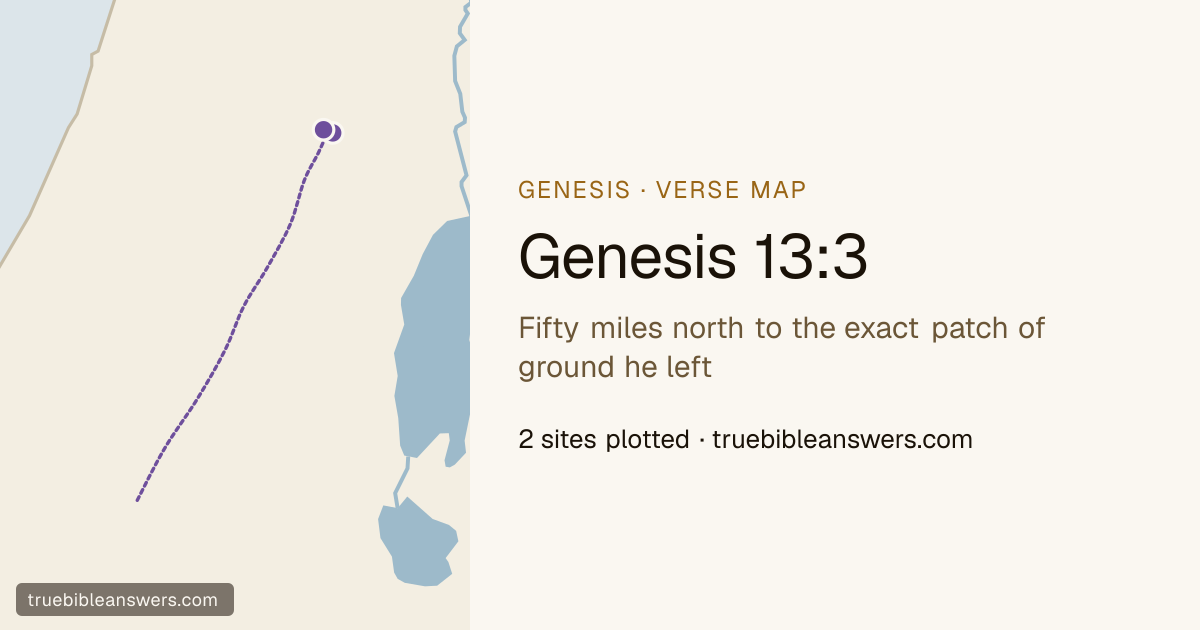
Read it →"And he journeyed on from the Negeb as far as Bethel to the place where his tent had been at the beginning, between Bethel and Ai." Read quickly it is a travel note. Read slowly it is the strangest sentence in the chapter, because the verse goes out of its way to say that the destination is not a town but a spot — the place where the tent had been, between two named settlements, at the beginning. The beginning is Genesis 12:8, five verses and one famine earlier: he pitched his tent with Bethel to the west and Ai to the east, built an altar, and called on the name of the LORD. Then the famine drove him south to Egypt, the next chapter of his life happened in a foreign court, and he came out of it rich and escorted. This verse walks him about fifty miles back up the ridge road from the Negeb, past everywhere he could have stopped, to stand again on the ground between the same two towns. The next verse says what he does there: "to the place where he had made an altar at the first. And there Abram called upon the name of the LORD." So the map draws a return rather than an arrival. The road is the central ridge, the spine of limestone that runs the length of the hill country and carries every north–south journey in the Old Testament, because the coastal plain belonged to other people and the rift below is a furnace. Bethel sits on it at about 2,900 feet; Ai is a mile and a half east and slightly lower; the tent went between them, on the saddle, with a view east over the wilderness falling away to the Jordan. That view is what makes the rest of the chapter happen. Two verses later the herdsmen quarrel, and Abram takes Lot to this same ridge and tells him to look — and what Lot sees from here is the Jordan valley, well watered like the garden of the LORD.
Regions on this map
Fifty miles up the central ridge, from the dry plateau to the saddle between Bethel and Ai. The verse names the destination twice over — as far as Bethel, and then more precisely than that: the place where his tent had been at the beginning.
The town on the east of the camp, a mile and a half from Bethel, and the other half of the bearing. Joshua burns it four books later; here it is simply the marker that tells you which side of the ridge the tent was pitched on — the side that looks east, down the wilderness, toward the Jordan.
Today: et-Tell, West Bank
The town on the west of the camp, about 2,900 feet up on the central ridge. Abram never enters it — in both Genesis 12:8 and this verse it is a bearing, the western half of a description of where a tent stood. Jacob names the place Bethel two generations later, after a dream on the same stretch of ridge.
Today: Beitin, West Bank
Where the verse starts and where the previous one left him. He came up out of Egypt into it; now he goes on through it, north, and the sentence does not stop again until it reaches a patch of ground between two towns.
no point of its own; every source anchors the Negeb at Tel Be'er Sheva
Genesis 13:3 in full
- Genesis 13:3And he journeyed on from the as far as to the place where his tent had been at the beginning, between and ,