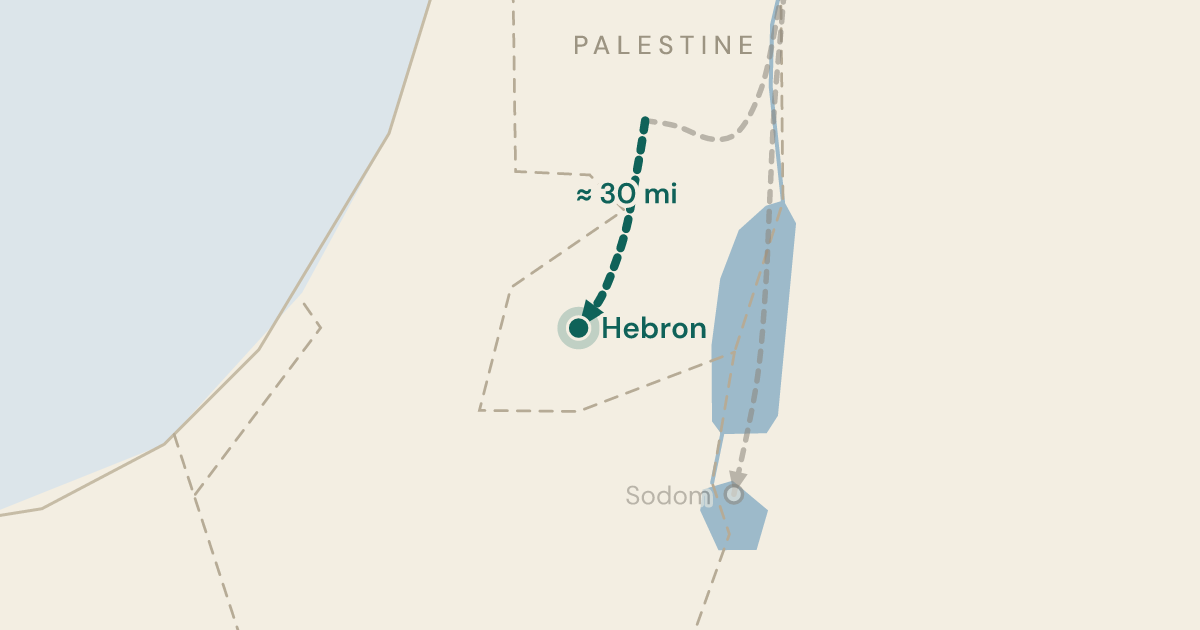
Genesis 13:18: The address he keeps for the rest of his life
Read it →Commentary on Genesis 13:18
Abram had just let Lot take the best-looking land, and God had answered him with the promise of the whole country. His move to Mamre, and the altar he built there, show what a man does when he gives up his claim and gains his God.
Loss That Restores
Giving Lot first choice cost Abram the fertile plain. One writer reads the move to Mamre as the recovery of the ground Abram had stood on when he first left home.
Here we see Abram back at the moral elevation that had marked his outset. Then he gave up Ur with its comforts; now he yields up the choicest part of the land of promise, content to be still a pilgrim, if in communion with God. His altar showed that he was in touch with God; his tent that he still remained a pilgrim, though in the land of promise.
Tent and Altar
The verse names two things: a tent and an altar. Each says something different about Abram.
His tent marked him as a stranger to the battles and prizes of this world. And his altar marked him as one whose pursuits were of a completely different kind, a heavenly one. His tent showed him to be a stranger on earth — his altar showed him to be at home in heaven.
That pairing carries a warning as well as a comfort. We cannot hold on to one without the other.
Our tent and altar must go together. If we do not keep the pilgrim way and character down here, we cannot expect to be fit to serve as priests before God in the heavenly sanctuary.
The Meaning of the Names
One writer reads the two place names for their meaning, and links this altar to the one Abram built before it.
Mamre means "fatness" and Hebron "communion." This follows on from the second altar, the altar of decision, which stood between Bethel and Ai (Gen. 12:8). True decision to put God's interests first leads to fatness, that is, spiritual prosperity. That prosperity is found in communion with the Lord. So this is the altar of communion. Communion with God rests on the truth of the person of the Lord Jesus (the altar), and it involves His sacrifice too, for that was the purpose of the altar. There is no approaching God without this.
A Settled Home
Another writer lists what living at Hebron gave Abram.
Abram enjoyed good company at Hebron — he had as "allies" Aner and Eshcol... Abram also had "trained servants" in his house — 318 of them. His was a disciplined household, producing qualities useful in the interests of God's people. Above all else, Abram's heart responded to God Himself: "there he built an altar to the LORD."
Hebron as the Place of Faith
One writer treats Hebron as a picture of where faith lives. He is also honest that such a walk is usually a lonely one.
So the picture Hebron gives us is complete. It is the home of the man of faith. It is not only his home, but also his place of worship... The God of glory had called him out of his country and from his relatives. When he obeyed that call, he judged the world to be a poor home for a man who might at any moment be asked to host heavenly visitors. Lot had never shared in this heavenly calling. And the path of faith is more often walked alone than in company.
What Hebron Became
The place Abram chose comes up again and again later in the Bible. One writer follows its story, and much of it turns out to be a record of graves.
When Lot chose the cities of the plain, Abraham, the father of the people, made his home there. There he built an altar to the LORD and received the promise of God. But more than anything, Hebron is the place of death, and Abraham knew that first. Sarah died there, and there she was buried. Abraham was buried there too, and Isaac, and then Jacob and the patriarchs... What is there in it to attract? Nothing for the natural man, everything for faith.
The same writer adds two later chapters. Hebron became a city of refuge. It was also where David's kingdom began.
Summary
- Surrender — Abram let Lot take the well-watered plain. The move to Mamre shows him back at the level of faith he started with, content to stay a pilgrim if he has fellowship with God.
- Tent — the tent marked him as a stranger on earth, with no stake in the quarrels and prizes of the world around him.
- Altar — the altar marked him as at home in heaven. Tent and altar go together: pilgrim living keeps worship real.
- Fellowship — Mamre means fatness and Hebron communion. Here is the settled place: spiritual prosperity, good company, a disciplined household, and worship, all resting on the altar.
- Legacy — the spot Abram chose held nothing for the natural man. Yet it became the burial place of the patriarchs, a city of refuge, and the place where David's kingdom began.