Genesis 13:12: Two men settle in one verse, and only one of them has a town
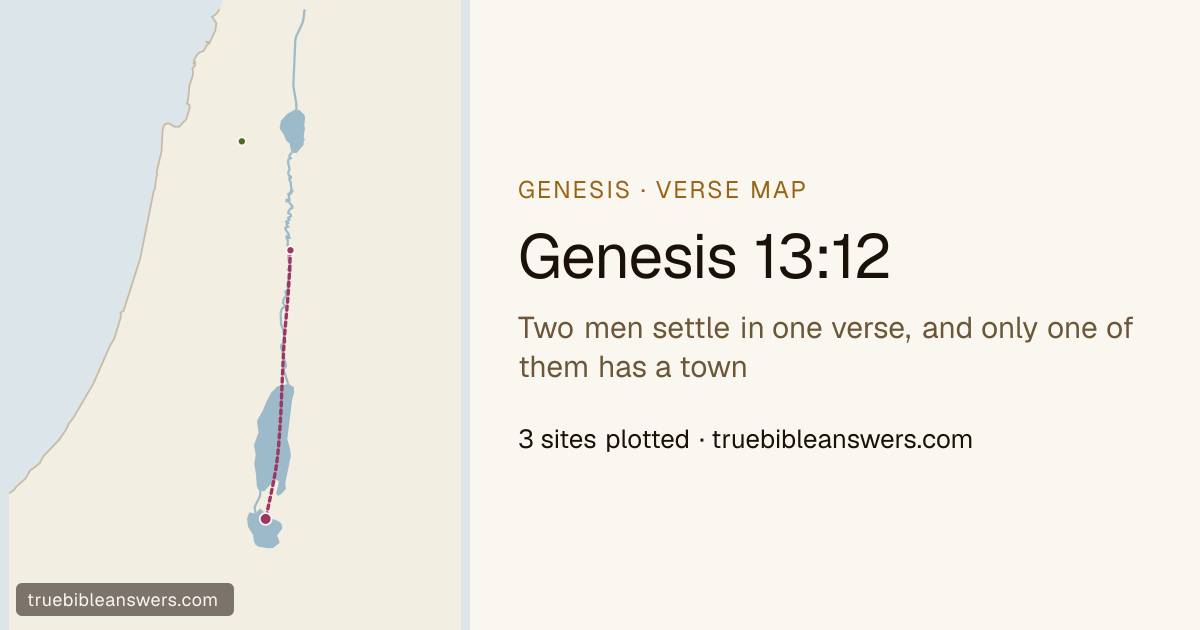
Read it →"Abram settled in the land of Canaan, while Lot settled among the cities of the valley and moved his tent as far as Sodom." One sentence, two households, and a sentence built to be read as a contrast. The verbs are the same — both men settle — and everything either side of them is different. Abram settles in a country, named as a country: the land of Canaan, the whole of it, which he has been promised and owns not one acre of. Lot settles among cities, and then the verse adds a detail it did not need: he moved his tent as far as Sodom. Not to Sodom. As far as. It is the language of a man edging, and Genesis will finish the movement in stages — by Genesis 14 he is living in Sodom and is carried off with its people, and by Genesis 19 he is sitting in the gate of it, which is where a city's business is done. The map draws that drift as the only line on it. Abram gets a pin and no arrow, because settling in a land is not a journey; Lot gets the length of the rift, from the valley he chose in the verse before down to the city at the south end of the Dead Sea. It is about seventy miles of trench, most of it below sea level. The next verse is the one the whole chapter has been walking toward, and it is eleven words long: "Now the men of Sodom were wicked, great sinners against the LORD." The narrator has now told the reader twice, in three verses, what Lot has moved his family next to. Abram, in the meantime, has an unfenced country and a promise, and in six verses he will pitch at Hebron and build an altar there.
Regions on this map
A country and no town in it. The verse gives Abram the whole land and no address, which is exactly his position for the rest of his life: he is promised Canaan and the only ground he ever owns in it is the burial cave he buys in Genesis 23.
Where Abram settles, named as a land and not a place. Plotted at the country's own centre rather than at a camp, because that is what the verse gives him — the whole of it, and nothing in it. The same pin appears on /maps/genesis-11-31 as the destination his father set out for and never reached.
Today: the land between the Jordan and the sea (representative point)
Seventy miles of rift, most of it below sea level, ending at the city the next verse calls wicked. "As far as Sodom" is a phrase about a limit being approached rather than a destination being reached, and Genesis finishes the movement in Genesis 14 and Genesis 19.
"The cities of the valley" — the ESV's phrase for the plain at the foot of the rift, the country Lot chose one verse earlier on the strength of a view from the ridge. The valley is the choice; Sodom is where the choice ends up.
Today: the Jordan rift, anchored near Beth-shan (representative point)
The far end of the drift. Lot moves his tent as far as Sodom in this verse, lives in it by Genesis 14, and is sitting in its gate by Genesis 19 — the place a city's elders sat and its business was settled. Where the city stood is unknown; the sources put it at the south end of the Dead Sea and cannot separate it from the other cities of the plain.
Today: unidentified; sited at the south end of the Dead Sea (representative point)
Genesis 13:12 in full
- Genesis 13:12Abram settled in the land of , while Lot settled among the cities of the and moved his tent as far as .