Genesis 13:10: Well watered everywhere, like the garden of the LORD, like the land of Egypt
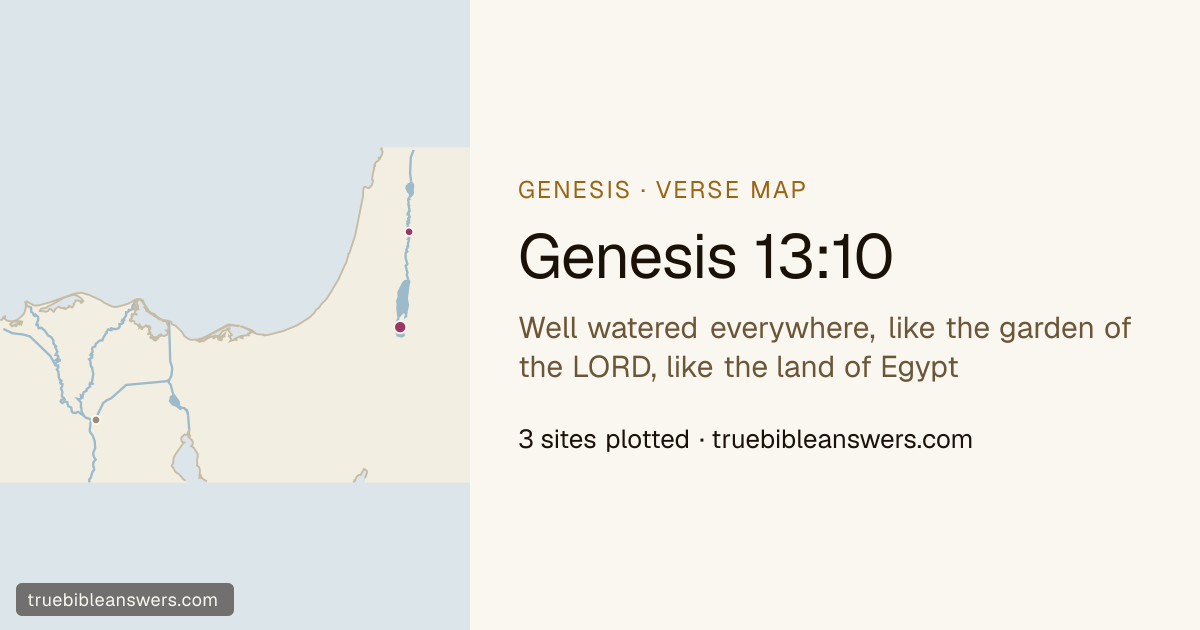
Read it →"And Lot lifted up his eyes and saw that the Jordan Valley was well watered everywhere like the garden of the LORD, like the land of Egypt, in the direction of Zoar. (This was before the LORD destroyed Sodom and Gomorrah.)" Nothing moves in this verse. It is a look, taken from the ridge between Bethel and Ai where the two households have just agreed to separate, and it names five places in one sentence — which is why it gets a map, and why the map is wider than the walk. Two of those names are not on the horizon at all. The garden of the LORD is Eden, and the land of Egypt is four hundred miles the other way, and Lot has just walked out of it. The comparison is the point: the only landscape in his experience that is green regardless of the sky is the one they were escorted out of two verses ago, and from this ridge the Jordan rift looks like it. So Egypt is on this frame — not as a stop, but as the measure he is using. What he is actually looking at is the deepest valley on the surface of the earth. From the saddle at Bethel the ground falls about 3,800 feet in fifteen miles to the Jordan, and keeps falling: the Dead Sea sits 1,400 feet below sea level, the lowest dry land anywhere. Before that drop the valley floor around Jericho runs on perennial springs and is green in a country where everything else waits on rain, and in the direction of Zoar — south, along the eastern rim toward the shallow end of the sea — the plain of the five cities was described the same way. The parenthesis is the whole tragedy in eleven words. The narrator interrupts his own scenery to say that the reader is looking at something that will not be there long, and that Lot is choosing on the strength of a view. He picks the valley in the next verse, settles as far as Sodom in the one after, and by Genesis 19 he is running out of it uphill at dawn with the smoke of the country going up behind him like the smoke of a furnace.
Regions on this map
The Jordan rift and the cities at the foot of it. From the ridge above Bethel the ground falls 3,800 feet in fifteen miles and keeps going, to the lowest dry land on earth; the floor runs on springs rather than rain, and is green all year in a country that is not.
Sodom's twin, and in Genesis almost never named without it. Both are named in this verse as the thing that is going to happen to the landscape Lot is admiring.
no point of its own; the sources resolve it to the same site as Sodom
The rift the Jordan runs down, and in this verse a whole landscape rather than a place: "well watered everywhere". It is the deepest valley on the surface of the earth, and the only part of Canaan that does not live or die on the winter rains. Lot chooses it in the next verse on the strength of this one look.
Today: the Jordan rift, anchored near Beth-shan (representative point)
Named here only in the narrator's aside, and not as somewhere Lot is looking — he is looking toward Zoar. The aside is the point: the reader is told, before the choice is made, that the country in the view is on borrowed time. Where the city stood is genuinely unknown; the sources put it at the south end of the Dead Sea and cannot separate it from the other cities of the plain.
Today: unidentified; sited at the south end of the Dead Sea (representative point)
The direction of the view — "in the direction of Zoar" — which puts Lot's eye down the eastern rim toward the shallow south end of the sea rather than straight out at Jericho. It is also the one city of the plain that survives Genesis 19, because Lot begs for it: "Behold, this city is near enough to flee to, and it is a little one."
no point of its own; the sources resolve it to the same site as Sodom
Egypt is on this map because the verse reaches for it: "like the land of Egypt". It is the one green-whatever-the-weather landscape Lot has seen, and he saw it a fortnight ago. Nobody travels there in this sentence.
The comparison, and the only one available to a man who has just spent a famine there. Egypt is green because the Nile floods, not because it rains; so is the Jordan floor, on its springs. Lot is not choosing a country in this verse — he is recognising a kind of country.
Today: Egypt, at Heliopolis in Cairo (representative point)
Genesis 13:10 in full
- Genesis 13:10And Lot lifted up his eyes and saw that the was well watered everywhere like the garden of the LORD, like the land of , in the direction of . (This was before the LORD destroyed and .)