Genesis 13:1: The famine road walked backwards, with more than he took down it
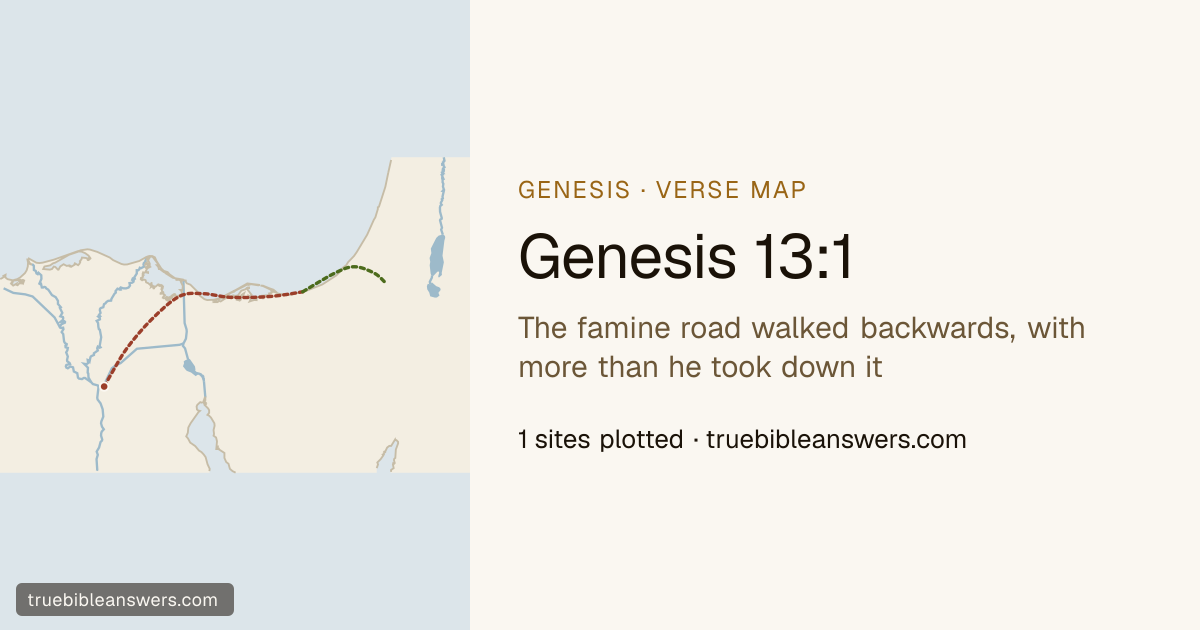
Read it →"So Abram went up from Egypt, he and his wife and all that he had, and Lot with him, into the Negeb." It is the only verse in Abraham's life that retraces a road he has already walked, and the two directions are not the same journey. Going down in Genesis 12:10 was a man out of options: a famine in the hill country, a two-hundred-and-fifty-mile walk to the one place in reach that eats regardless of rain, and the legal status of a resident alien with rights nobody has to honour. Coming up is a man being escorted out. Pharaoh has discovered that the woman he took into his house is Abram's wife and not his sister, and he sends the household away with what it has acquired — "and Abram was very rich in livestock, in silver, and in gold", says the next verse. The going up is not a return so much as an expulsion with baggage, and the baggage is what causes the trouble in the rest of the chapter: two households with too much livestock for one hill country, and a quarrel between herdsmen that ends with Lot choosing the Jordan valley. Up and down are the text's own words and they are literal here as well as idiomatic. Egypt is a delta at sea level; the Negeb is a plateau that rises to about a thousand feet, and the hill country beyond it to three thousand. Every journey out of Egypt into Canaan in the Bible goes up, and every journey the other way goes down, because that is what the ground does. The Negeb is where he lands, and the map draws it as ground rather than as a place: the sources give the region no settlement of its own and anchor it at Tel Be'er Sheva, so the ring is the anchor and not a camp. It is the first Canaanite ground he stands on coming back, and it is where the next verse finds him — journeying on, up the ridge, to the exact spot he pitched his tent on before he ever went south.
Regions on this map
Where the verse starts, and he is being shown out of it. Pharaoh has found out that Sarai is Abram's wife, and the household leaves with everything it has acquired — the livestock, the silver and the gold the next verse counts, and the Egyptian servant Genesis 16 will name.
The country the famine sent him to and the one he is now being escorted out of. He arrived as a resident alien with a half-truth about his wife, and he leaves rich, with an Egyptian servant in the household — which is the whole of Genesis 16 and half of Genesis 21 in one sentence of consequence.
Today: Egypt, at Heliopolis in Cairo (representative point)
The first Canaanite ground he stands on coming back: the dry plateau south of the hills, rising to about a thousand feet. It is drawn as a ring rather than a pin because the sources give the region no settlement of its own and anchor all of it at Tel Be'er Sheva.
The dry country south of the hills, and where Abraham spends more of his life than anywhere except Hebron. He is "still going toward" it when the famine sends him further south still; it is the first Canaanite ground he stands on coming back out of Egypt; and Genesis 20:1 sends him down into it for three chapters. Isaac is living in it when Rebekah arrives.
no point of its own; every source anchors the Negeb at Tel Be'er Sheva, which is the tell Beersheba stands on eight chapters later
Genesis 13:1 in full
- Genesis 13:1So Abram went up from , he and his wife and all that he had, and Lot with him, into the .