Genesis 12:9: A direction of travel, and no arrival
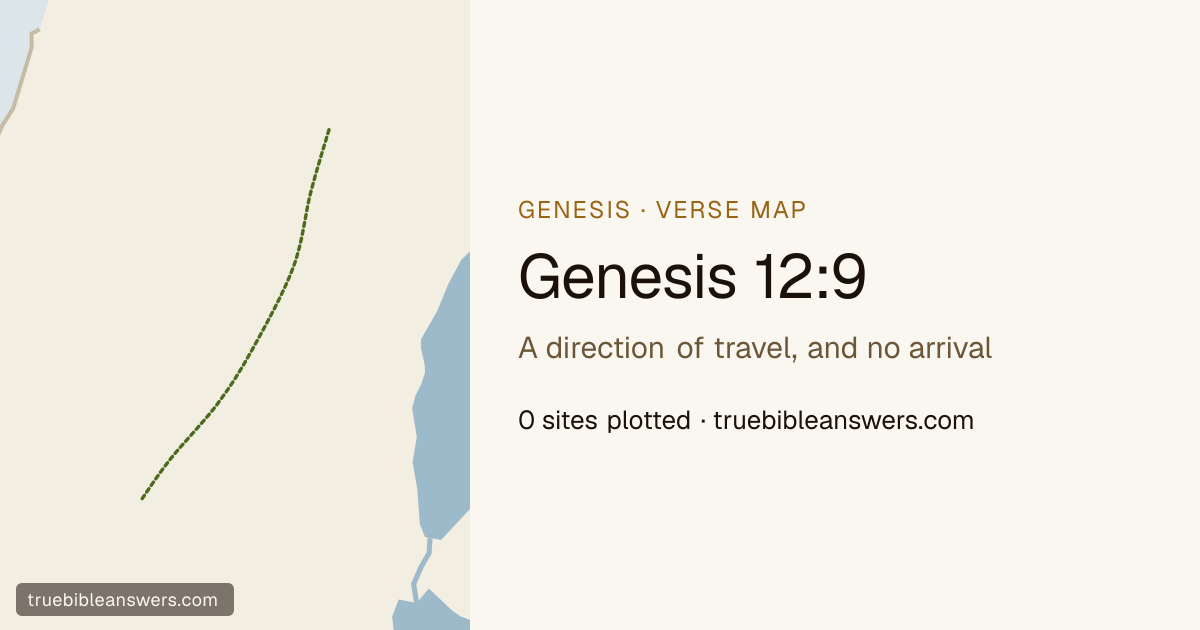
Read it →"And Abram journeyed on, still going toward the Negeb." Eleven words, one place name, and no destination reached. It is the shortest verse in this series and one of the few whose whole content is a bearing. The Negeb is not a town and the verse does not treat it as one. It is the dry country south of the Judean hills — the word means the parched land, and it doubles in Hebrew as the compass direction south, which is exactly the ambiguity the sentence is trading on. He is going south, and he is going into the south. It runs from roughly the latitude of Beersheba down toward the wilderness of Paran, and the rainfall falls away across it from about twelve inches a year at the northern edge to under four. That gradient is the whole geography of the next verse: a man moving into country that lives on marginal rain, in the season before a famine. So the map draws the movement open-ended, the way this corpus draws any stretch where the text has stopped saying where the traveller is. The arrow leaves the ridge at Bethel and Ai, runs down the spine of the hills past where Jerusalem and Hebron would be, and simply stops. There is no camp at the end of it, because the verse names none. The ring ahead of the arrow is the Negeb itself: the sources give it no settlement of its own and anchor the whole region at Tel Be'er Sheva, so it is drawn as ground rather than as a pin, and the ring is where the sources will actually put a finger. What the sentence is really doing is running down a clock. Three verses have carried him from Haran into the land, to Shechem, to the ridge above the rift, and now south, and each one is shorter than the last. The next verse is the famine.
Regions on this map
South down the spine of the hills from the camp between Bethel and Ai, past the sites of Jerusalem and Hebron, into country that gets drier with every mile. The line ends in the open because the verse does — he is going toward the Negeb, and the sentence never says he arrives.
The dry country south of the hills, and where Abraham spends more of his life than anywhere except Hebron. He is "still going toward" it when the famine sends him further south still; it is the first Canaanite ground he stands on coming back out of Egypt; and Genesis 20:1 sends him down into it for three chapters. Isaac is living in it when Rebekah arrives.
no point of its own; every source anchors the Negeb at Tel Be'er Sheva, which is the tell Beersheba stands on eight chapters later
Genesis 12:9 in full
- Genesis 12:9And Abram journeyed on, still going toward the .