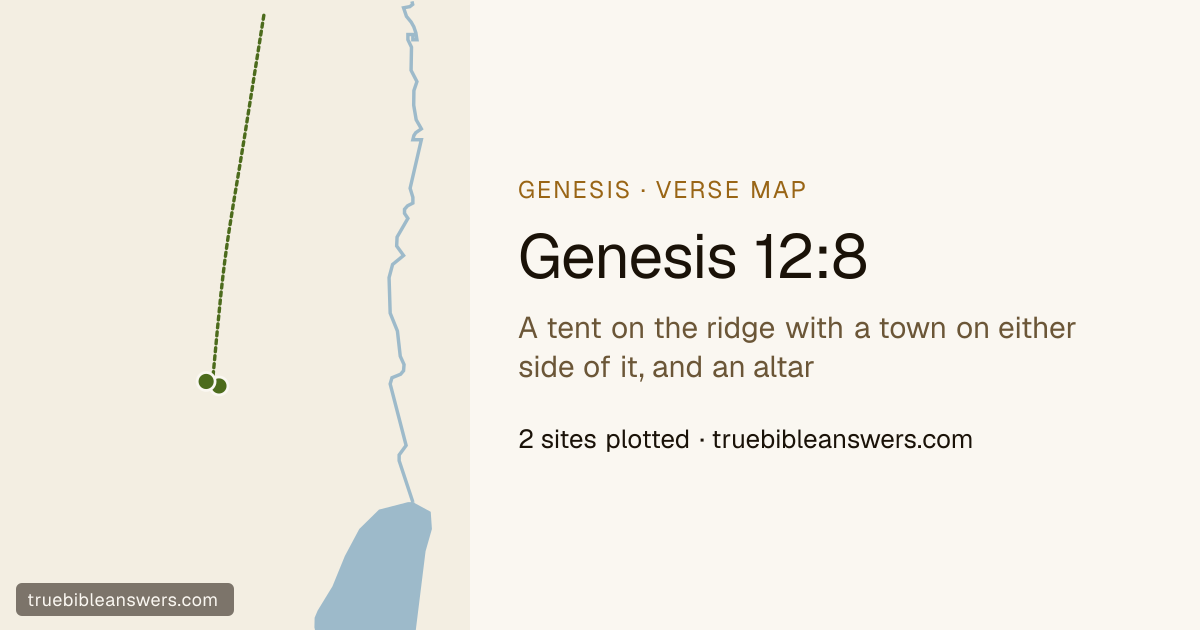
Genesis 12:8: A tent on the ridge with a town on either side of it, and an altar
Read it →This is the most precisely sited sentence in Abraham's life. Most of the time the text says he came to a place, or lived in a land, or journeyed toward a region. Here it fixes the tent by triangulation: "he moved to the hill country on the east of Bethel and pitched his tent, with Bethel on the west and Ai on the east." Two towns, two compass bearings, and the camp is the point between them. The two tells are about two miles apart, on the watershed twelve miles north of Jerusalem, at around three thousand feet. Bethel is Beitin; Ai is generally et-Tell, on the eastern lip of the ridge where the ground begins to fall away into the wilderness and, eventually, four thousand feet down to the Jordan. So the camp is on the spine of the country with the settled hill country behind it to the west and the drop to the rift in front of it to the east. It is a place chosen for grazing and for view, and it is where Genesis keeps coming back to. It comes back almost immediately. Genesis 13:3 walks Abram up out of Egypt and the Negeb "as far as Bethel to the place where his tent had been at the beginning, between Bethel and Ai" — the same two miles of ridge, named the same way, and the text is explicit that it is the same spot. From this ground Lot lifts up his eyes and looks east over the edge at the Jordan valley, and chooses it. And there is the altar, the second of the three Abram builds in Canaan and the first one he calls on the name of the LORD at. The pattern of his life in the land is set in these two verses: he does not own the ground, he does not build a town on it, he pitches a tent and builds an altar and moves on. Bethel keeps the memory — the name means house of God, and Jacob will give it that name for his own reasons a generation later, on ground his grandfather had already put an altar on.
Regions on this map
Twelve miles north of where Jerusalem would be, on the watershed at about three thousand feet, with the settled hills to the west and the ground falling away east toward the Jordan rift. The verse fixes the tent between two towns two miles apart, and the arrow stops between them because that is all the sentence says.
The town on the east side of the camp, on the lip of the ridge where the hill country starts to fall away toward the Jordan. It is named here only to fix where the tent was, and named again in Genesis 13:3 to say that he came back to the same two miles of ground.
Today: et-Tell, near Deir Dibwan, West Bank
The town on the west side of the camp, and the second altar. The journey turns on it: Abram comes back up out of Egypt to "the place where his tent had been at the beginning", and it is from this ridge that Lot looks east and chooses the valley. The name means house of God, which Jacob gives it again, for his own reasons, a generation later on the same ground.
Today: Beitin, West Bank
Genesis 12:8 in full
- Genesis 12:8From there he moved to the hill country on the east of and pitched his tent, with on the west and on the east. And there he built an altar to the LORD and called upon the name of the LORD.