Genesis 12:5: The road Genesis 11:31 set out on, finished
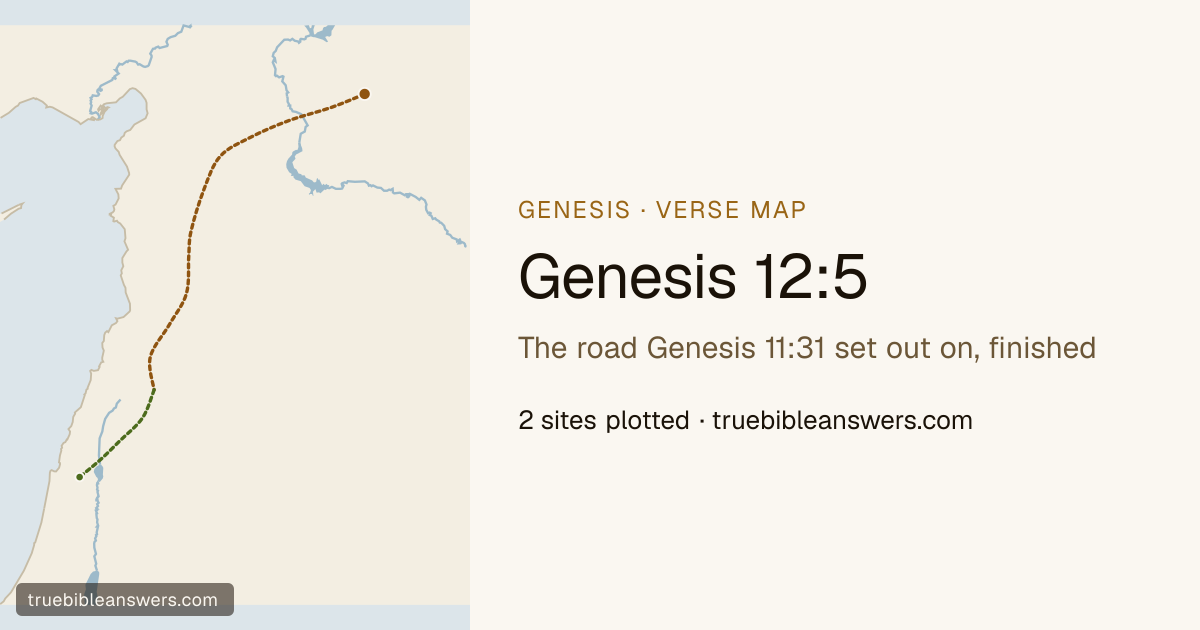
Read it →This is the arrival, and it is the answer to a sentence written a chapter earlier. Genesis 11:31 had Terah take his household out of Ur "to go into the land of Canaan", and then stop four hundred miles short: "when they came to Haran, they settled there." That map draws the intention as a dotted line fading out in northern Syria, because on the day that verse ends nobody in the family has set foot in the country they set out for. Genesis 12:5 is the same clause finished by the son — "they set out to go to the land of Canaan. When they came to the land of Canaan" — and this map draws the line solid all the way. The road is the only road there is. From Haran you go west across the top of the Syrian steppe to Aleppo, then south down the Orontes past Hama and Homs, through the gap between the Lebanon and the Anti-Lebanon, out at Damascus, and down into Canaan from the north-east. It is roughly four hundred and fifty miles and it took caravans about a month. Nobody goes straight: the direct line from Haran to Canaan crosses the Syrian desert, which is not a road and never was, and the whole shape of this journey — up the Euphrates from Ur, west along the top, and down the far side — is the shape of the watered country. The verse also counts what moved. Sarai, Lot, all their possessions, and "the people that they had acquired in Haran" — a household, not a family. Sixty-five years of Haran are in that phrase, and it is the clearest indication in the chapter that the years between 11:31 and 12:4 were prosperous ones. What walks into Canaan is a small travelling estate with livestock, and that matters within two chapters, when the herdsmen of Abram and the herdsmen of Lot cannot share a hill country and Abram can put three hundred and eighteen armed men born in his own house into the field. Canaan is drawn here as the gazetteer draws it: one representative point for a whole country, at the land's own centre rather than at any place a foot was put down. The verse does not say which town they came to first. The next verse does.
Regions on this map
Where the verse starts and where the family had been for a generation. What leaves is not four people but a travelling estate — a wife, a nephew, everything they had gathered, and the people acquired in Haran. The arrow is about four hundred and fifty miles of caravan road, and it is the only road: the straight line crosses the Syrian desert.
A caravan town on the Balikh, sixty miles north of the Euphrates, where Terah stopped on the way to Canaan and died at two hundred and five. Abram leaves it at seventy-five, and the verse counts what leaves with him: his wife, his nephew, everything they had gathered, and the people they had acquired here. Genesis 24 sends a servant back to it for a wife for Isaac and calls it the city of Nahor.
Today: Harran, Şanlıurfa, Turkey
The destination Genesis 11:31 named and did not reach. Here the arrowhead lands on it, which is the whole difference between this page and that one. The pin is the gazetteer's single point for an entire country, at the land's own centre — the verse says they came to the land, and does not say to which town.
Named at the outset as where Terah was going, reached here, and named for the last time over Sarah's grave — "in the land of Canaan" is how Genesis 23 twice fixes the field Abraham buys, as if the point of the purchase were which country it is in. Plotted at the land's own centre rather than at any stop, so the pin is a country and not a place anyone stood.
Today: the land between the Jordan and the sea (representative point)
Genesis 12:5 in full
- Genesis 12:5And Abram took Sarai his wife, and Lot his brother's son, and all their possessions that they had gathered, and the people that they had acquired in , and they set out to go to the land of . When they came to the land of ,