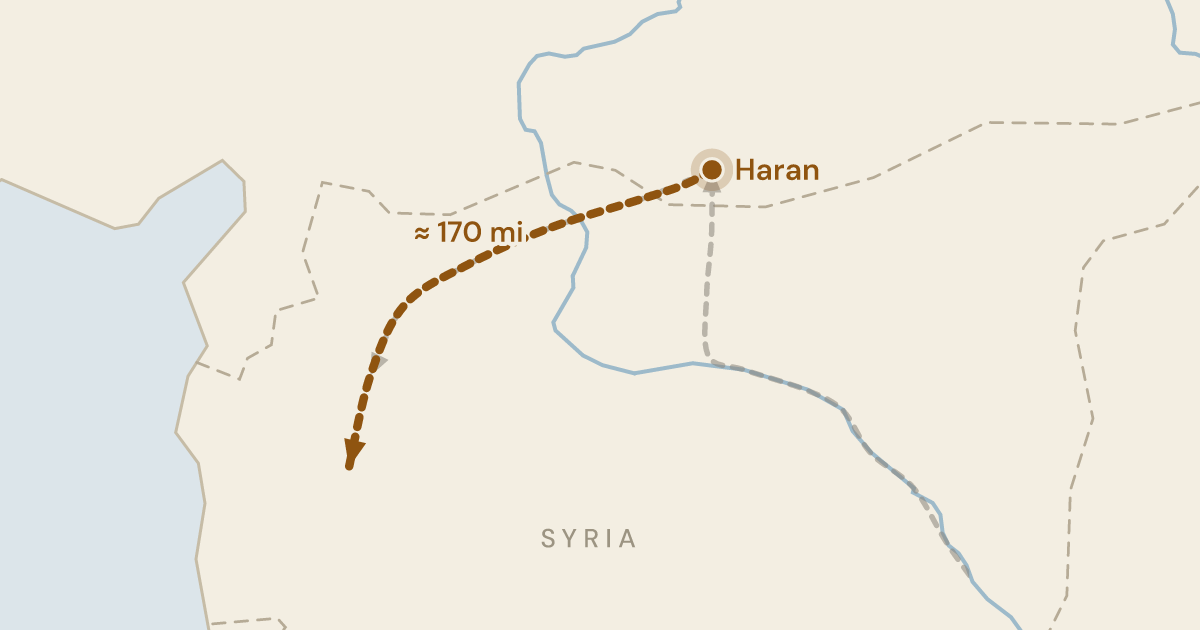
Genesis 12:4: Seventy-five years old, walking out of the town his father died in
Read it →Commentary on Genesis 12:4
Genesis 12:4 is the moment Abram finally moves. God had spoken years earlier, but the journey stalled at Haran, and now Abram sets out at seventy-five with his nephew Lot beside him.
Obedience Built Into the Call
The call itself carried a condition. Abram was not offered a blessing to enjoy where he stood; he was told to leave, and the promise waited on his going.
This calling, however special and personal, however much it marked him out for favour, necessarily involved obedience. The call of blessing to Abraham was a call to leave his country for a land which God would show him. Whatever the power acting on his mind might be, obedience was the result. The very terms of the call made it clear — no obedience, no blessing.
"As the LORD Had Told Him"
An earlier start toward Canaan had stopped at Haran. The difference now is who leads, and how far they get.
Terah, as long as he lived, was a dead weight on Abraham's obedience. But when Terah died, "Abram went, as the LORD had told him." Then the language is pointedly different: "And Abram took Sarai his wife, and Lot his brother's son, and all their possessions … and they set out to go to the land of Canaan, and into the land of Canaan they came." There was no failure now, because his faith was no longer hampered by the natural ties that almost always take the upper hand. That was why the earlier move had lacked the power of God to give it effect. Once that weight was gone, the blessing followed at once.
Terah and Haran
Even the names in this story carry the lesson.
Terah fulfills his name ("delay"), and ends his days at Haran, named after his dead son. Natural things hold him fast, though death is written on them, and memory only keeps the loss fresh. "Haran" means "parched," yet there he stays (and Abram with him) till he dies. Then we find that Terah had been holding back the very man he had led. Abram rises up in the power of a divine call — a call that had come to him, and to him alone at the first.
The Silence of the Waiting Years
God said nothing new to Abram while he stayed in Haran. He waited instead of softening His command.
We are not told how long Abraham stayed at Haran. Yet God kindly waited on His servant until he was free of nature's hold and could fully obey His command. There was, however, no adjusting of that command to the circumstances of nature. That would never do. God loves His servants too well to rob them of the full blessedness of complete obedience. There was no fresh revelation to Abraham's soul during his stay in Haran. It is good to see this. We must act up to the light already given, and then God will give us more.
Lot Went With Him
The verse also names Lot, who went with him. Lot is a real believer, but he moves on another man's faith.
Lot appears as a companion who walks alongside people of faith, not as a man who has faith and acts in its energy himself. This marks his path from the beginning. So when he is put to the test, there is only weakness. In how many things do we act alongside those who have faith, before having it for ourselves! The soul will not stand when sifted by temptation, if it is walking in another's light.
Three men in this account answer God in three different ways.
In Terah we have seen the man of nature. He can make a fair profession, but he cannot take the path of faith that leads outside the world. In Abraham we have seen the man of faith. Acting on the word of the LORD, he takes the outside place, though at times he may fail in that path. In Lot we see a true believer, who takes the outside place, not in faith in God, but under the influence of man. We have already read that when Abraham departed from Haran, "Lot went with him."
Seventy-Five Years Old
Abram's age raises a puzzle about the family dates. Writers answer it by saying Abram was not the eldest son.
The conclusion seems to be that Terah's family began when he was seventy years old. Abram was not born till Terah was a hundred and thirty. Abram is named first because Terah's other children were of small importance compared with him. These things should teach us that God cares about moral and spiritual matters, not about dates.
Summary
- Delay — "Terah" means delay and "Haran" means parched; a family tie held Abram in a dry halfway place for years.
- Silence — God gave no new word at Haran. He waits for us to act on the light already given, and He does not adjust His command to our circumstances.
- Departure — Once nature's hold broke, Abram went "as the LORD had told him." This time they did not stop short: into Canaan they came.
- Company — Lot "went with him," a real believer walking by another man's faith; such a soul will not stand when tested.
- Age — Abram left Haran at seventy-five, though he was not Terah's eldest son. Scripture orders these lives by spiritual weight, not by birth order.