Genesis 12:10: The hill country lives on rain, and the Nile does not
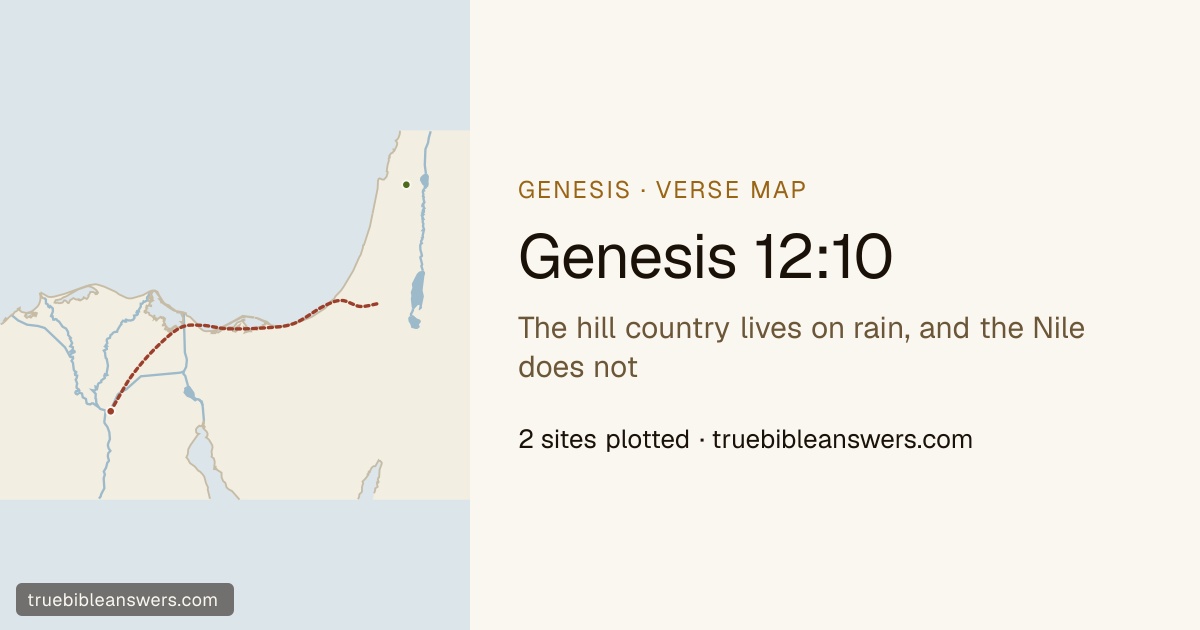
Read it →"Now there was a famine in the land. So Abram went down to Egypt to sojourn there, for the famine was severe in the land." Six verses after being promised the country, he leaves it, because it has stopped feeding him. The geography is the explanation and it is not complicated. Canaan is rain-fed farming country and the rain comes off the Mediterranean in winter; a season or two of failed westerlies and the hill country has nothing. Egypt is fed by a river that rises in the Ethiopian highlands and floods every summer regardless of what the sky over Canaan has done. That is why the movement in this verse only ever goes one way. It is the same road Jacob's sons take in Genesis 42, and the same reason. The route is the coast road, the one the later texts call the way of the land of the Philistines: south-west out of the hill country, across the Negeb, along the shore past Gaza, over the Sinai coast and the Ways of Horus, and into the Delta. It is about two hundred and fifty miles, and the last hundred of it is the only stretch of desert on the whole of Abram's life that has a well every day's march. Egypt on this map is pinned where the gazetteer pins it, at Heliopolis on the eastern edge of what is now Cairo — a country given one point, near the head of the Delta. "To sojourn" is the word doing the moral work. He is not emigrating; he is a resident alien waiting out a season, which is a legal status in the ancient Near East with rights attached and none of them very good. What happens in Egypt is the consequence: he judges his position weak enough to pass his wife off as his sister, and he is put out of the country by a Pharaoh who is angrier about being deceived than about anything else. He comes back up the same road in Genesis 13:1, richer, with an Egyptian servant called Hagar in the household, and the whole of Genesis 16 and 21 follows from that.
Regions on this map
The country he has just been promised and is now walking out of. Canaan farms on winter rain off the Mediterranean; two failed seasons and the hill country has nothing. The verse names it only as "the land", so no word in the sentence lights this pin — it is here because the famine is here.
The land of the promise, six verses old, and the land the famine is in. Genesis says only "the land" here, twice, and lets the reader supply the name from verse 5. Plotted at the land's own centre rather than at any stop, so the pin is a country and not a place anyone stood.
Today: the land between the Jordan and the sea (representative point)
Two hundred and fifty miles down the coast road, into the one country in reach that does not depend on rain: the Nile floods every summer off the Ethiopian highlands whatever the sky over Canaan has done. "To sojourn" means he goes as a resident alien waiting out a season, and the pin is where the sources fix a whole country — at Heliopolis, on the eastern edge of the Delta.
Where you go when the hill country fails, because the Nile does not depend on rain. Abram passes his wife off as his sister, Pharaoh takes her and is plagued for it, and the household is escorted out of the country richer than it came in — with, among other things, an Egyptian servant called Hagar. It stays on the map long after he leaves: Ishmael's wife is fetched from Egypt, and the covenant of Genesis 15 measures the land from the river of Egypt to the Euphrates.
Today: Egypt, at Heliopolis in Cairo (representative point)
Genesis 12:10 in full
- Genesis 12:10Now there was a famine in the land. So Abram went down to to sojourn there, for the famine was severe in the land.