Genesis 11:31: Out of Ur for Canaan, and no further than Haran
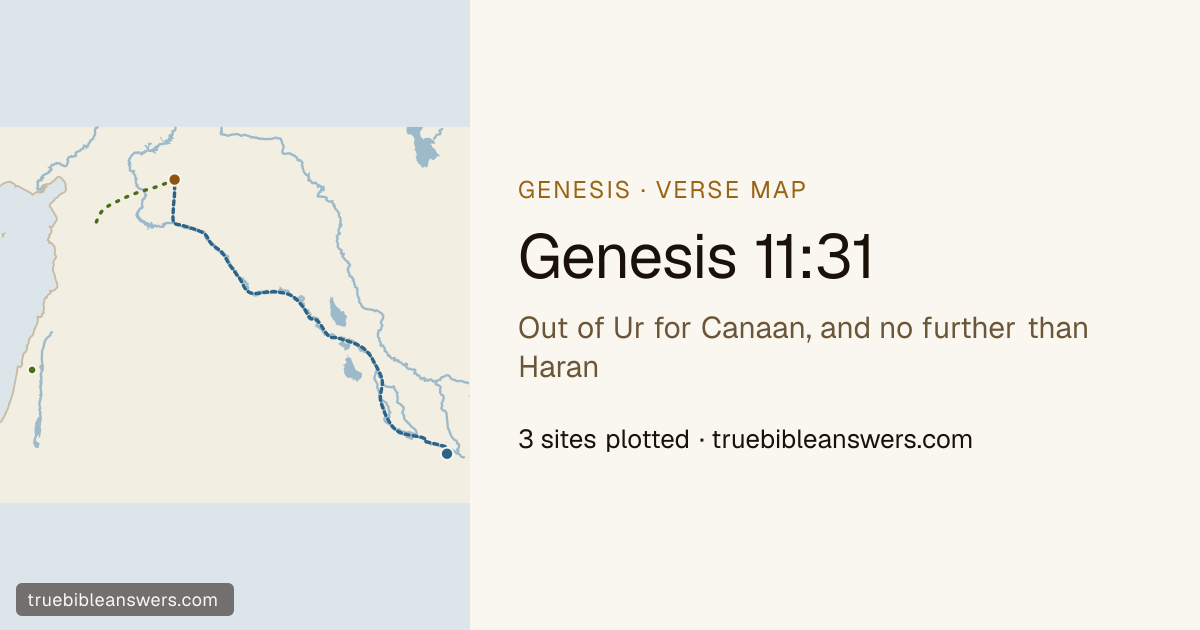
Read it →One sentence, three places, and a journey that stops halfway. Terah takes his son Abram, his grandson Lot and his daughter-in-law Sarai out of Ur of the Chaldeans — a Sumerian city on the lower Euphrates, near the head of the Persian Gulf as the coast then ran — and the verse says plainly where he is going: into the land of Canaan. He does not get there. Nobody crosses the Arabian desert to reach Canaan from Ur, so the road runs the long way round, up the river past Babylon and Mari to the crossing at the Balikh, and Haran is where the family stops. They settle. The next verse buries Terah there at two hundred and five, and Canaan is still four hundred miles off. So this map draws two different things and refuses to draw them alike. The solid arrow is the eight hundred miles of river road the verse actually records being walked, from Ur to Haran. The dotted line leaving Haran is the rest of the road, the part that exists in this verse only as an intention — it fades out short of the border and no arrow reaches the pin for Canaan, because on the day this verse ends nobody in the family has set foot in it. Canaan is on the frame as the destination, not as a stop: the gazetteer's point for the whole country, which nobody in Genesis 11 has seen. What makes the sentence worth a map of its own is how much of the rest of Genesis is folded into it. The call comes in the next chapter and Abram is seventy-five when he answers it, walking out of the town his father died in and down the road his father stopped on. The place he is going is the place Terah was already going. And when God names the departure again in the covenant of Genesis 15:7 — "I am the LORD who brought you out from Ur of the Chaldeans" — he names Ur and not Haran, as though the whole journey were one journey with a long pause in the middle of it. The three places are on one frame here so that the pause is visible.
Regions on this map
Where the verse starts, and the only stretch of it anybody walks. Terah takes three of his household out of a Sumerian city on the lower Euphrates and turns upriver, because the desert between Ur and Canaan is not a road and never was. The solid arrow is that journey: about eight hundred miles by the river, past Babylon and Mari to the ford at the Balikh.
Not a stop but a surname for one: the ESV says "Ur of the Chaldeans" three times — twice here in Genesis 11, and once eleven chapters later when God names the place again in the covenant of Genesis 15:7 — and never names the country on its own.
no point of its own; the gazetteer resolves it to Ur, which this verse leaves under its own name
The departure. A Sumerian city on the lower Euphrates, near the head of the Persian Gulf as the coast then ran, and the furthest point east on this frame. Where it was decides how long the road is: 846 of the 924 votes behind this dataset put it at Tell el-Muqayyar in Sumer, but 31 put it at Urfa in the north, twenty-five miles up the road from Haran, and 30 more in Urartu — and on that reading Terah never crosses Mesopotamia and this verse is two days' walk rather than eight hundred miles.
Today: Tell el-Muqayyar, Dhi Qar, Iraq
A caravan town on the Balikh, a day north of the Euphrates bend, and the last word of the verse. The arrow ends on it because the journey does: they came to Haran and settled, and the next verse buries Terah there at two hundred and five with Canaan still four hundred miles off.
Where the journey stopped for a generation: a caravan town on the Balikh, a day north of the Euphrates bend, where Terah settled and died at two hundred and five. Sixty-five years after Abram walks out of it he sends his servant back to it for a wife for Isaac, and Genesis 24 calls it Mesopotamia and the city of Nahor. This verse names the man Haran and the town Haran in one sentence, which is a coincidence of the ESV's spelling and not a connection.
Today: Harran, Şanlıurfa, Turkey
Named in this verse only as somewhere they are going. It is on the map because the verse says it, and nothing arrives at it because the verse says that too — the dotted line out of Haran is the road they intended, drawn in Canaan's colour and stopped in northern Syria where the sentence stops. Abram walks the rest of it in Genesis 12, sixty-five years and one chapter later. The pin is the gazetteer's point for the whole country rather than any place a foot was put down.
The destination, and in this verse nothing else. Terah sets out for it and stops four hundred miles short; the family that reaches it is Abram's, in the next chapter, after his father has died in Haran. Plotted at the land's own centre rather than at any stop, so the pin is a country and not a place anyone stood — which is the honest drawing of a place nobody in this verse has seen.
Today: the land between the Jordan and the sea (representative point)
Genesis 11:31 in full
- Genesis 11:31Terah took Abram his son and Lot the son of Haran, his grandson, and Sarai his daughter-in-law, his son Abram's wife, and they went forth together from of the to go into the land of , but when they came to , they settled there.