He had sent Judah ahead of him to Joseph to show the way before him in Goshen, and they came into the land of Goshen.
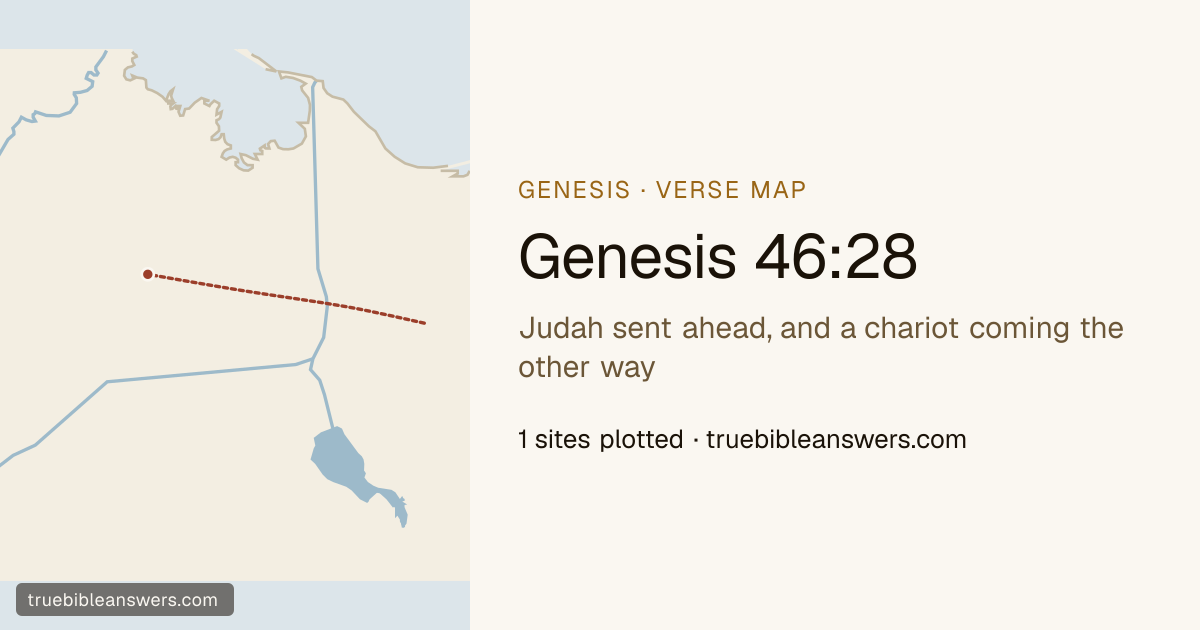 Open map →Judah sent ahead, and a chariot coming the other wayGenesis 46:28 · 1 place plotted
Jacob's family is nearing Egypt. Before they arrive, he sends Judah ahead to Joseph, the son who now governs Egypt, to prepare the way into Goshen. Two questions follow: why this son, and why this corner of Egypt?
A message sent ahead
Sending word before you arrive is simple good manners. Older translations read the errand as giving notice of his coming rather than showing the way. One writer contrasts the dignity of Jacob's family with the polish of the great civilisations around them.
William KellyCivilisation was not what marked the fathers. It marked the line of Cain in the world before the flood, and Egypt, Assyria and Babylon after the flood, among others. But there is a dignity that goes with the fear of God, far better than any such worldly gloss, however pleasant it is to fallen nature. We see the same godly sense of what is fitting in Abraham and Isaac. We see it here in Jacob too, who sends Judah ahead to Joseph to give good notice of his own coming to Goshen.
Why Judah carried it
Judah is not the eldest son. He is the one who had already put himself on the line for his brother Benjamin.
The Bible TreasuryJudah makes no grand offer staking his own sons; his offer is far more modest, and at his own risk. "Send the boy with me… I will be a pledge of his safety." Jacob trusts him at once and lets Benjamin go. In doing so Jacob showed again his discernment of character. Judah nobly kept his pledge: he stood forward in Egypt and offered himself in place of Benjamin.
The son moving into first place
That trust was not a one-off. Judah's place among his brothers was changing, and it would shape Israel's future.
Morrish Bible DictionaryThough not the eldest son he began to take a chief place in the family. He persuaded his father to let Benjamin go into Egypt, and whenever appeals had to be made to Joseph, Judah made them. When Jacob blessed his sons, the predictions show that the royal line was centred in Judah.
Goshen, and why it was the right ground
The destination was not picked at random. One writer explains what made this corner of Egypt fit them.
William KellyGoshen was the outlying part of Egypt. There they could best keep to their old work, and were least exposed to the idolatry and moral corruption of that land.
Another writer looks at what came of it.
F. B. HoleIt is easy to see how this suited the purpose of God, which was to make a nation of them, free from any mixture of foreign blood. Though under Egyptian rule, there was to be a dividing line from the very start between them and the natives of Egypt. … Pharaoh was very kind. He welcomed them, gave them the best of the land in Goshen, and offered them important posts looking after his cattle. Remember that Egypt, along with the rest of the world, was in the middle of a great famine. Such favourable treatment was extraordinary, and can only be explained by the moving of God's hand behind the scenes.
Reaching one person
The errand is aimed at a person: Judah is sent to Joseph. Goshen matters because Joseph is there.
Hamilton SmithTo reach Joseph, Israel had to make the journey. He had to leave the scene of all his natural affections. And so with ourselves, if we are to reach Christ where He is, we must forget the things that are behind. So Israel comes into the new land — the land of Goshen.
The picture behind the move
One writer reads the scene as a picture of things to come — Joseph in power, and his family settled near him.
J. N. DarbyJoseph is now known as alive — Governor of the world — its source of blessing — and Jacob is brought to Him in this role of glory and power. Israel still has, however, his own portion and separate place in the world in Goshen, and in the best of it.
Summary
- Sent — Jacob does not arrive unannounced. Sending word ahead shows the same godly sense of what is fitting that marked Abraham and Isaac.
- Trusted — the errand goes to Judah. He had offered himself in Benjamin's place, and Jacob trusted him at once.
- Rising — Judah is not the eldest, yet he takes the chief place. The royal line runs through him.
- Placed — Goshen sits on the edge of Egypt. A dividing line from the start let a nation grow there, instead of dissolving into Egypt.
- Near — the whole journey aims at a person. To reach Joseph, Israel had to leave everything familiar behind.