And Jacob came safely to the city of Shechem, which is in the land of Canaan, on his way from Paddan-aram, and he camped before the city.
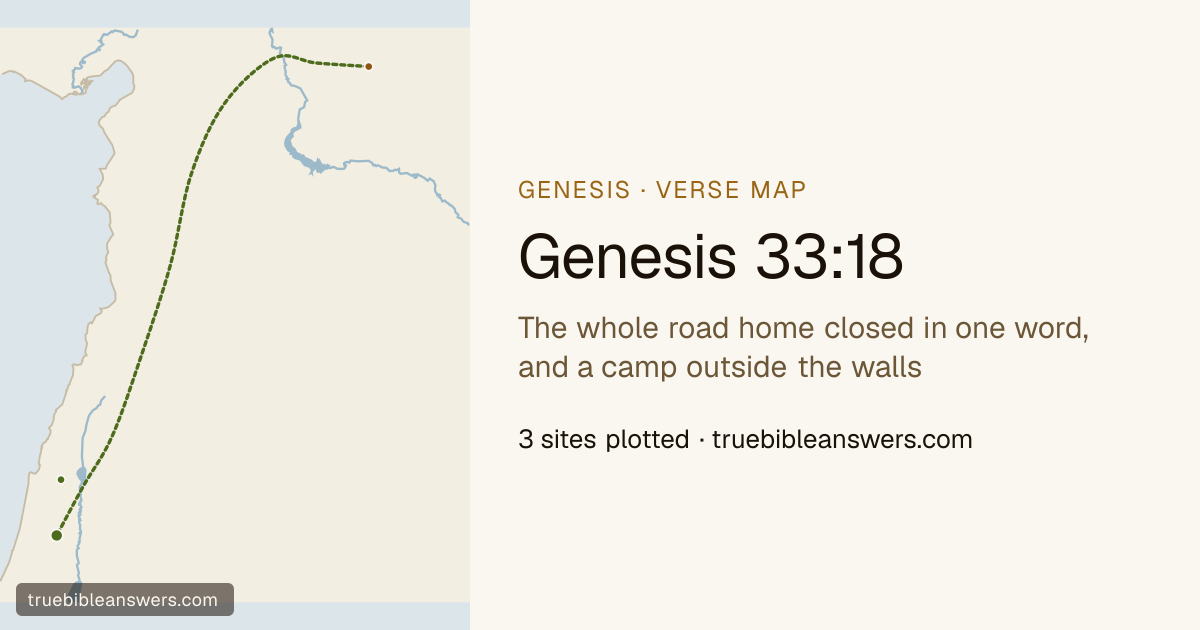 Open map →The whole road home closed in one word, and a camp outside the wallsGenesis 33:18 · 3 places plotted
Jacob is back in the land of promise after twenty years away, camped outside a Canaanite city. Two questions drive the verse: what does "safely" say about him, and why did he stop at Shechem instead of going on to Bethel?
"Safely" or "Shalem"?
Older translations treat the word as a town name, "Shalem." One dictionary reads it as a description instead.
Morrish Bible DictionaryThis is judged not to be a proper name. The passage should read that Jacob came 'safely' to the city of Shechem (Gen. 33:18). The Revised Version has 'came in peace.'
The word sets his fear on the road against his state on arrival. And Shechem, of all places, is where he failed most.
William KellyThere is little need to defend "in peace" against "to Shalem," the reading of the King James Version. "In peace" stands in contrast with his troubled mind, when dread of Esau filled him between Peniel and Succoth. That contrast is surely to the point. Yet as he failed at Succoth, so he failed still more at Shechem. Shechem had a pointed claim on him beyond Shalem. For it was there that Abraham, the father of the faithful, first saw Jehovah appear to him in Canaan, and received the promise that God would give that land to his descendants. And there Abraham built an altar to Jehovah who appeared to him.
Kept by God, not by himself
Jacob arrived in one piece. One writer traces that to God, not to anything in Jacob.
J. N. DarbyGod's secret providence kept Jacob in this way. There was nothing in him to approve. Yet God secretly secured blessing and preservation for him, and Jacob returns to the land of promise.
Stopping short of Bethel
Bethel, God's house, was where Jacob should have gone. He stopped twice before he got there.
L. M. GrantRather than going to Bethel (God's house) he built a house for himself. This was only half-way obedience. It clearly did not satisfy his own conscience, for he left all these buildings behind and travelled to Shalem, a city of Shechem. Shalem means "peace." Jacob was not at peace at Succoth, but he seems to find it at Shalem. Shechem means "shoulder." It implies that we cannot enjoy peace unless we take responsibility on our shoulders. Here he does not build a house, but pitches his tent. At least he seems to realise that, in being away from Bethel, he should keep his pilgrim character.
Camped "before the city"
Jacob camped right in front of a Canaanite city. One writer weighs both the tent and the spot he chose.
F. B. HoleHere, though he had a tent and an altar, we can again see that his separation from the people of the land was being weakened. He pitched his tent close to the city, and then bought the land where he had camped.
Abraham had lived in that same place as a stranger. Darby sets the two men side by side.
J. N. DarbyHe buys a field near Shechem and settles down there. Abraham had only been a stranger in that place. Abraham knew the will of God, and owned no spot of ground there to set his foot on.
What the stop cost
The camp outside Shechem was not a harmless pause. One writer traces a long train of trouble back to it.
William KellyOne wrong step away from our true position before the Lord leads to many a sin, scandal, and sorrow. So we find here as the result of Jacob's buying the land of the Hivite, and building himself a house. His stay at Succoth and Shechem covers some ten years. He has to be unsettled before he returns to his pilgrim place. But the way was painful for all. It brought deep shame, humiliation and fear to Jacob.
A picture of Israel's return
Shechem and Succoth turn up again in Psalm 60. One writer sees Israel's future there.
H. L. Rossier"God has spoken in His holiness: I will exult, I will divide Shechem, and mete out the valley of Succoth" (Ps. 60:6). Shechem and Succoth remind us of how Israel's history began with Jacob, their father (Gen. 33:17-20). These are the first places where he settled when he returned to the land of promise after wandering in a strange land. So it will one day be for the remnant of Israel. They will gather round the true David and take back their land as they follow Him.
Summary
- Safe — "Shalem" in older versions is most likely not a town but a condition. Jacob arrives in peace, after dread of Esau on the road.
- Kept — God's secret providence brought him through. There was nothing in Jacob to approve.
- Short — he stops at Shechem instead of going on to Bethel, God's house. One writer calls this half-way obedience.
- Near — he pitched his tent by the city, then bought the ground. Abraham had owned nothing there.
- Costly — ten years at Succoth and Shechem end in shame and fear. He has to be unsettled before he returns to his pilgrim place.