But Jacob journeyed to Succoth, and built himself a house and made booths for his livestock. Therefore the name of the place is called Succoth.
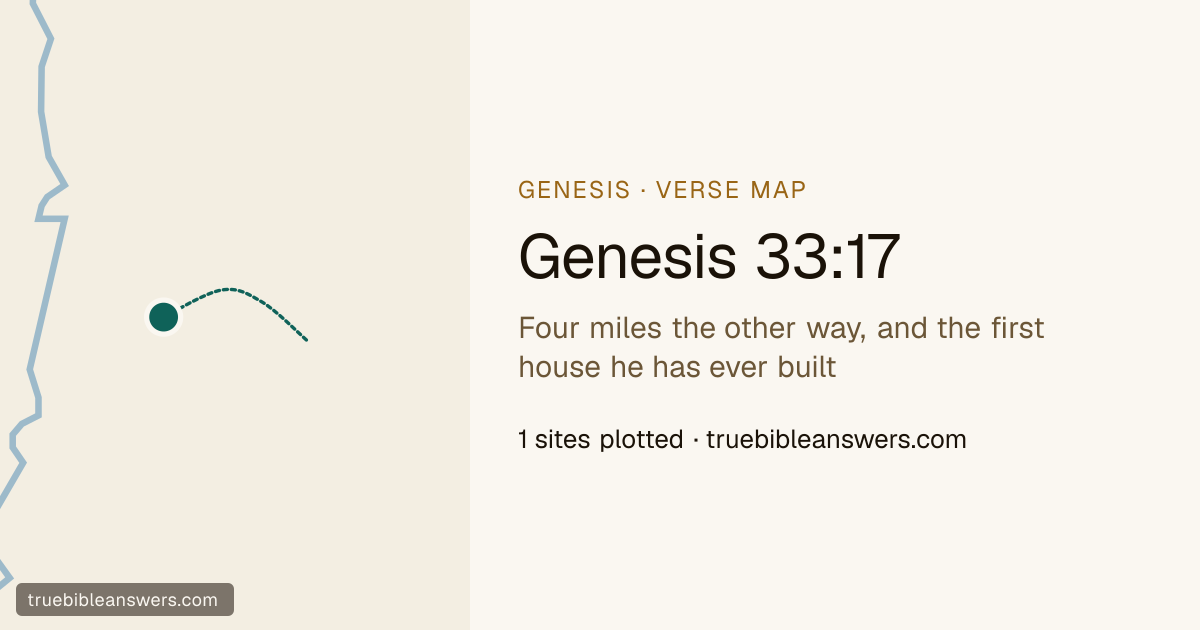 Open map →Four miles the other way, and the first house he has ever builtGenesis 33:17 · 1 place plotted
Jacob has survived the brother he feared, and he is back in the land God promised him. But he stops short of where God sent him, and commentators read the house he builds at Succoth as the first sign that his heart had shifted.
The Name and the Place
The place takes its name from what Jacob put up there for his animals:
Morrish Bible DictionaryTemporary shelters made from tree branches. They were used especially at the Feast of Tabernacles. Jonah made himself such a shelter. They were also used for cattle. The Hebrew is succoth.
A Turn in the Opposite Direction
Jacob had told Esau he would follow him to Seir. He went the other way:
F. B. HoleJacob had refused the help offered him, and Esau had gone. Again Jacob shows the crookedness that seems to have been his natural bent. He had said to Esau, "I come to my lord in Seir," and then he went straight to Succoth, which lay in a different direction altogether. And once he arrived there, the record is that he built a house and made booths for his cattle. This shows he had a mind to settle down in the land, rather than keep the character of a stranger, as his grandfather Abraham had done.
House Instead of Tent
The booths were for the animals; the house was for himself. One writer marks where this happened, and refuses to soften that word "house":
William KellyJacob slips away to Succoth, which should be marked east of the Jordan... The serious sign of the patriarch's state was that he built a house for himself. That was a plain departure from the pilgrim practice of his fathers, and indeed his own. Matthew Henry says Jacob "was glad of booths," as if the contrast were with his descendants in houses of stone. That is incorrect. The very point of God's word here is that he "built himself a house," while his fathers lived in tents even in the land of promise. It was marked indifference and decline in this respect; all the more because Jacob was only on his way to the land.
Another writer puts the change in social terms:
J. G. BellettJacob had exchanged the tent for a house, and the pilgrim stranger had become a citizen and a freeholder.
Succoth Was Not Bethel
The name God gave Himself points to where Jacob should have gone:
C. H. MackintoshAfter all this display of God's goodness, we find Jacob settling down in Succoth. Succoth was not the destination God appointed for him. The Lord had not said to him, "I am the God of Succoth"; no, but "I am the God of Bethel." Bethel, then, and not Succoth, should have been Jacob's great object. But the heart is always prone to settle for a position and a portion short of what God would graciously give.
Another writer traces what Jacob did next:
L. M. GrantRather than going on to Bethel (God's house), he built a house for himself. This was only half-way obedience. It did not satisfy his own conscience, for he left all these buildings behind and travelled to Shalem, a city of Shechem.
When the Gifts Crowd Out the Giver
God's goodness to Jacob was fresh. That is what makes this stop dangerous:
The Bible TreasuryHowever small, it was a turn away from the path of a pilgrim. It was also a halt on a road he should have followed without stopping until he reached Bethel. And since one shortcoming always leads to another, the next thing we read of him is that he bought a piece of a field from the children of Hamor... God Himself is not the first object of the soul. His gifts, sadly, too often shut out God Himself.
The Long Price of a Short Stop
One step aside carried a long cost:
William KellyOne wrong step away from our true position before the Lord leads to many a sin, scandal and sorrow... His stay at Succoth and Shechem covers some ten years. He had to be unsettled to get him back to his pilgrim place. The way was painful for all, and it brought deep shame, humiliation and fear to the patriarch.
The Same Ground, Later Claimed
Yet these place names return later, in one of Israel's psalms:
H. L. Rossier"God has spoken in His holiness: 'With exultation I will divide up Shechem and portion out the Vale of Succoth'" (Psalm 60:6). Shechem and Succoth remind us how Israel's history began with Jacob, their father. These are the first places where he settled when he came back to the land of promise, after his years in a foreign land. One day it will be the same for the remnant of Israel. They will gather around the true David and take back their land as they follow Him.
Summary
- Booths — Succoth means the branch-shelters Jacob put up for his animals. The place east of the Jordan took its name from them.
- House — the shelters were temporary; the house was not. Trading the tent for a house turned a pilgrim stranger into a citizen and freeholder.
- Half-way — God called Himself the God of Bethel, not of Succoth. Jacob stopped short and built his own house instead of reaching God's.
- Drift — one small turn aside led to the next step, buying a field. God's gifts can shut out God Himself.
- Hope — Israel's psalm names this same ground as land God will yet divide up, when the people follow the true David.