Genesis 28:5: The same road, walked for a reason nobody says out loud
Read it →Commentary on Genesis 28:5
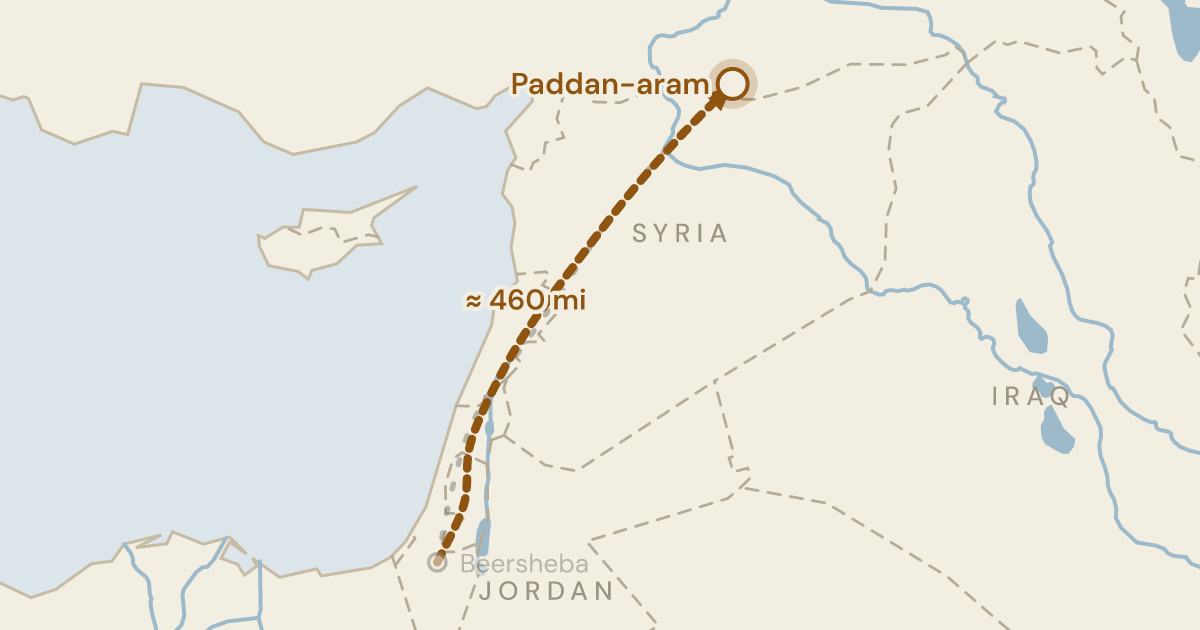
One short line sends Jacob north to his mother's family in Padan-aram. Behind it stand a father acting in faith at last, a son leaving home as an exile, and one question: is God blessing Jacob here, or disciplining him?
Isaac, at last a man of faith
Earlier chapters show Isaac in a poor light. Here his tone changes.
At this point we see him in a much more favourable light, and speaking as a man of faith. He charges Jacob to go to Padan-aram and find a wife among his own people, and he blesses him in a way that surely shows he now accepted the purpose of God as to his two sons, which overruled and cancelled out his own natural inclinations. He asks God to give "the blessing of Abraham" to Jacob. That blessing brought with it the coming of the "Seed," in whom all nations would be blessed, and it was the very heart of the birthright Jacob had wanted so much.
What the blessing includes — and where it stops
Commentators differ on how far Isaac's words reach. Another writer weighs what the prayer never mentions.
"And God Almighty bless you," prayed Isaac, "and make you fruitful, and multiply you, that you may become a company of peoples." So it was of old, so it will be yet more in the future. Here, as before, the blessing is for earth alone. Not one word points to heaven or eternity. It guarantees growth on earth and says nothing higher. Even Isaac's prayer for "the blessing of Abraham," for Jacob and his offspring, narrows to one thing: "that you may take possession of the land of your sojournings that God gave to Abraham."
The journey as discipline
Isaac never left Canaan to find a wife; a servant brought Rebekah to him. Jacob must make the journey himself.
Here, on the contrary, Jacob must go to Padan-aram and take a wife there from the patriarch's family, from Laban's daughters. So early must Jehovah deal with Jacob according to his ways… He became an exile from the land of promise. In a strange land his own relatives cheated him. That was the sad payment for his crooked ways, used to grab what Jehovah had already given him and would have secured in His holy way of faithfulness and truth.
The mood of the departure
This is no joyful send-off.
After all this, at the end of his ways though not of his days, Isaac sends Jacob away. The suspicious and frightened Rebekah asked for it. He does it with sorrow, shame and disappointment — the bitter fruit their own way had prepared for them.
Where God's dealings begin
From this verse Jacob has no home. That is where God begins to work on him.
We now follow Jacob as he leaves his father's roof, and see him as a homeless, lonely wanderer on the earth. It is here that God's special dealings with him begin… God will carry out His own purpose, no matter by what means. But if His child takes himself out of His hands, unrepentant in spirit and unbelieving in heart, he must expect much sorrowful exercise and painful discipline. So it was with Jacob: he might not have had to flee to Haran, had he allowed God to act for him.
In Padan-aram, but never at home there
Jacob reaches the land his family came from. He never treats it as home.
His wrong way brings him under divine chastening, and he has to seek the distant land of his forefathers. But he is there as an exile, not as a man at home. He is there because God is disciplining him, not because his own heart wanted it… As he set out, he was already talking eagerly of his return.
A picture of a nation
One writer reads Jacob's road north as a preview of what would happen to his descendants.
Jacob's departure stands for Israel being driven out of their own land into wandering and suffering, until God brings them back to the land He swore to the fathers of the nation. In the chastening that passed over Jacob we see how God governs Israel.
Summary
- Blessed. Isaac sends Jacob off as a man of faith. He has accepted God's choice over his own preference.
- Limited. Isaac prays for fruitfulness and the land. Commentators differ over whether the promised Seed stands inside that prayer.
- Sent. Isaac never left Canaan for a wife; Jacob must go himself. The road to Laban is God dealing with him according to his ways.
- Disciplined. From this verse he is a homeless wanderer, and God's special dealings with him begin. He might have avoided the chastening had he let God act for him.
- Longing. He lives in Padan-aram as an exile, talking of return from the day he sets out. His story maps a nation later scattered and brought home.