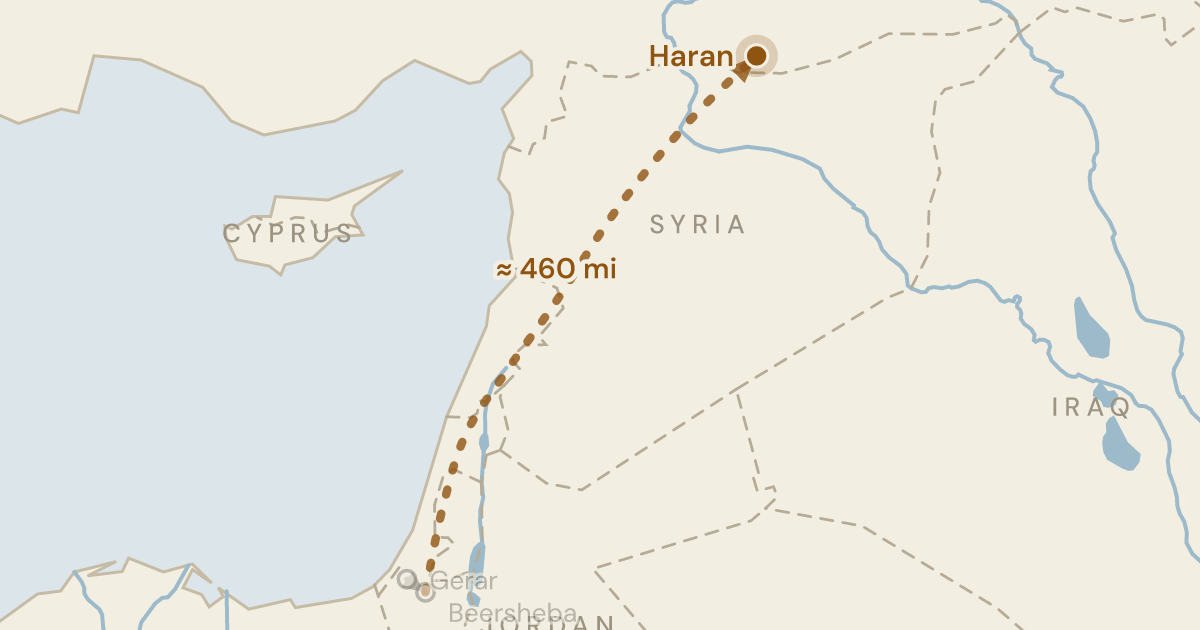
Genesis 27:43: A road named in a whisper, five hundred miles long
Read it →Commentary on Genesis 27:43
Rebekah's plan has worked: the blessing is on Jacob, and now Esau is planning murder. Her answer is one urgent word: run. That flight will cost her and Jacob far more than she expects.
The threat behind the flight
Esau's rage is what forces the advice. One writer looks at what Esau valued, and finds the same man who once traded his birthright for a meal:
So Esau quickly turned from wailing and tears to murderous hatred. It was not Jehovah that he valued, but the blessing; just as he had already proved how little he thought of the birthright when he sold it for one meal. He was a godless man. This was no real excuse for the wrongdoing of Rebekah and Jacob; but it made Isaac's sin worse. From then on hatred of his brother, even to the point of taking his life, filled Esau's heart.
A short stay that became a lifetime
Rebekah expects a short absence. The same writer weighs her words against what actually followed, and notices that her own reunion plan never happened:
She herself has to do the greatest violence to her own feelings as well as Jacob's, and urges him to flee to Haran, to stay with her brother Laban. "Some days" did she say? Ah, poor Rebekah — for many a long year to be cheated by Laban, just as you and Jacob cheated Isaac! No, it will never be yours, whatever comes of Esau's fury and anger, to send and fetch your Jacob back from there.
Another writer puts a number on the gap between her expectation and the outcome:
So Rebekah advised Jacob to leave and take a long journey back to Haran, where he could count on the hospitality of her brother Laban. She tells him he should stay there "a few days" until Esau's anger has cooled. But the few days turned out to be over twenty years, probably because Jacob was not anxious to see Esau in all that time. But the government of God did not allow Jacob to see his mother again on earth.
The one who schemed most loses most
Rebekah must send Jacob away herself. One writer ties her loss to her leading part in the plan:
She was the prime mover in using a wrong way to reach a right end. So she had most to feel God's chastening, under His unfailing moral government. Soon after this event Jacob left for the land of the sons of the east, and his mother never saw her beloved child again. He too, through years of sorrow, had to suffer under the crafty cheating schemes of his mother's brother, his own father-in-law. No human being shall or can boast.
Another writer counts up who paid for the plan, and hears her stated reason as both real and convenient:
Everybody suffered: Esau and Isaac, and in the end both Jacob and Rebekah. The parting lasted for many years, not the "few days" she expected. Jacob went out to be deceived by others, and Rebekah stayed behind with the unwelcome company of the Hittite women. She dwelt on her weariness as a reason and an excuse for sending Jacob off to her brother. But the discord between them was no doubt very real, and she had to face it without her favourite son.
Exile as the school where grace and discipline meet
Jacob has two lessons to learn on this road:
There are two things Jacob has to learn on this memorable occasion. First, for his comfort, he will learn that all his failures will not alter God's purpose to bless him in sovereign grace. Second, for his correction, he will learn that God's sovereign grace will not hold back God's chastening hand because of his failures... He still has to go his lonely way as a wanderer. He must spend long years of toil and bondage in a stranger's house, because of his sin against his father and brother.
Jacob obeys his mother's voice rather than resting in the God who blessed him:
He who has now got the blessing is still totally unable to trust God for its fulfilment. Rebekah's voice is heard again, urging him to flee from his brother's anger... It is now that, alone, a wanderer and a fugitive, he arrives at Bethel, and here for the first time God appears to him.
God disposes what men plan
Esau was waiting for his father's death before he struck. God's timing overruled his:
But He whose eye is over all hearts kept aged Isaac alive for a long time to come. The days of mourning did not arrive before Esau met Jacob with four hundred men, to Jacob's great distress. But God turned the heart that meant to kill him, so that he received the trembling man with kisses and tears. So truly does God dispose, whatever those may propose who do not know Him.
Summary
- Cause. Rebekah and Jacob used a wrong way to reach a right end, and the flight to Haran is the first bill coming due.
- Cost. A stay of a few days stretched past twenty years. The mother who schemed hardest to keep her son lost him, and never saw him again.
- Correction. The exile is discipline, not accident: Laban cheats the man who cheated his own father.
- Consolation. Failure does not cancel God's purpose to bless — but grace does not cancel His chastening either; both run side by side.
- Conclusion. The lonely road ends at Bethel, where God appears to the fugitive for the first time. The brother who wanted him dead meets him with tears instead of a sword.