Genesis 26:21: The second well, and the only place in the chapter worth arguing about
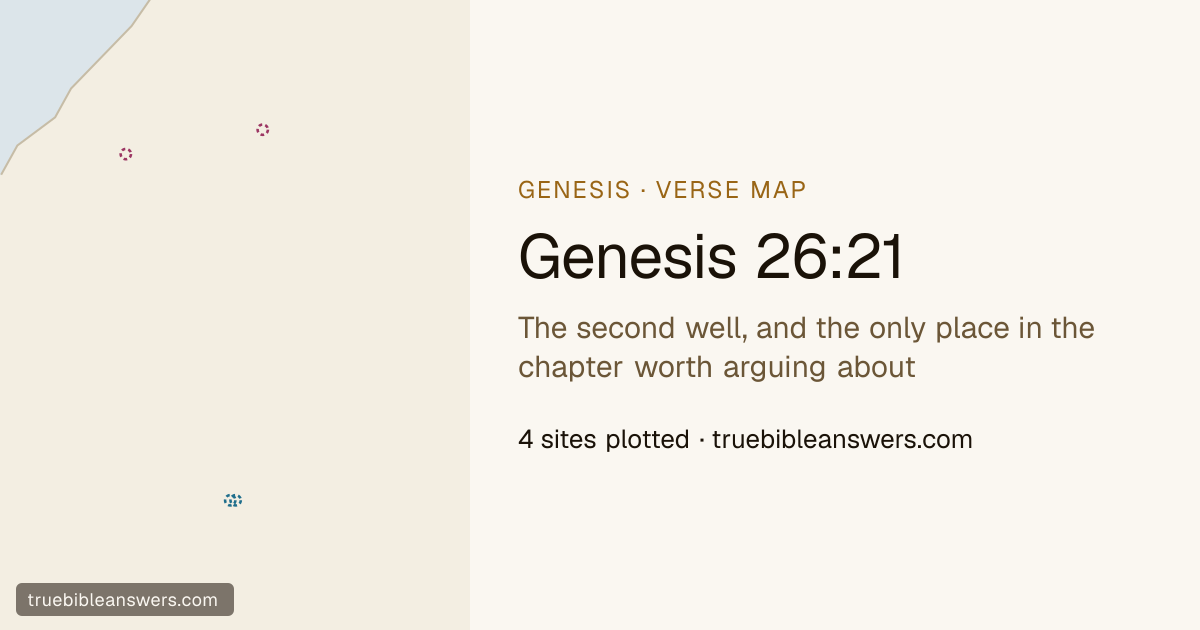
Read it →"Then they dug another well, and they quarreled over that also, so he called its name Sitnah." One clause longer than it needs to be — "over that also" — and the whole of the second round. Sitnah means enmity; it is the same root the Old Testament builds the word satan on, an accuser or an adversary. Esek was contention over a claim. This one is named for the feeling. This is the one place in Genesis 26 where the sources are genuinely split, and split in a way that changes what the verse describes, so the map draws both answers instead of choosing. On the first reading, Sitnah is twenty-five miles south-east of the Gerar valley, at the Byzantine ruins the Arabic sources call Ruheibeh, and it has the strongest kind of evidence there is for a place like this: the name survived. One of the two points in that cluster is recorded as Sutnet er-Ruheibeh — Sutnet for Sitnah, Ruheibeh for Rehoboth, both wells in one modern name, seven hundred metres apart. Which is also the difficulty with it, because the next verse has Isaac move away from Sitnah before he digs Rehoboth, and this reading puts the two of them within sight of each other. On the second, Sitnah stays in the wadi with Esek, somewhere between the two towns, and the whole quarrel happens on ground Abimelech's herdsmen could reach in a morning — which is what a quarrel with them requires. It has fewer votes and no name to rest on. The ring is open on both, because neither has a site anybody has excavated and called Sitnah. A further hundred and eight votes belong to an identification that fixes nothing at all — it says only that Sitnah stands near other places the sources have not fixed either — and they are counted nowhere on this map, which is why the numbers on the two rings do not add up to the total. The story does not care. He digs, they quarrel, he moves. The third time nobody comes.
Regions on this map
Enmity — the same root the word for an adversary is built on. The second well in three verses, and the second one taken off him; the map draws the two places it might be, because they are twenty-five miles apart and the next verse depends on which.
The second well, and the only place in Genesis 26 the sources really divide over. 169 of the votes that fix a site at all are for the Ruheibeh cluster in the Negev, where the name survives as Sutnet er-Ruheibeh; 77 keep it in the Gerar valley with Esek. A further 108 belong to an identification that sites nothing, and are counted nowhere. Whichever it is, Isaac names it for enmity and walks away from it.
Not pinned: the field splits twenty-five miles between the ruins at Ruheibeh, where the name survives, and the wadi below Gerar, where the quarrel has to happen for Abimelech's herdsmen to be in it
Genesis 26:21 in full
- Genesis 26:21Then they dug another well, and they quarreled over that also, so he called its name .
Where the sources put the contested places
One name on this map carries no pin, because the sources have not settled where it is. Every site proposed is drawn instead, in the colour of the reconstruction it belongs to.
- At Ruheibeh, in the Negev
- The larger block of votes, and the one with a name behind it: the ruins twenty-five miles south-east of the Gerar valley, where one of the recorded points is Sutnet er-Ruheibeh — Sitnah and Rehoboth preserved in a single modern place-name. It is the strongest evidence anybody has for either well, and it puts the two of them seven hundred metres apart, which is not what the next verse describes.
- In the Valley of Gerar
- The reading that keeps Sitnah where Esek is, in or beside the wadi below the town. It has no surviving name to rest on and fewer votes, but it is the only one on ground Abimelech's herdsmen could be at by morning — and a quarrel with them is what the verse is about.
Sitnah
The second well, and the only place in Genesis 26 the sources really divide over. 169 of the votes that fix a site at all are for the Ruheibeh cluster in the Negev, where the name survives as Sutnet er-Ruheibeh; 77 keep it in the Gerar valley with Esek. A further 108 belong to an identification that sites nothing, and are counted nowhere. Whichever it is, Isaac names it for enmity and walks away from it.
Not pinned: the field splits twenty-five miles between the ruins at Ruheibeh, where the name survives, and the wadi below Gerar, where the quarrel has to happen for Abimelech's herdsmen to be in it
At Ruheibeh, in the Negev169 of 246 votes
- Ruheibeh · 92 votes — The largest single block, and the site the whole Negev reading is anchored on: a large Byzantine ruin with wells, in country dry enough that a well is worth naming.
- Sutnet er-Ruheibeh · 77 votes — Seven hundred metres from the first and the reason the reading exists at all: the modern name carries Sitnah and Rehoboth together, which is either the best surviving evidence in the chapter or a later reader naming the ground out of the Bible.
In the Valley of Gerar77 of 246 votes
- between Gerar and Beersheba · 54 votes — The same bearing the sources give Esek, and for the same reason: close enough to the town for its herdsmen to turn up, and not fixed any further than that.
- the Nahal Gerar · 23 votes — In the wadi itself, where the digging of Gen 26:19 happens and where spring water under the bed is what there is to quarrel about.