Genesis 26:2: The one road in the family's story that is closed, and the only map of it is of a journey nobody makes
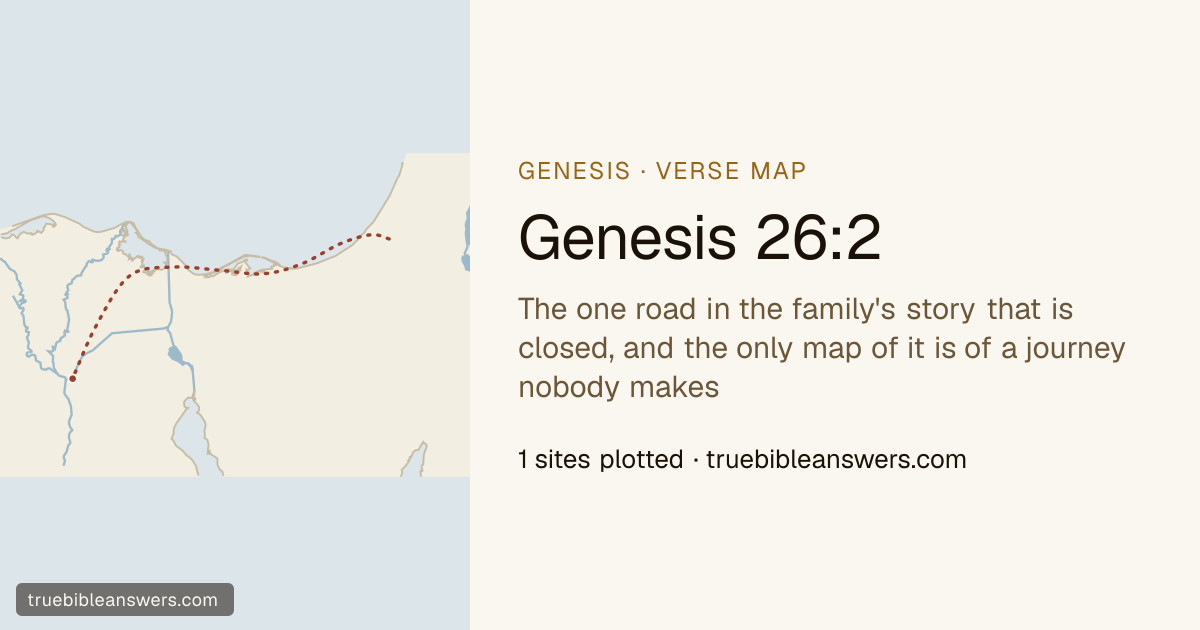
Read it →"And the LORD appeared to him and said, 'Do not go down to Egypt; dwell in the land of which I shall tell you.'" This is the only verse in Genesis that draws a road in order to shut it. Every other place name in Abraham's walk is somewhere somebody goes; this one is somewhere Isaac is forbidden to go, and the whole point of putting it on a map is that the line has an arrow at neither end. The road itself is not hypothetical. It is the coast route through the Philistine plain, down past Gaza and across the top of Sinai to the delta — the way Abram went in the first famine, the way Hagar was running when the angel stopped her, the way Ishmael's wife came from, and the way Jacob's sons will go with their sacks. It is the single best-travelled line in the book. Isaac is standing at Gerar, already a third of the way along it, in a famine, with a Philistine king willing to have him. Going on is the obvious thing to do, and it is what his father did. So the map draws the road as a ghost: a course this atlas keeps for a journey that is proposed and never made. It runs from where he is to the point the sources use for Egypt — Heliopolis, at the head of the delta, one dot standing in for a whole country — and it is the same colour every Egypt on this walk is drawn in. What he gets instead is the vaguest instruction in the chapter: dwell in the land of which I shall tell you. It is almost word for word what his father was given at the very start — go to the land that I will show you — except that Abram was being sent somewhere and Isaac is being told to stay. The next thirty verses are him moving four times inside a fifteen-mile square, which is what obeying that sentence turns out to look like. Isaac is the only one of the three patriarchs who never leaves Canaan. Abraham came from Ur and went down to Egypt; Jacob dies in Egypt and is carried back. Isaac is born in the land, lives in it, and is buried in it, and this verse is where that is decided.
Regions on this map
The road his father took in the first famine, drawn here because it is refused. It is the best-worn line in Genesis — the coast route past Gaza and over the top of Sinai — and Isaac is the one man in the family who never sets foot on it.
The obvious answer to a famine and the one Isaac is not allowed to give. Abram went down in the first one and came back richer and smaller; Jacob's household will go down in a later one and stay four hundred years. All 500 votes resolve the country to Heliopolis at the head of the delta, which is a marker for a country and not a claim about a town — nothing in this verse happens there, which is the point.
Today: Heliopolis, at the head of the Nile delta (representative point)
Genesis 26:2 in full
- Genesis 26:2And the LORD appeared to him and said, “Do not go down to ; dwell in the land of which I shall tell you.